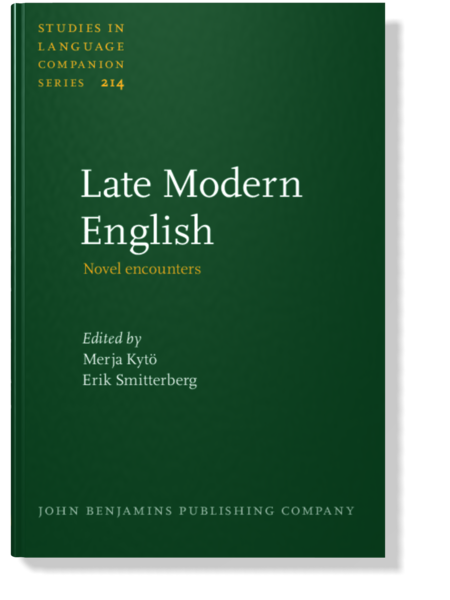
In:Late Modern English: Novel encounters
Edited by Merja Kytö and Erik Smitterberg
[Studies in Language Companion Series 214] 2020
► pp. 203–218
Women writers in the 18th century
The semantics of motion in their choice of perfect auxiliaries
Published online: 18 March 2020
https://doi.org/10.1075/slcs.214.09cal
https://doi.org/10.1075/slcs.214.09cal
Abstract
The present study analyses perfect auxiliaries
combined with a set of verbs that semantically encode an idea of
motion, either physical or metaphorical (arrived, become,
come, departed, entered, fallen, gone, got, grown, passed,
returned and run) in a corpus of eight
novels written by four women in the 18th century, Burney, Inchbald,
Radcliffe and Wollstonecraft. The focus is on whether the semantics
of the components of motion situations conditioned their choice of
auxiliary, and on whether there are differences within the texts
depending on where the perfect structures appear, in the narration
or in the dialogue. The conclusion indicates that the semantics of
motion situations, particularly the different types of
figure and ground, may have conditioned their
choices.
Article outline
- 1.Introduction
- 2.Previous studies on perfect tenses in Late Modern English
- 3.Basic motion situations
- 4.Method
- 5.Results
- 5.1The motion situation components
- 5.1.1The figure
- 5.1.2The ground and the path
- 5.2Narration versus dialogue
- 5.1The motion situation components
- 6.Discussion
- 7.Conclusion
Notes References

References (26)
Burney, Fanny. [1778] 2004. Evelina. Urbana IL: Project Gutenberg. <[URL]> (15 November 2016).
. [1796] 2012. Camilla. Urbana IL: Project Gutenberg. <[URL]> (15 November 2016).
Calvo Cortés, Nuria. 2014. A
Corpus-based study of gradual meaning change in Late Modern
English. In Diachrony
and Synchrony in English Corpus
Linguistics, Alejandro Alcaraz Sintes & Salvador Valera Hernández (eds), 25–54. Bern: Peter Lang.
. 2019. Conservatism
or the influence of the semantics of motion situation in the
choice of perfect auxiliaries in Jane Austen’s letters and
novels. In Developments
in English Historical
Morpho-Syntax [Current Issues in
Linguistic Theory 346], Claudia Claridge & Birte Bös (eds), 175–198. Amsterdam: John Benjamins.
Inchbald, Elizabeth. [1791] 2007. A
Simple Story. Urbana IL: Project Gutenberg. <[URL]> (15 November 2016).
. [1796] 2007. Nature
and Art. Urbana IL: Project Gutenberg. <[URL]> (15 November 2016).
Kytö, Merja. 1997. Be/have
+ past participle: The choice of the auxiliary with
intransitives from Late Middle to Modern
English. In English
in Transition: Corpus-Based Studies in Linguistic Variation
and Genre Styles, Matti Rissanen, Merja Kytö & Kirsi Heikkonen (eds), 17–84. Berlin: Mouton de Gruyter.
Matsumoto, Yo. 1996. Subjective
motion and English and Japanese
verbs. Cognitive
Linguistics 7: 138–226.
McFadden, Thomas. 2017. On
the disappearance of the BE perfect in Late Modern
English. Acta Linguistica
Hafniensia 49(2): 159–175.
Radcliffe, Ann. [1794] 2002. The
Mysteries of Udolpho. Urbana IL: Project Gutenberg. <[URL]> (20 November 2016).
. [1790] 2005. A
Sicilian Romance. Urbana IL: Project Gutenberg. <[URL]> (20 November 2016).
Ramscar, Michael, Matlock, Teenie & Boroditsky, Lera. 2009. Time,
motion and meaning: The experiential basis of abstract
thought. In The
Spatial Foundations of Language and
Cognition, Kelly S. Mix, Linda B. Smith & Michael Gasser (eds), 67–82. Oxford: OUP.
Rydén, Mats & Brorström, Sverker. 1987. The Be/Have Variation with Intransitives in English. Stockholm: Almqvist & Wiksell International.
Slobin, Dan I. 1996. Two
ways to travel: Verbs of motion in English and
Spanish. In Grammatical
Constructions, Masayosi Shibatani & Sandra A. Thompson (eds), 195–219. Oxford: Clarendon Press.
Sorace, Antonella. 2000. Gradients
in auxiliary selection with intransitive
verbs. Language 76: 859–890.
Talmy, Leonard. 1975. Semantics
and syntax of
motion. In Syntax
and
Semantics, Vol. 4, John P. Kimbali (ed.), 181–238. New York NY: Academic Press.
. 1987. Lexicalization
patterns: Semantic structure in lexical
forms. In Language
Typology and Syntactic
Description, Timothy Schopen (ed.), 57–149. Cambridge: CUP.
Visser, Fredericus T. 1963–1973. An
Historical Syntax of the English
Language, Vols. I–III. Leiden: Brill.
Werner, Valentin, Seoane, Elena & Suárez-Gómez, Cristina (eds). 2016. Re-assessing
the Present
Perfect. Berlin: Mouton de Gruyter.
Wollstonecraft, Mary. [1788] 2005. Mary:
A Fiction. Urbana IL: Project Gutenberg. <[URL]> (20 November 2016).
. [1792] 2006. Maria
or the Wrongs of a
Woman. Urbana IL: Project Gutenberg. <[URL]> (20 November 2016).