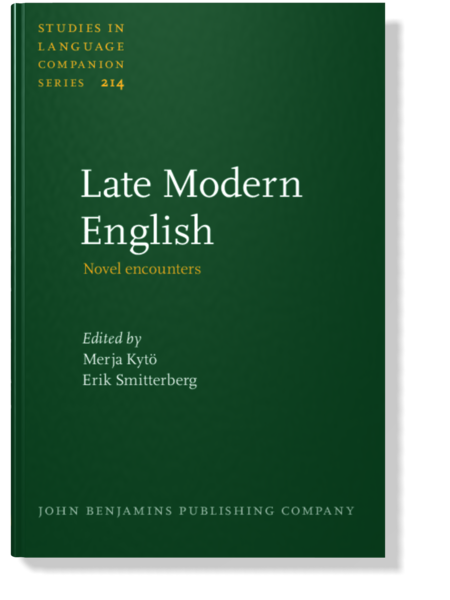
In:Late Modern English: Novel encounters
Edited by Merja Kytö and Erik Smitterberg
[Studies in Language Companion Series 214] 2020
► pp. 143–164
A diachronic constructional analysis of locative alternation in English, with particular attention to load and spray
Published online: 18 March 2020
https://doi.org/10.1075/slcs.214.06ish
https://doi.org/10.1075/slcs.214.06ish
Abstract
This paper is devoted to explaining the
historical development of constructions of the representative
locative alternation verbs load and
spray from a diachronic construction grammar
perspective. These verbs can occur in at least two syntactic frames:
the location-as-object variant (e.g., load the wagon with
hay) and the locatum-as-object variant (e.g.,
load hay onto the wagon). These two variants
have undergone different historical developments. This paper
proposes that the prototype of the constructions with
load/spray was the adjectival “[location] (be)
loaded/sprayed with [locatum]” construction,
from which the location-as-object variant developed. The
locatum-as-object variants for load and
spray, in contrast, developed in the
Present-day English period, independently of the location-as-object
variants or, at most, the two variants are linked metonymically.
Article outline
- 1.Introduction
- 2.Previous approaches
- 2.1Two variants and their relationship
- 2.2Summary
- 2.3The grammatical status of with-phrases
- 3.The historical development of constructions with
load and spray
- 3.1Load
- 3.2Spray
- 3.3Summary
- 4.An explanation
- 4.1A usage-based model and diachronic change in constructions
- 4.2Explanation for the historical development
- 4.2.1Identifying the prototype
- 4.2.2Extension from the prototype
- 5.Conclusion
Notes References Corpora and a dictionary

References (25)
Barðdal, Jóhanna, Smirnova, Elena, Sommerer, Lotte & Gildea, Spike. 2015. Diachronic
Construction Grammar [Constructional
Approaches to Language
18]. Amsterdam: John Benjamins.
Brinton, Laurel J. & Traugott, Elizabeth Closs. 2005. Lexicalization
and Language
Change. Cambridge: CUP.
Goldberg, Adele E. 1995. Constructions:
A Construction Grammar Approach to Argument
Structure. Chicago IL: University of Chicago Press.
Hilpert, Martin. 2013. Constructional
Change in English: Developments in Allomorphy, Word
Formation and
Syntax. Cambridge: CUP.
. 2017. From
construction to construction
grammar. In The
Cambridge Handbook of Cognitive
Linguistics, Barbara Dancygier (ed), 284–309. Cambridge: CUP.
Ishizaki, Yasuaki. 2018. Some
notes on the historical developments of construction with
load. Nanzan
Junior College
Kiyo 39: 81–94.
Iwata, Seizi. 2005. Locative
alternation and two levels of verb
meaning. Cognitive
Linguistics 16(2): 355–407.
. 2008. Locative
Alternation: A Lexical-Constructional
Approach [Constructional Approaches
to Language
6]. Amsterdam: John Benjamins.
Langacker, Ronald W. 1987. Foundations
of Cognitive Grammar, Vol. 1: Theoretical
Prerequisites. Stanford CA: Stanford University Press.
2000. A
dynamic usage-based
model. In Usage-Based
Models of Language, Michael Barlow & Suzanne Kemmer (eds), 1–63. Stanford CA: CSLI.
Pinker, Steven. 1989. Learnability
and Cognition: The Acquisition of Argument
Structure. Cambridge MA: The MIT Press.
Rappaport, Hovav M. & Levin, Beth. 1985. A
study in lexical analysis: The locative
alternation. Ms, Bar Ilan University & Northwestern University.
A Representative
Corpus of Historical English Registers
(ARCHER) <[URL]> (10 August, 2017).
British Library’s
Historical Texts (BLHT) <[URL]> (5 March, 2018).
Early English Books
online (EEBO) <[URL]> (5 March, 2018).
Oxford
English
Dictionary (online) <[URL]> (10 August, 2017).
The Proceedings of
the Old Bailey <[URL]> (10 August, 2017)