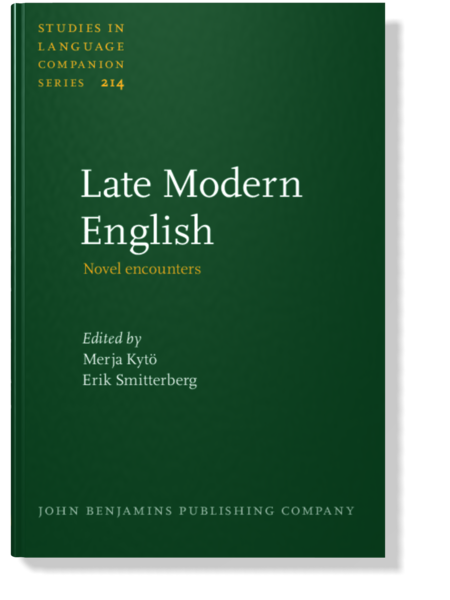
In:Late Modern English: Novel encounters
Edited by Merja Kytö and Erik Smitterberg
[Studies in Language Companion Series 214] 2020
► pp. 43–64
The interplay of internal and external factors in varieties of English
Published online: 18 March 2020
https://doi.org/10.1075/slcs.214.02hic
https://doi.org/10.1075/slcs.214.02hic
Abstract
The validity of a division of factors for
language change into internal and external forms the focus of the
present study. A distinction is made between speaker-internal and
speaker-external on the one hand and community-internal and
community-external on the other. A central concern is whether such
distinctions are merely artefacts of linguistic analysis or whether
they reflect the reality of speakers’ linguistic behaviour. Data is
considered from varieties of English to show that instances of
change are frequently combinations of factors and that the
disruption caused by socially-triggered change can be minimised by
speakers applying considerations of system symmetry and regularity
to a change and thus provide a clear trajectory which can be
transmitted across generations.
Article outline
- 1.Introduction: Terminology
- 1.1The purported reality of the internal – external division
- 1.2A closer look at internally-motivated and externally-motivated change
- 1.3Lifespan and the internal – external division
- 1.4The course of internal and external change
- 1.5Further differentiation of the internal – external division
- 2.The speaker-internal and speaker-external distinction
- 2.1Primarily speaker-internal motivation
- 2.1.1Grammaticalisation
- 2.1.2Regularisation
- 2.2Primarily speaker-external motivation
- 2.2.1The special case of mergers
- Merger of which and witch
- Pre-rhotic mergers
- Merger of horse and hoarse
- Merger of merry, Mary, marry
- The cot – caught merger
- 2.2.1The special case of mergers
- 2.3The role of prescriptivism
- 2.1Primarily speaker-internal motivation
- 3.Discussion and conclusion
Notes References

References (82)
Allen, Cynthia. 2016. Typological
change: Investigating loss of inflection in early
English. In Kytö & Pahta (eds), 444–459.
Beal, Joan. 1993. The
grammar of Tyneside and Northumbrian
English. In Milroy & Milroy (eds), 187–213.
. 2008. English
dialects in the North of England:
Phonology. In Varieties
of English, 1: The British
Isles, Bernd Kortmann & Clive Upton (eds), 122–144. Berlin: Mouton de Gruyter.
Boberg, Charles. 2008. English
in Canada:
Phonology. In Varieties
of English, 2: The Americas and the
Caribbean, Edgar W. Schneider (ed.), 144–160. Berlin: Mouton de Gruyter.
(ed.). 1994. The
Cambridge History of the English Language, Vol. V: English
in Britain and Overseas: Origins and
Development. Cambridge: CUP.
Butters, Ronald R. 2001. Grammatical
structure. In Cambridge
History of the English Language, Vol. IV: English in North
America, John Algeo (ed.), 325–339. Cambridge: CUP.
Bybee, Joan L. & Hopper, Paul J. (eds). 2001. Frequency
and the Emergence of Linguistic
Structure [Typological Studies in
Language
45]. Amsterdam: John Benjamins.
Dobson, E. J. 1968. English
Pronunciation 1500–1700, Vol.1: Survey of the sources, Vol.
2: Phonology, 2nd
edn. Oxford: OUP.
Dorian, Nancy C. 1993. Internally
and externally motivated change in contact situations:
Doubts about
dichotomy. In Historical
Linguistics. Problems and
perspectives, Charles Jones (ed.), 131–155. London: Longman.
Eckert, Penelope. 2000. Linguistic
Variation as Social Practice. The Linguistic Construction of
Identity in Belten
High. Malden MA: Blackwell.
Edwards, Walter F. 2008. African
American Vernacular English:
Phonology. In Varieties
of English, 2: The Americas and the
Caribbean, Edgar W. Schneider (ed.), 181–191. Berlin: Mouton de Gruyter.
Filppula, Markku, Klemola, Juhani & Sharma, Devyani (eds). 2017. The
Oxford Handbook of World
Englishes. Oxford: OUP.
Gerritsen, Marinel & Stein, Díeter (eds). 1992. Internal
and External Factors in Syntactic
Change. Berlin: Mouton de Gruyter.
Gick, Bryan. 2003. Articulatory
correlates of ambisyllabicity in English glides and
liquids. In Papers
in Laboratory Phonology VI, John Local, Richard Ogden & Rosalind Temple (eds), 222–236. Cambridge: CUP.
Gordon, Elizabeth. 2010. Describing
and complaining: Written evidence of early New Zealand
English
pronunciation. In Varieties
of English in Writing: The Written Word as Linguistic
Evidence [Varieties of English
Around the World G41], Raymond Hickey, 349–364. Amsterdam: John Benjamins.
Gordon, Matthew. 2008. New
York, Philadelphia and other northern cities:
Phonology. In Varieties
of English, 2: The Americas and the
Caribbean, Edgar W. Schneider (ed.), 67–86. Berlin: Mouton de Gruyter.
Hernández-Campoy, Juan Manuel & Conde-Silvestre, Juan Camilo (eds). 2012. The
Handbook of Historical
Sociolinguistics. Malden MA: Wiley-Blackwell.
Hickey, Raymond. 2002. Internal
and external forces again: Word order change in Old English
and Old
Irish. In Collecting
Views on Language Change, Raymond Hickey (ed.). Special
issue of Language
Sciences 24(3–4): 261–283.
. 2003a. How
do dialects get the features they have? On the process of
new dialect
formation. In Motives
for Language Change, Raymond Hickey (ed.), 213–239. Cambridge: CUP.
. 2003b. Rectifying
a standard deficiency. Pronominal distinctions in varieties
of
English. In Diachronic
Perspectives on Address Term
Systems [Pragmatics & Beyond New
Series 107], Irma Taavitsainen & Andreas H. Jucker (eds), 345–374. Amsterdam: John Benjamins.
. 2005. Dublin
English. Evolution and
Change [Varieties of English Around
the World
G35]. Amsterdam: John Benjamins.
. 2009. Weak
segments in Irish
English. In Phonological
Weakness in English. From Old to Present-Day
English, Donka Minkova (ed.), 116–129. Houndmills: Palgrave Macmillan.
. 2010. Language
contact: Reassessment and
reconsideration. In The
Handbook of Language Contact, Raymond Hickey (ed.), 1–28. Malden MA: Wiley-Blackwell.
. 2012. Internally
and externally motivated language
change. In Hernández-Campoy & Conde-Silvestre (eds), 401–421.
. 2013. Supraregionalisation
and dissociation. Handbook of
Language Variation and Change, 2nd
edn, Jack K. Chambers and Natalie Schilling (eds), 537–554. Malden MA: Wiley-Blackwell.
. 2014a. Mergers,
losses and the spread of
English. In Developments
in English: Expanding Electronic
Evidence, Irma Taavitsainen, Merja Kytö, Claudia Claridge & Jeremy J. Smith (eds), 237–250. Cambridge: CUP.
. 2014b. Vowels
before /r/ in the history of
English. In Contact,
Variation and Change in the History of
English, Daniel Schreier [Studies
in Language Companion Series
159], Olga Timofeeva, Anne Gardner, Alpo Honkapohja & Simone Pfenninger (eds), 95–110. Amsterdam: John Benjamins.
. 2015. The
North of England and Northern
English. In Researching
Northern English [Varieties of
English Around the World G55], Raymond Hickey (ed.), 1–24. Amsterdam: John Benjamins.
Joseph, Brian. 2012. Lexical
diffusion and the regular transmission of language change in
its sociohistorical
context. In Hernández-Campoy & Conde-Silvestre (eds), 408–426.
Kiparsky, Paul. 1995. The
phonological basis of sound
change. The Handbook of
Phonological Theory, John A. Goldsmith (ed.), 640–670. Cambridge MA: Blackwell.
Kortmann, Bernd. 2012. Typology
and typological change in English historical
linguistics. In Nevalainen & Traugott (eds), 605–621.
Kytö, Merja & Pahta, Päivi (eds). 2016. The
Cambridge Handbook of English Historical
Linguistics. Cambridge: CUP.
Jones, Mari C. & Esch, Edith (eds). 2002. Language
Change: The Interplay of Internal, External and
Extra-Linguistic
Factors. Berlin: Mouton de Gruyter.
Lahiri, Aditi (ed.). 2000. Analogy,
Levelling, Markedness. Principles of Change in Phonology and
Morphology. Berlin: Mouton de Gruyter.
Lass, Roger & Wright, Susan. 1986. Endogeny
vs. contact: “Afrikaans influence” on South African
English. English
World-Wide 7: 201–224.
Mesthrie, Rajend. 1996. Language
contact, transmission, shift: South African Indian
English. In Focus
on South Africa [Varieties of
English Around the World G15], Vivian de Klerk (ed.), 79–98. Amsterdam: John Benjamins.
. 2002. Endogeny
versus contact revisited: Aspectual busy in South African
English. In Collecting
Views on Language Change, Raymond Hickey (ed.). Special
issue of Language
Sciences 24(3–4): 345–358.
. 2003. On
the role of the speaker in language
change. In Motives
for Language Change, Raymond Hickey (ed.), 143–157. Cambridge: CUP.
. 2012. Sociolinguistics
and ideologies in language
history. In Hernández-Campoy & Conde-Silvestre (eds), 571–584.
Milroy, James & Milroy, Lesley (eds). 1993. Real
English. The Grammar of the English Dialects in the British
Isles. London: Longman.
Montgomery, Michael. 2001. British
and Irish
antecedents. In The
Cambridge History of the English Language, Vol. VI: English
in North America, John Algeo (ed.), 86–153. Cambridge: CUP.
Nevalainen, Terttu & Traugott, Elizabeth Closs (eds). 2012. The
Oxford Handbook of the History of
English. Oxford: OUP.
Nevalainen, Terttu & Raumolin-Brunberg, Helena. 2016. Historical
Sociolinguistics. Language Change in Tudor and Stuart
England, 2nd
edn. London: Routledge.
Newmeyer, Federick J. 2003. Formal
and functional motivation for language
change. In Hickey (ed.), 18–36.
Pargman, Sheri. 2002. Internal
and External Factors in Language
Change. Chicago IL: University of Chicago, Department of Linguistics.
Percy, Carol. 2012. Attitudes,
prescriptivism, and
standardisation. In Nevalainen & Traugott (eds), 446–456.
Phillips, Betty S. 2001. Lexical
diffusion, lexical frequency, and lexical
analysis. In Bybee & Hopper (eds), 123–136.
2015. Lexical
diffusion in historical
phonology. In The
Oxford Handbook of Historical
Phonology, Patrick Honeybone & Joseph Salmons (eds). Oxford: OUP.
Roberge, Paul. 2012. The
teleology of change: Functional and non-functional
explanations for language varieties and
change. In Hernández-Campoy & Conde-Silvestre (eds), 369–386.
Traugott, Elizabeth. 1972. A
History of English Syntax. A Transformational Approach to
the History of English Sentence
Structure. New York NY: Holt, Rinehart & Winston.
. 1998. Third-person
singular zero: African American Vernacular English, East
Anglian dialects and Spanish persecution in the Low
Countries. Folia Linguistica
Historica 18(1–2): 139–148.
Turner, Lorenzo D. 1971. Notes
on the sounds and vocabulary of
Gullah. In Williamson & Burke (eds), 121–35.
Williamson, Juanita V. & Burke, Virginia M. (eds). 1971. A
Various Language. Perspectives on American
Dialects. New York NY: Holt, Rinehart & Winston.
Winford, Donald. 2005. Contact-induced
changes: Classification and
processes. Diachronica 22 (2): 373–427.
. 2013. Substrate
influence and universals in the emergence of contact
Englishes: Re-evaluating the
evidence. In English
as a Contact Language, Daniel Schreier & Marianne Hundt (eds), 222–241. Cambridge: CUP.
Wolfram, Walt & Thomas, Erik R. 2002. The
Development of African American
English. Malden MA: Blackwell.
Cited by (7)
Cited by seven other publications
Allan, Kathryn
Cuesta, Julia Fernández
Hickey, Raymond
Needle, Jeremy M. & Sali A. Tagliamonte
Salameh Jiménez, Shima
2024. Linguistic change in the 20th century. In Language Change in the 20th Century [Pragmatics & Beyond New Series, 340], ► pp. 17 ff.
This list is based on CrossRef data as of 3 december 2025. Please note that it may not be complete. Sources presented here have been supplied by the respective publishers. Any errors therein should be reported to them.