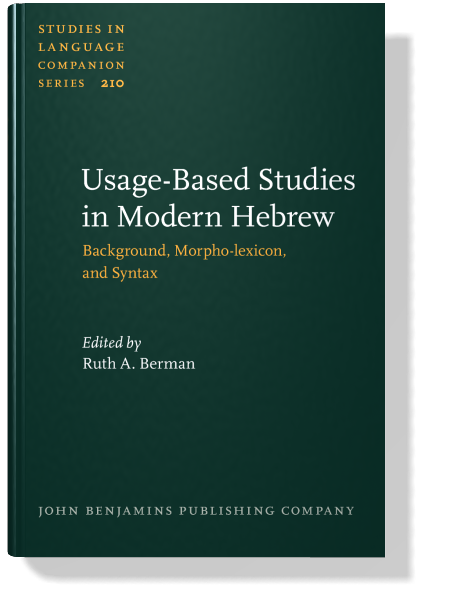
In:Usage-Based Studies in Modern Hebrew: Background, Morpho-lexicon, and Syntax
Edited by Ruth A. Berman
[Studies in Language Companion Series 210] 2020
► pp. 583–622
Chapter 16Negation in Modern Hebrew
Published online: 18 March 2020
https://doi.org/10.1075/slcs.210.17sho
https://doi.org/10.1075/slcs.210.17sho
This chapter examines the expression of negation in spontaneous spoken Modern
Hebrew. It provides a quantitative description of syntactic negation in the Corpus
of Spoken Israeli Hebrew (CoSIH) to address syntactic, pragmatic, and prosodic
properties of negation. The study shows that in addition to the prototypical function of
rejection and denial, negative utterances are used for mitigating evaluations, implying the
desirability of a state/event, and strengthening the speaker’s claim by rejecting potential
counter-arguments. Moreover, the prosodic prominence of negators may be influenced by
cognitive and interactional motivations. Particular attention is paid to phenomena that
usually remain unaddressed in descriptions of negation, such as negative sentences with
extra-sentential scope, negation-based discourse markers, and non-linguistic negation.
Article outline
- 1.Introduction
- 2.Data and methodology
- 3.Quantitative results
- 4.Wide-scope negation
- 4.1The negator ‘lo’
- 4.2The negator ‘al’
- 4.3The negator ‘en’
- 5.Narrow-scope negation
- 5.1Contrastive negation
- 5.2Preposing
- 6.Negative indefinites
- 7.Negation and prosody
- 8.Negation-based discourse markers
- 9.Non-linguistic negation
- 10.Concluding comments
Notes References

References (91)
Amiraz, Omri. Forthcoming. Negation in Modern Hebrew. In: Miestamo, Matti & Ljuba Veselinova (eds.), Negation in the languages of the world: Typologically and functionally based descriptions (Studies in Diversity Linguistics). Berlin: Language Science Press.
Altman, Ya’akov. 1999. tmimah Ɂani lo – mabaʕey hašlilah hamemukedet (Innocent I am not – utterances with focused negation). ћelkat lašon 27. 62–75.
Anderwald, Lieselotte. 2002. Negation in Non-Standard British English: Gaps, Regularizations,
Asymmetries. London: Routledge.
Bar, Tali. 2009. On cleft sentences in Contemporary Hebrew. In Egyptian, Semitic and General Grammar Studies in Memory of H.J. Polotsky, Gideon Goldenberg & Ariel Shisha-Halevy (eds), 337–355. Jerusalem: The Israel Academy of Sciences and Humanities.
Bardenstein, Ruti. (in preparation). Grammaticalization Paths of Rectification Constructions. PhD dissertation, Tel-Aviv University. (in Hebrew)
Bar-Adon, A. 1966. New imperative and jussive formations in Contemporary Hebrew. Journal of the American Oriental Society 86(4): 410–413.
Bar-Asher Siegal, Elitzur A. 2015. The case for external sentential negation: Evidence from Jewish Babylonian
Aramaic. Linguistics 53(5): 1031–1078.
Ben Moshe, Yotam M. & Yael Maschler. "Hebrew non-lexical vocalizations as discourse markers." Paper presented at the Symposium on Pragmatic Particles: Talk-in-interaction, Thessaloniki, June 24-25, 2019.
Birner, Betty J. & Ward, Gregory. 1998. Information Status and Noncanonical Word Order in English [Studies in Language Companion Series 40]. Amsterdam: John Benjamins.
Bolozky, Shmuel. 2013. Imperative and prohibitive: Modern Hebrew. In Encyclopedia of Hebrew Language and Linguistics, Geoffrey Khan (ed.), 245–248. Leiden: Brill.
Bressem, Jana & Müller, Cornelia. 2014. The family of away-gestures: Negation, refusal, and negative
assessment. In Body – Language – Communication: An international Handbook on Multimodality in
Human Interaction [Handbooks of Linguistics and Communication Science 38.2], Cornelia Müller, Alan Cienki, Ellen Fricke, Silva H. Ladewig, David McNeill & Jana Bressem (eds), 1592–1604. Berlin: Mouton de Gruyter.
Bressem, Jana, Stein, Nicole & Wegener, Claudia. 2017. Multimodal language use in Savosavo: Refusing, excluding and negating with
speech and gesture. Pragmatics 27(2): 173–206.
Burstein, Ruth. 1999. darxey hašeɁelah vehatšuvah baʕivrit haktuvah bat yameynu – Ɂaspektim taћbiriyim,
semantiyim vepragmatiyim (Questions and responses in contemporary Hebrew: A syntactic semantic and pragmatic
approach). PhD dissertation, Bar-Ilan University.
Clancy, Brian. 2015. Investigating Intimate Discourse: Exploring the Spoken Interaction of Families,
Couples and Friends. London: Routledge.
Dahl, Östen. 2010. Typology of negation. In The Expression of Negation, Laurence R. Horn (ed.), 9–38. Berlin: Mouton de Gruyter.
Deppermann, Arnulf. 2014. ‘Don’t get me wrong’: Recipient design by using negation to constrain an
action’s interpretation. In Grammar and Dialogism: Sequential, Syntactic, and Prosodic Patterns between
Emergence and Sedimentation, Susanne Günther, Wolfgang Imo & Jörg Bücker, (eds), 15–52. Berlin: De Gruyter.
Ford, Cecilia E. 2001. At the intersection of turn and sequence: Negation and what comes
next. In Studies in Interactional Linguistics [Studies in Discourse Grammar 10], Margret Selting & Elizabeth Couper-Kuhlen (eds), 51–80. Amsterdam: John Benjamins.
2002. Denial and the construction of conversational turns. In Complex Sentences in Grammar and Discourse: Essays in Honour of Sandra A.
Thompson, Joan L. Bybee & Michael Noonan (eds), 61–78. Amsterdam: John Benjamins.
Frajzyngier, Zygmunt & Shay, Erin. 2016. The Role of Functions in Syntax: A Unified Approach to language Theory,
Description, and Typology [Typological Studies in Language 111]. Amsterdam: John Benjamins.
Gil, David. 2013. Para-linguistic usages of clicks. In The World Atlas of Language Structures Online. Matthew S. Dryer & Martin Haspelmath (eds). Leipzig: Max Planck Institute for Evolutionary Anthropology. <[URL]> (21 January 2018).
Giora, Rachel, Fein, Ofer, Ganzi, Jonathan, Alkeslassy Levi, Natalie & Sabah, Hadas. 2005. On negation as mitigation: The case of negative irony. Discourse Processes 39: 81–100.
Giora, Rachel, Livnat, Elad, Fein, Ofer, Barnea, Anat, Zeiman, Rakefet & Berger, Iddo. 2013. Negation generates nonliteral interpretations by default. Metaphor and Symbol 28: 89–115.
Giora, Rachel, Givoni, Shir, & Fein, Ofer. 2015. Defaultness reigns: The case of sarcasm. Metaphor and Symbol 30(4): 290–313.
Givón, Talmy. 1978. Negation in language: Pragmatics, function, ontology. In Syntax and Semantics, 9: Pragmatics, Peter Cole (ed), 69–112. New York NY: Academic Press.
. 2005. Context as Other Minds: The Pragmatics of Sociality, Cognition and
Communication. Amsterdam: John Benjamins.
Grishina, Elena. 2015. Russian gestures of negation (O russkom zhestikulyatsionnom
otritsanii). Proceedings of Institute of Russian Language 6: 556–604.
Halevy, Rivka. 2006. tifkudah šel ‘ze’ habilti leksikalit beʕivrit bat yameynu (The functions of non-lexical zeh (it) in contemporary
Hebrew). lešonenu 68: 283–307.
. 2013. The dative in Modern Hebrew. In Encyclopedia for Hebrew Language and Linguistics, Geoffrey Khan (ed.), 659–663. Leiden: Brill.
Harrison, Simon. 2014. The organisation of kinesic ensembles associated with
negation. Gesture 14(2): 117–141.
Harrison, Simon & Larrivée, Pierre. 2015. Morphosyntactic correlates of gestures: A gesture associated with negation
in French and its organisation with speech. In Negation and polarity. Experimental perspectives, Pierre Larrivée & Chungmin Lee (eds), 75–94. Dordrecht: Springer.
Haspelmath, Martin. 2013. Negative indefinite pronouns and predicate negation. In The World Atlas of Language Structures Online, Matthew S. Dryer & Martin Haspelmath (eds). Leipzig: Max Planck Institute for Evolutionary Anthropology. <[URL]> (11 January 2017).
Hayashi, Makoto & Kushida, Shuya. 2013. Responding with resistance to wh-questions in Japanese
talk-in-interaction. Research on Language and Social Interaction 46: 231–255.
Hedberg, Nancy & Yaeger-Dror, Malcah. 2008. The effect of informational and interactive factors on the prosodic prominence of
negation. Paper presented at the Linguistic Society of America, Chicago IL.
Hirschberg, Julia. 1993. Pitch accent in context: Predicting prominence from text. Artificial Intelligence 63: 305–340.
2010. Introduction. In The Expression of Negation, Laurence R. Horn (ed.), 1–8. Berlin: Mouton de Gruyter.
Harrison, S. (2018). The impulse to gesture: Where language, minds, and bodies intersect. Cambridge University Press.
Inbar, Ana. 2016. Is subordination viable? The case of Hebrew šɛ
‘that’. CHIMERA. Romance Corpora and Linguistic Studies 3(2): 287–310.
Inbar, Ana & Shor, Leon. In preparation. Negation in spoken Israeli Hebrew: From verbal to gestural
communication.
Inbar, A., & Shor, L. (2019). Covert negation in Israeli Hebrew: Evidence from co-speech gestures. Journal of Pragmatics, 143, 85-95.
Izre’el, Shlomo. 2012. Basic sentence structures: A view from spoken Israeli Hebrew. In Penser les langues avec Claire Blanche-Benveniste [Langues et Langage 20], Sandrine Caddéo, Marie-Noëlle Roubaud, Magali Rouquier & Frédéric Sabio (eds), 215–227. Aix-en-Provence: Presses Universitaires de Provence.
. 2017. Unipartite clauses: A view from spoken Israeli Hebrew. In Afroasiatic: Data and Perspectives [Current Issues in Linguistic Theory 339], Mauro Tosco (ed.), 235–259. Amsterdam: John Benjamins.
. Forthcoming. The basic unit of spoken language and the interface between
prosody, discourse and syntax: A view from spontaneous spoken Hebrew. In In Search of a Reference Unit for Speech: A Corpus-driven Cross-linguistic Approach
to Spontaneous Spoken Communication, Shlomo Izre’el, Heliana Mello, Alessandro Panunzi, Tommaso Raso (eds). Amsterdam: John Benjamins.
Keevallik, Leelo. 2012. Compromising progressivity: ‘No’-prefacing in Estonian. Pragmatics 22: 119–146.
Keren, Einat-Haya. 2015. From negative polarity to negative concord–Slavic footprints in the
diachronic change of Hebrew meʔuma, klum, and
šum davar
. Journal of Jewish Languages 3(1–2): 180–194.
Kim, Stephanie Hyeri. 2015. Resisting the terms of polar questions through ani (‘no’)-
prefacing in Korean conversation. Discourse Processes 52(4): 311–334.
Klima, Edward S. 1964. Negation in English. In The Structure of Language: Readings in the Philosophyof Language, Jerry A. Fodor & Jerrold J. Katz (eds), 246–323. Englewood Cliffs NJ: Prentice-Hall.
Kuzar, Ron. 2012. Sentence Patterns in English and Hebrew [Constructional Approaches to Language 12]. Amsterdam: John Benjamins.
Ladusaw, William. 1996. Negation and polarity items. In The Handbook of Contemporary Semantic Theory, Shalom Lappin (ed.), 321–341. Oxford: Blackwell.
Linell, Per. 2005. The Written Language Bias in Linguistics: Its Nature, Origins and
Transformations. London: Routledge.
Maschler, Yael. 2017. The emergence of Hebrew loydea/loydat
(‘I dunno m/f’) from interaction – Blurring the boundaries between discourse marker,
pragmatic marker, and modal particle. In Pragmatic Markers, Discourse Markers and Modal Particles: New Perspectives [Studies in Language Companion Series 186], Andrea Sansò & Chiara Fedriani (eds), 37–69. Amsterdam: John Benjamins.
McCawley, James D. 1991. Contrastive negation and metalinguistic negation. In CLS 27: Papers from the 27th Regional Meeting of the Chicago Linguistics Society
1991, Part Two: italic>the Parasession on Negation, Lise M. Dobrin, Lynn Nichols & Rosa M. Rodriguez (eds), 189–206. Chicago IL: CLS.
Miestamo, Matti. 2007. Negation – an overview of typological research. Language and Linguistics Compass 1(5): 552–570.
. 2009. Negation. In Grammar, Meaning and Pragmatics [Handbook of Pragmatics Highlights 5], Frank Brisard, Jan-Ola Östman & Jef Verschueren (eds), 208–229. Amsterdam: John Benjamins.
Miestamo, Matti & van der Auwera, Johan. 2007. Negative declaratives and negative imperatives: Similarities and
differences. In Linguistics Festival, May 2006, Bremen, Andreas Ammann (ed.), 5–77. Bochum: Brockmeyer.
Miestamo, Matti, Tamm, Anne & Wagner-Nagy, Beáta. 2015. Negation in Uralic languages – Introduction. In Negation in Uralic Languages [Typological Studies in Language 108], Matti Miestamo, Anne Tamm & Beáta Wagner-Nagy (eds), 1–41. Amsterdam: John Benjamins.
Mithun, Marianne. 2012. Tags: Cross-linguistic diversity and commonality. Journal of Pragmatics 44(15): 2165–2182.
Mondada, Lorenza 2017. Precision timing and timed embeddedness of imperatives in embodied courses
of action. In Imperative Turns at Talk: The Design of Directives in Action [Studies in Language and Social Interaction 30], Marja-Leena Sorjonen, Liisa Raevaara & Elizabeth Couper-Kuhlen (eds), 65–101. Amsterdam: John Benjamins.
Nishi, H. 2019. Making ‘yes’ stronger by saying ‘no’: Utterance-initial iya in statements of ‘yes’ in Japanese. Pragmatics, 29(1), 133–154.
Ono, Tsuyoshi & Thompson, Sandra. 2017. Negative scope, temporality, fixedness, and right- and left-branching:
Implications for typology and cognitive processing. Studies in Language 41(3): 543–576.
O’Shaughnessy, Douglas & Allen, Jonathan. 1983. Linguistic modality effects on fundamental frequency in
speech. Journal of the Accoustical Society of America 74: 1155–1171.
Ozerov, Pavel. 2010. miqum hahatʕama vemivneh hameser basiaћ haspontani beʕivrit (Location of Accents and Information Structure in Spontaneous Israeli
Hebrew). MA thesis, The Hebrew University of Jerusalem.
Polak-Yitzhaki, Hilla & Maschler, Yael. 2016. Disclaiming understanding? Hebrew ’ani lo mevin/a (‘I don’t
understand m/f’) in everyday conversation. Journal of Pragmatics 106:163–183.
Quirk, Randolph, Sidney Greenbaum, Geoffrey Leech & Jan Svartvik. 1985. A Comprehensive Grammar of the English Language. Harlow: Longman.
Raclaw, Joshua. 2013. Indexing Inferables and Organizational Shifts: ‘No’-prefaces in English
Conversation. PhD dissertation, University of Colorado at Boulder.
Sadock, Jerry. 2012. Formal features of questions. In Questions: Formal, Functional and Interactional Perspectives, Jan P. De Ruiter (ed.), 103–122. Cambridge: CUP.
Schwarzwald, Ora Rodrigue & Sigal, Shlomo. 2015. Modern Hebrew še- and Judeo-Spanish ke- (que-) in independent modal
constructions. In Language Contact and the Development of Modern Hebrew, Edit Doron (ed.), 87–100. Leiden: Brill.
Shor, Leon. 2018. milat hašlilah ‘lo’ baʕivrit hameduberet – prozodyah, siaћ vetaћbir (The negator lo in spoken Israeli Hebrew – Prosody, discourse and
syntax). balšanut ʕivrit 72: 105–125.
. Forthcoming. ‘lo, Ɂata codek bemeah Ɂaxuz –
šimušim proceduraliyim bemilat hašlilah ‘lo’ baʕivrit hameduberet
(No, you’re one hundred percent right’ – Procedural uses of the negator
lo in spoken Israeli Hebrew). Balšanut Ivrit.
van der Auwera, Johan & Ludo Lejeune (with Valentin Goussev). 2013. The prohibitive. In Matthew S. Dryer & Martin Haspelmath (eds), The World Atlas of Language Structures Online. Leipzig: Max Planck Institute for Evolutionary Anthropology. <[URL]> (11 January 2017).
Van Valin, Robert D. & LaPolla, Randy J. 1997. Syntax: Structure, Meaning, and Function. Cambridge: CUP.
Vázquez Carranza, Ariel. 2017. Some uses of ‘no’ in Spanish talk-in-interactions. International Review of Pragmatics 9: 1–24.
Veselinova, Ljuba. 2013. Negative existentials: A cross-linguistic study. Rivista di Linguistica 25(1): 107–145.
Ward, Gregory & Birner, Betty J. 2004. Information structure and non-canonical syntax. The Handbook of Pragmatics, Laurence Horn & Gregory Ward (eds), 152–174. Oxford: Blackwell.
Willis, David, Lucas, Christopher & Breitbarth, Anne. 2013. Comparing diachronies of negation. In The History of Negation in the Languages of Europe and the Mediterranean: Vol. I: Case Studies. David Willis, Christopher Lucas & Anne Breitbarth (eds), 1–50. Oxford: OUP.
Yaeger-Dror, Malcah. 1985. Intonational prominence on negatives in English. Language and Speech 28: 197–230.
. 1996. Register as a variable in prosodic analysis: The case of the English
negative. Speech Communication 19: 39–60.
. 2002. Register and prosodic variation, a cross language comparison. Journal of Pragmatics 34: 1495–1536.
Yaeger-Dror, Malcah, Takano, Shoji, Hall-Lew, Lauren & Granadillo, Tania. 2011. The sociophonetics of prosodic contours on NEG in three language
communities: Teasing apart socio-, -linguistic and phonetic influences on
speech. In Sociophonetic Reader, Dennis R. Preston & Nancy Niedzielski (eds),133–176. Berlin: Mouton de Gruyter.
Cited by (7)
Cited by seven other publications
Inbar, Anna
2025. Contrastive negation constructions in Israeli
Hebrew. In Multimodal Communication from a Construction Grammar Perspective [Constructional Approaches to Language, 38], ► pp. 251 ff.
Inbar, Anna & Yael Maschler
Ben-Moshe, Yotam M. & Yael Maschler
Cohen-Achdut, Miri & Leon Shor
Harrison, Simon
Izre'el, Shlomo
This list is based on CrossRef data as of 3 december 2025. Please note that it may not be complete. Sources presented here have been supplied by the respective publishers. Any errors therein should be reported to them.