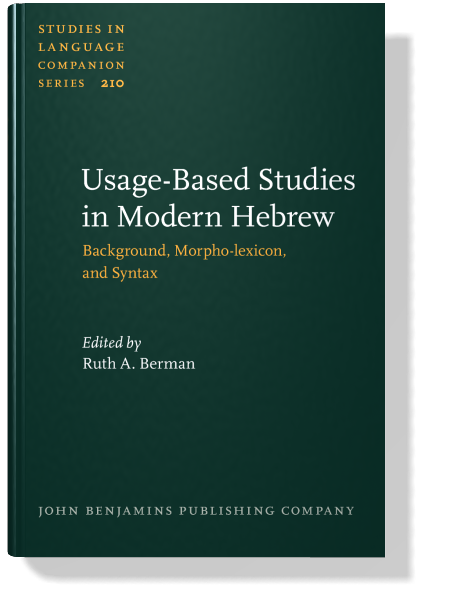
In:Usage-Based Studies in Modern Hebrew: Background, Morpho-lexicon, and Syntax
Edited by Ruth A. Berman
[Studies in Language Companion Series 210] 2020
► pp. 539–582
Chapter 15Impersonal and pseudo-impersonal constructions
Published online: 18 March 2020
https://doi.org/10.1075/slcs.210.16hal
https://doi.org/10.1075/slcs.210.16hal
The domain of impersonal constructions is highly complex and heterogeneous in
Hebrew as in other languages. It includes sentences that lack an overt constituent bearing
the properties of a referential and identifiable subject or that are altogether lacking in
canonical subject properties. The aim of the present chapter is to present an up-to-date
classification of the major impersonal and generalized or impersonalized constructions in
Modern, primarily spoken, Hebrew. To this end, the coding properties of such constructions
are analyzed, based on the typological characterization of Modern Hebrew (MH) as a non-subject-oriented and
non-configurational language characterized by synthetic inflectional morphology with marking
of person in finite verbs, so not requiring an expletive or ‘dummy’ subject. Functional
properties of impersonal and generalized constructions in MH are noted in relation to
pragmatic underpinnings of their patterning and use.
Article outline
- 1.Introduction
- 2.Relevant properties of MH
- 3.Hebrew empty-subject constructions
- 4.Classes of impersonals in MH
- 4.1Uncontrolled events: Meteorological and environmental assertions
- 4.2Constructions of existence and possession
- 4.3Internal impersonals in modal and evaluative function
- 4.4Experiential impersonals
- 4.5Impersonal passives
- 4.63rd person plural subjectless impersonals
- 4.7Impersonals with overt pronouns
- 4.7.1Impersonals with 1st person plural subjects
- 4.7.22nd person singular impersonal pronouns
- 4.8Impersonals with generic noun subjects
- 5.Concluding remarks
Notes References

References (84)
Benveniste, Émile. 1966. Structure des relations de personne dans le verbe. In Problèmes de linguistique générale, Vol. 1, 225–236. Paris: Gallimard.
Berman, Ruth A. 1979. Form and function: Impersonals, passives, and middles in Modern
Hebrew. Berkeley Linguistic Society 5: 1–27.
1980. The case of an (S)VO language: Subjectless constructions in Modern
Hebrew. Language 56(4): 759–776.
2005. Introduction: Developing discourse stance in different text types and
languages. Journal of Pragmatics 37(2): 105–124.
2011. Revisiting impersonal constructions in Modern Hebrew: Discourse-based
perspectives. In Impersonal Constructions: A Cross-linguistic Perspective [Studies in Language Companion Series 124], Andrej Malchukov & Anna Siewierska (eds), 323–355. Amsterdam: John Benjamins.
Berman, Ruth A. & Neeman, Yonni. 1994. Development of linguistic forms: Hebrew. In Relating Events in Narrative: A Crosslinguistic Developmental Study, Ruth A. Berman & Dan I. Slobin (eds), 285–328. Hillsdale NJ: Lawrence Erlbaum Associates.
Blau, Joshua. 1996. ʕal hasavil hastami bamiqraʔ (On the impersonal passive in Biblical Hebrew). In Studies in Hebrew Linguistics, 114–121. Jerusalem: Magnes.
Borer, Hagit. 1989. Anaphoric AGR. In The Null Subject Parameter [Studies in Natural Language and Linguistic Theory 15], Osvalso Jaeggli & Kenneth J. Safir (eds), 69–109. Dordrecht: Kluwer.
Borschev, Vladimir & Partee, Barbara H. 2002. The Russian genitive of negation: Theme-rheme structure or perspective
structure? Journal of Slavic Linguistics 10(1–2): 105–144.
Bossong, Georg. 1998. Le marquage de l’expérient dans les langues
d’Europe. In Actance et valence dans les langues de l’Europe [Empirical Approaches to Language Typology 20–2], Jack Feuillet (ed.), 259–294. Berlin: Mouton de Gruyter.
Bybee Joan L. & Hopper, Paul. 2001. Frequency and the Emergence of Linguistic Structure [Typological Studies in Language 45]. Amsterdam: John Benjamins.
Cabredo Hofherr, Patricia. 2003. Arbitrary readings of 3pl pronominal. In Proceedings of the Conference ‘sub7 – Sinn und Bedeutung’ [Arbeitspapier 114], Matthias Weisgerber (ed.), 81–94. Konstanz: FB Sprachwissenshaft, Universität Konstanz. < [URL]>
Cinque, Gugliemo. 1988. On Si constructions and the theory of Arb
. Linguistic Inquiry 19(4): 521–581.
Creissels, Denis. 2006. Syntaxe générale: Une introduction typologique. Paris: Hermes Science–Lavoisier.
. 2008. Impersonal and related constructions: A typological approach. Lectures
presented at the University of Tartu, 2–3 June.
Croft, William A. 2001. Radical Construction Grammar: Syntactic Theory in Typological Perspective. Oxford: OUP.
Doron, Edit. 2003. Bare singular reference to kinds. In Proceedings of Israel Association for Theoretical Linguistics 19, Yehuda F. Falk (ed.). Jerusalem: Hebrew University. <
[URL]
>
Dubnov, Keren. 2013. Russian and Slavic influence on Modern Hebrew. In Encyclopedia of Hebrew Language and Linguistics, Vol. 3, Geoffrey Khan (ed.), 576–578. Leiden: Brill.
Gast, Volker & Florian Haas. 2011. On the distribution of subject properties in formulaic presentationals of
Germanic and Romance: A diachronic-typological approach. In Impersonal Constructions: A Cross-linguistic Perspective [Studies in Language Companion Series 124], Andrej Malchukov & Anna Siewierska (eds), 127–166. Amsterdam: John Benjamins.
Gast, Volker & van der Auwera, Johan. 2013. Towards a distributional typology of human impersonal
pronouns. In Languages across Boundaries: Studies in Memory of Anna Siewierska, Dik Bakker & Martin Haspelmath (eds), 119–158. Berlin: Walter de Gruyter.
Givón, Talmy. 1976a. Topic, pronoun and grammatical agreement. In Subject and Topic, Charles N. Li (ed.), 151–188. New York NY: Academic Press.
. 1976b. On the VS order in Israeli Hebrew: Pragmatics and typological
change. In Studies in Modern Hebrew Syntax and Semantics: The Transformational-Generative
Approach [North Holland Linguistic Series 32], Peter Cole (ed.), 153–181. Amsterdam: North Holland.
Goldberg, Adele E. 1995. Constructions: A construction Grammar Approach to Argument Structure. Chicago IL: University of Chicago Press.
2003. Constructions: A new theoretical approach to language. Trends in Cognitive Science 7(5): 219–224.
Goldenberg, Gideon. 1998. On verbal structure and the Hebrew verb. In Studies in Semitic Linguistics: Selected Writings, 148–197. Jerusalem: Magnes.
Grossman, Eitan. 2013. ‘So you just flow with it’: A discourse strategy in ‘soldiers’ testimonies’
from the occupied Palestinian territories. In Meditations on Authority, David Dean Shulman (ed), 157–191. Jerusalem: Magnes.
Hale, Ken. 1982. Preliminary remarks on configurationality. Proceedings of the North Eastern Linguistic Society 12: 86–96.
Halevy, Rivka. 1992. tʔarim ħofšiyim utʔarim bilti ħofšiyim baʕivrit
haħadašah (Free and restricted adjectives in Contemporary
Hebrew). In Language Studies, Vol. 5–6, Moshe Bar-Asher (ed.), 521–537. Jerusalem: Magnes.
. 2006. tifqudah šel ‘zeh’ habilti leqsiqalit bʕivrit bat
yameynu (The function of nonlexical ‘ze’ in Contemporary
Hebrew). Lešonenu 67: 283–307.
. 2013a. Deixis: Modern Hebrew. In Encyclopedia of Hebrew Language and Linguistics, Vol. 1, Geoffrey Khan (ed.), 693–697. Leiden: Brill.
. 2013b. Syntax: Modern Hebrew. In Encyclopedia of Hebrew Language and Linguistics, Vol. 3, Geoffrey Khan (ed.), 707–722. Leiden: Brill.
. 2016. Non-canonical ‘existential-like’ constructions in colloquial Modern
Hebrew. In Atypical Predicate-Argument Relations [Lingvisticæ Investigationes Supplementa 33], Thierry Ruchot & Pascale Van Praet (eds), 27–60. Amsterdam: John Benjamins.
Izre’el, Shlomo. 2018. Unipartite clauses: A view from spoken Israeli Hebrew. In Afroasiatic Data and Perspectives [Current Issues in Linguistic Theory 339], Mauro Tosco (ed.), 235–260. Amsterdam: John Benjamins.
Jespersen, Otto & Haislund, Niels. 2013. Modern English Grammar on Historical Principles, Vol. 7:
Syntax
. London: Routledge. (Original work published 1954)
Keenan, Edward L. 1976. Towards a formal definition of ‘Subject’. In Subject and Topic, Charles N. Li (ed.), 305–333. New York NY: Academic Press.
Kitagawa, Chisato & Lehrer, Adrienne. 1990. Impersonal uses of personal pronouns. Journal of Pragmatics 14(5): 739–759.
Kuzar, Ron. 1993. ha‘ħagam’ – ħeleq dibur ʔo ʕemdah taħbirit? (The impersonal constructions – a part of speech or a syntactic
position?). Lešonenu 56(3): 241–248.
. 2000. ‘ʔašrey hamaʔamin’ wtavniyot domot bʕivrit ʕal
rvadeha (
‘Blessed is the believer’ and similar constructions in the different
phases of Hebrew). Hebrew Linguistics 46: 55–67.
. 2002. tavnit ha‘ħagam’ hapšutah balašon hamyuceget
kimduberet([The simple impersonal construction in texts represented as
colloquial Hebrew). In Speaking Hebrew: Studies in the Spoken Language and in Linguistic Variation in
Israel [Te’uda 18], Shlomo Izre’el (ed.), 329–352. Tel Aviv: Tel Aviv University.
. 2012. Sentence Patterns in English and Hebrew [Constructional Approaches to Language 12]. Amsterdam: John Benjamins.
Lambert, Pierre-Yves. 1998. L’impersonnel. In Actance et valence dans les langues de l’Europe [Empirical Approaches to Language Typology 20–2], Jack Feillet (ed.), 295–345. Berlin: Mouton de Gruyter.
Lambrecht, Knud. 2000. When subjects behave like objects: An analysis of the merging of S and O in
sentence focus constructions across languages. Studies in Language 24(3): 611–682.
Langacker, Robert W. 1991. Foundations of Cognitive Grammar, Vol. 2. Stanford CA: Stanford University Press.
Lauwers, Peter & Willems, Dominique. 2011. Coercion: Definitions and challenges, current approaches, and new
trends. Linguistics 49(6): 1219–1235.
Leonetti, Manuel. 2008. Definiteness effect and the role of the coda in existential
constructions. In Essays on Nominal Determination: From Morphology to Discourse Management [Studies in Language Companion Series 99], Henrik Høeg Müller & Alex Klinge (eds), 131–162. Amsterdam: John Benjamins.
Malchukov, Andrej & Siewierska, Anna. 2011. Impersonal Constructions: A Cross-linguistic Perspective [Studies in Language Companion Series 124]. Amsterdam: John Benjamins.
Malchukov, Andrej & Ogawa, Akio. 2011. Towards a typology of impersonal constructions: A semantic map
approach. In Impersonal Constructions: A Cross-linguistic Perspective [Studies in Language Companion Series 124], Andrej Malchukov & Anna Siewierska (eds), 19–56. Amsterdam: John Benjamins.
McNally, Louise. 2011. Existential sentences. In Semantics: An International Handbook of Natural Language Meaning, Vol. 2 [Handbooks of Linguistics and Communication Science 33–2], Klaus von Heusinger, Claudia Maienborn & Paul Portner (eds), 1829–1848. Berlin: Mouton de Gruyter.
Muchnik, Malka. 2015. The Gender Challenge of Hebrew [The Brill Reference Library of Judaism 42]. Leiden: Brill.
Perlmutter, David M. 1983. Personal vs. impersonal constructions. Natural Language & Linguistic Theory 1(1): 141–200.
Rabin, Haiim B. 1998. givun signoni baguf hastami bamikraʔ (Stylistic variation in use of impersonals in Biblical
Hebrew). In Linguistic Studies: Collected Papers in Hebrew and Semitic Languages, Moshe Bar-Asher & Baraq Dan (eds), 244–253. Jerusalem: The Academy of Hebrew Language & The Bialik Institute. (Original work published 1979)
1977. Contemporary Hebrew [Trends in Linguistics: State-of-the-Art Reports 11]. The Hague: Mouton de Gruyter.
Sa’ar, Amalia. 2007. Masculine talk: On the subconscious use of masculine linguistic forms among
Hebrew- and Arabic-speaking women in Israel. Signs: Journal of Women in Culture and Society 32(2): 405–429.
. 2006. Theticity. In Pragmatic Organization of Discourse in the Languages of Europe [Empirical Approaches to Language Typology 20–8], Giuliano Bernini & Marcia Linda Schwartz (eds), 255–308. Berlin: Mouton de Gruyter.
. 2008. Introduction: Impersonalization from a subject-centered vs. agent-centered
perspective. Transactions of the Philological Society 106(2): 1–23.
Siewierska, Anna & Papastathi, Maria. 2011. Third person plurals in the languages of Europe: Typological and
methodological issues. Linguistics 43(2): 575–610.
Cited by (9)
Cited by nine other publications
DATTNER, Elitzur & Dorit RAVID
Brandel, Noa
Halevy, Rivka
Halevy, Rivka
Halevy, Rivka
Izre'el, Shlomo
Izre'el, Shlomo
Notarius, Tania
This list is based on CrossRef data as of 3 december 2025. Please note that it may not be complete. Sources presented here have been supplied by the respective publishers. Any errors therein should be reported to them.