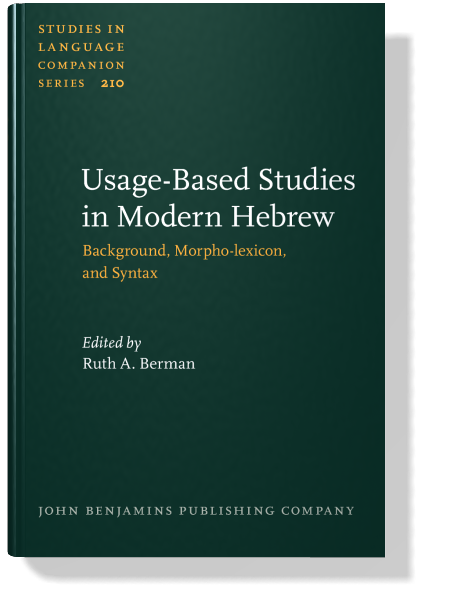
In:Usage-Based Studies in Modern Hebrew: Background, Morpho-lexicon, and Syntax
Edited by Ruth A. Berman
[Studies in Language Companion Series 210] 2020
► pp. 147–202
Chapter 7Inflection
Published online: 18 March 2020
https://doi.org/10.1075/slcs.210.08sch
https://doi.org/10.1075/slcs.210.08sch
Inflection in Modern Hebrew is described as involving the following categories:
Tense (Past, Future), Mood (Imperative), Person, Number, and Gender in verbs; Number,
Gender, and Construct-State in nouns; Number and Gender in adjectives. Most inflection is
manifested by suffixes, except for Person inflection on Future tense verbs. Inflection is
obligatory for Tense in verbs (except for nominalized forms) and in Prepositions,
Adjectives, and Participles. Noun inflection varies, depending on the features of Count for
Number and Animacy for Gender. Accusative-case marking on verbs and Genitive-case marking on
nouns are increasingly replaced by analytic alternatives in Modern Hebrew. The chapter first
details the pronominal system, and then proceeds to description of the major lexical classes
of Verbs, Nouns, and Adjectives, concluding with a brief discussion of conservative features
as against variability and changes in MH inflection.
Article outline
- 1.Introduction
- 2.Pronouns
- 2.1Independent, free pronouns
- 2.2Dependent pronouns
- 2.2.1Prepositions + pronouns
- 2.2.1.1Prepositons with Set I pronominal suffixes
- 2.2.1.2Prepositions with Set II pronominal suffixes
- 2.2.2Pronominal suffixation on nouns
- 2.2.3Pronominal suffixation on verbs
- 2.2.4Pronominal suffixation on numerals and other closed class words
- 2.2.1Prepositions + pronouns
- 3.Verb inflection
- 3.1Root and templates
- 3.2Tense inflection
- 3.3Mood inflection
- 3.4Infinitives, gerunds, and action nominals
- 3.5Agreement marking for person, gender and number inflection
- 4.Nouns
- 4.1Gender inflection: Masculine and feminine
- 4.1.1Suffix distribution
- 4.2Number inflection
- 4.2.1Plural suffixes
- 4.2.2Distribution of plural suffixes
- 4.2.3Minor plural forms
- 4.2.4Stress assignment in plural forms
- 4.2.5Plural assignment in complex nouns
- 4.3Construct state inflection
- 4.1Gender inflection: Masculine and feminine
- 5.Adjectives
- 5.1Gender inflection in adjectives
- 5.2Number inflection
- 6.Concluding remarks
Notes References

References (145)
Anderson, Stephen R. 1985. Inflectional morphology. In Language Typology and Syntactic Description, Timothy Shopen (ed.), 151–201. Cambridge: CUP.
1988. Inflection. In Theoretical Morphology, Approaches in Modern Linguistics, Michael Hammond & Michael Noonan (eds), 23–43. Orlando FL: Academic Press.
Ashkenazi, Orit, Ravid, Dorit & Gillis, Steven. 2016. Breaking into the Hebrew verb system: A learning problem. First Language 36: 1–20.
Avioz, Hagit. 2004. ntiyat hamispar untiyat haqinyan bšem haʕecem bʕivrit bat
zmanenu (Modern Hebrew Number and Possessive Inflection in
Nouns). PhD dissertation, Bar Ilan University.
Bar-Adon, Aaron. 1966. New imperative and jussive formation in Contemporary Hebrew. Journal of the American Oriental Society 86: 410–413.
Bat-El, Outi. 1996. Selecting the best of the worst: The grammar of Hebrew
blends. Phonology 13: 283–328.
. 2013. Blends. In Encyclopedia of Hebrew Language and Linguistics, Vol. I. Geoffrey Khan et al.. (eds), 371–373. Leiden: Brill.
Bauer, Hans & Leander, Portos. 1965. Historische Grammatik der Hebräischen Sprache des alten Testamentes. Hildesheim: Olms.
Ben-Asher, Mordechai. 1972. ʕiyunim btaħbir haʕivrit haħadašah (Essays on the Syntax of Modern Hebrew). Tel Aviv: Hakibbutz Hameuchad.
. 1976. šimušey hamaqor wšem hapʕulah blšon hamiqraʔ lʕumat lšon
yameynu (On the infinitive and nomen actionis in Biblical and Modern
Hebrew). In Kilšon ʕamo: Studies in Applied Linguistics, Ben-Ziyyon Fischler & Raphael Nir (eds), 23–35. Jerusalem: Council on the Teaching of Hebrew.
1981. Regularization of plural forms in the Hebrew noun system. Papers and Reports on Child Language Development 20: 34–44.
1983. Establishing a schema: Children’s construal of verb-tense
marking. Language Sciences 5: 61–78.
1985. The acquisition of Hebrew. In The Crosslinguistic Study of Language Acquisition, Vol. 1, Dan I. Slobin (ed.), 255–371. Hillsdale NJ: Lawrence Erlbaum Associates.
1988. Language knowledge and language use: Binominal constructions in Modern
Hebrew. General Linguistics 28: 261–285.
1989. The role of blends in Modern Hebrew word-formation. In Studia Linguistica et Orientalia Memoriae Haim Blanc Dedicate, Paul Wexler, Alexander Borg, & Sasson Somekh (eds), 45–61. Wiesbaden: Harrassowitz.
1993. Developmental perspectives on transitivity: A confluence of
cues. In Other Children, Other Languages: Issues in the Theory of Acquisition, Yonata Levy (ed.), 189–241. Hillsdale NJ: Lawrence Erlbaum Associates.
1994. Formal, lexical, and semantic factors in acquisition of Hebrew resultative
participles. Berkeley Linguistic Society 20: 82–92.
2009. Children’s acquisition of compound constructions. In The Oxford Handbook of Compounding, Rochelle Lieber & Pavol Stekauer (eds), 298–322. Oxford: OUP.
2012. Revisiting roots in Hebrew: A multi-faceted view (in
English). In Studies on Modern Hebrew and Jewish Languages in Honor of Ora (Rodrigue)
Schwarzwald (in Hebrew), Malka Muchnik & Zvi Sadan (eds), 132–158. Jerusalem: Carmel Press.
2014. Acquiring and expressing temporality in Hebrew: A T/M/A
Language. SKASE Journal of Theoretical Linguistics 11(2): 2–29. [URL]
2017. Word class distinctiveness versus polycategoriality in Modern Hebrew:
Psycholinguistic perspectives. In Lexical Polycategoriality: Cross-Linguistic, Cross-Theoretical, and Language
Acquisition Approaches [Studies in Language Companion Series 182], Valerina Vapnarsky & Edy Veneziano (eds), 343–376. Amsterdam: John Benjamins.
2018. From pre-grammaticality to proficiency in L1: Acquiring and using Hebrew
infinitives. Psychology of Language and Communication. 22(1):557–580.
Berman, Ruth & Nir-Sagiv, Bracha. 2004. Linguistic indicators of inter-genre differentiation in later language
development. Journal of Child Language 31: 339–380.
Berman, Ruth A. & Ravid, Dorit. 1986. ʕal dargat hamilun šel cerufey smixut (Lexicalization of noun compounds). Hebrew Linguistics 24: 5–22.
Berman, Ruth A. & Seroussi, Batia. 2011. Derived nouns in Modern Hebrew: Structural and psycholinguistic
perspectives. Rivista Di Linguistica 23(1): 105–125.
Bickel, Balthasar & Nichols, Johanna. 2007. Inflectional morphology. In Language Typology and Syntactic Description, Timothy Shopen (ed.), 169–240. Cambridge: CUP.
Blevins, James P. 2015. Inflectional paradigms. In The Oxford Handbook of Inflection, Matthew Baerman (ed.), 87–111. Oxford: OUP.
Bliboim, Rivka. 2001. ʕal smixut šem hatoʔar wtaħlifeha barvadim hašonim šel haʕivrit (Adjective annexation and its equivalents). Lešonenu 63: 81–105.
Bliboim, Rrivka & Shatil, Nimrod. 2014. beyn cmidut lsmixut blšon yameynu (Juxtaposition and construct states in contemporary
Hebrew). Lešonenu 76: 345–370.
. 1997. Israeli Hebrew phonology. In Phonologies of Asia and Africa, Alan S. Kaye (ed.), 287–311. Winona Lake IN: Eisenbrauns.
. 1999. Measuring Productivity in Word Formation: The Case of Israeli Hebrew [Studies in Semitic Languages and Linguistics 27]. Leiden: Brill.
Borer, Hagit. 1988. On the morphological parallelism between compounds and
constructs. In Morphology Yearbook, Vol. 1, Geert Booij & Jaap van Marle (eds), 45–65. Dordrecht: Foris.
Bybee, Joan. 1985. Morphology: A Study of the Relation Between Meaning and Form [Typological Studies in Language 9]. Amsterdam: John Benjamins.
Bybee, Joan & Fleischman, Suzanne (eds). 1995. Modality in Grammar and Discourse [Typological Studies in Language 32]. Amsterdam: John Benjamins.
Chomsky Gilit. 2017. ˁal ˀahava ˀani roca lhagid (Regarding Love I Want to Say). Rishon LeZion: Yediot Aharonot Publishers.
Cohen, Smadar. 2016. Person Markers in Spoken Spontaneous Israeli Hebrew: A Systematic Description and
Analysis. Utrecht: LOT.
2015. Features of inflection. In The Oxford Handbook of Inflection, Matthew Baerman (ed.), 35–46. Oxford: OUP.
CoSIH: The Corpus of Spoken Israeli Hebrew. n.d. <[URL]> (5 February 2018).
Doron, Edit. 2003a. Agency and voice: The semantics of the Semitic template. Natural Language Semantics 11(1): 1–67.
. 2003b. Transitivity alternations in the Semitic template system. In Research in Afroasiatic Grammar Selected Papers from the Fifth Conference on
Afroasiatic Languages, Paris 2000, Vol. II [Current Issues in Linguistic Theory 241], Jacqueline Lecarme (ed.) 127–150. Amsterdam: John Benjamins.
. 2007. Rosén ʕal hasemantiqah šel maʕarexet zmaney hapoʕal bʕivrit (Rosén on the
semantics of temporal inflection in the verbal system of Hebrew). Haivrit Weahyoteha 6–7: 249–268.
. In press. The gerund subject alternation of Biblical Hebrew. Brill’s Journal of Afroasiatic Languages and Linguistics.
Doron, Edit & Meir, Irit. 2013. Construct state: Modern Hebrew. In The Encyclopedia of Hebrew Language and Linguistics, Vol. 1, Geoffrey Khan, Shmuel Bolozky, Steven Fassberg, Gary Rendsburg, Ora R. Schwarzwald, Aaron Rubin, Tamar Zewi et al.. (eds), 581–589. Leiden: Brill.
Dubnov, Keren. 2000. kinuyey haqinyan haħavurim whaprudim šel šem haʕecem baʕivrit
hamduberet (Synthetic and analytic possessive pronouns related to nouns in
Spoken Hebrew). Hebrew Linguistics 47: 21–26.
Gafter, Roey J. 2016a. Pharyngeal beauty and depharyngealized geek: Performing ethnicity on Israeli
reality TV. In Raciolinguistics: How Language Shapes our Ideas about Race, Samy H. Alim, John R. Rickford & Arnetha F. Ball (eds), 185–202. Oxford: OUP.
2016b. What’s a stigmatized variant doing in the word list? Authenticity in reading
styles and the Hebrew pharyngeals. Journal of Sociolingustics 20: 31–58.
Gerlach, Brigit & Grijzenhout, Janet. 2000. Clitics in Phonology, Morphology and Syntax [Linguistik Aktuell/Linguistics Today 36]. Amsterdam: John Benjamins.
Gesenius, Wilhelm. 1910. Hebrew Grammar, Emil Kautzsch (ed.), Arthur Ernest Cowley (trans.). Oxford: Clarendon Press.
Glinert, Lewis. 1976. hasofit -ayim, dugmah bhomonimiyut taħbirit
leqsiqalit (The suffix -ayim: A case of lexico-syntactic
homonymy). Hebrew Computational Linguistics 10: 1–16.
. 1977. Number switch: A singular feature-change rule of Modern
Hebrew. AfroAsiatic Linguistics 4(2): 1–38.
Goldenberg, Gideon. 1998. On Verbal Structure and the Hebrew Verb. In Studies in Semitic Linguistics: Selected Writings, 148–196. Jerusalem: Magnes.
. 2009b. šinuyey tnuʕut baʕivrit hamduberet bhašraʔat ħoq haħituf:
meħqar sadeh (The influence of the rule of vowel reduction on vowel changes in
spoken Hebrew). Lešonenu 71: 167–179.
Gonen, Einat & Rubinstein, Doron. 2016. mahalaxim ʕal cir hastamiyut: qawim ldmuto šel šem hamispar
baʕivrit hamduberet (The numerals in spontaneous corpus of colloquial
Hebrew). Te’uda 27: 369–395.
Halevy, Rivka. 1992. tʔarim ħofšiyim utʔarim bilti ħofšiyim baʕivrit
haħadašah (Free and restricted adjectives in Contemporary
Hebrew). In Language Studies, Vol. 5–6, Moshe Bar-Asher (ed.), 521–536. Jerusalem: Magnes.
. 2007. “ʕiyun bherkevey toʔar ʕaqifim ubħinat tifqudam baʕivrit šel yameynu (“Indirect” adjective + noun construct phrases in Contemporary Hebrew). In Sha’arei Lashon: Studies in Hebrew, Aramaic, and Jewish Languages Presented to
Moshe Bar-Asher, Aharon Maman, Steven Fassberg & Yochanan Breuer (eds), 96–116. Jerusalem: Bialik Institute.
. 2016. The “swift of foot” construction and the phrasal structure of the adjective
construct in Hebrew. Studies in Language 40: 380–413.
Hazout, Ilan. 2000. Adjectival genitive constructions in Modern Hebrew: A case study in coanalyses. Linguistic Review 171: 29–52.
Henkin, Roni. 1997. disimilaciyah šel BKP bcrorot poʕaliyim: sugyah bdiqduq
hapoʕal baʕivrit hamduberet (Dissimilation of BKP in consonant clusters). In Hadassah Shy Jubilee Book, Yaakov Bentolila (ed.), 199–209. Jerusalem: Bialik Institute.
Joüon, Paul & Muraoka, Takamitsu. 2011. A Grammar of Biblical Hebrew. Rome: Gregorian & Biblical Press.
Kalev, Danny. 2015. zmanim moderniyim: hagramtizacyah šel haʔanteriyor baʕivrit
bat zmanenu (The grammaticalization of the anterior in Contemporary
Hebrew). Proceedings of the 29th–30th Annual Meetings of the Haiim B. Rosén Israeli
Linguistic Society 20: 51–60.
. 2017. hazmanim hayaħasiyim bʕivrit: haʔanteriyor whaposteriyor (The relative tenses in Hebrew: The posterior and the
anterior). Proceedings of the 31th–32th Annual Meetings of the Haiim B. Rosén Israeli
Linguistic Society 21: 20–40.
Kaplan, Dafna & Berman, Ruth A. 2015. Developing linguistic flexibility across the school years. First Language 351: 27–53.
Laks, Lior. 2011. Morpho-Phonological and Morph-Thematic Relations in Hebrew and Arabic Verb
Formation. PhD dissertation, Tel Aviv University.
. 2013. Why and how do Hebrew verbs change their form? A morpho-thematic
account. Morphology 233: 351–383. <>
. 2017. picuy morfologi: ʕal tcurat šem hapoʕal šel pʕalim
svilim [Morphological compensation: On passive gerund
formation]. Presented at the
Annual Meeting of the Israel Linguistic Society, Bar Ilan University
.
Levy, Yonata. 1983. The acquisition of Hebrew plurals: The case of the missing gender
category. Journal of Child Language 10: 107–121.
Lustigman, Lyle. 2012. Non-finiteness in early Hebrew verbs. Brill’s Journal of Afroasiatic Languages and Linguistics [BAAL] 41: 213–231.
Maschler, Yael. 2009. Metalanguage in Interaction: Hebrew Discourse Markers [Pragmatics & Beyond New Series 181]. Amsterdam: John Benjamins.
McCarthy, John J. 1981. Prosodic theory of nonconcatenative morphology. Linguistic Inquiry 12: 373–418.
1984, Prosodic organization in morphology. In Language Sound Structure, Mark Aronoff & Richard T. Oehrle (eds) 299–317. Cambridge MA: The MIT Press.
Meir, Irit. 2005. zaxar wnqevah bamispar: hamin hadiqduqi bšmot hamispar
kmaʕarexet pgiʕah (The vulnerability of gender marking in Modern Hebrew
numerals). Hebrew Linguistics 55: 31–42.
. 2006. Morphological levels and diachronic change in Modern Hebrew plural
formation. Studies in Language 30: 777–806.
. 2008. The role of prosody in morphological change: The case of Hebrew bound
numerals. Language Variation and Change 20: 41–65.
. 2013. Numerals: Modern Hebrew. In The Encyclopedia of Hebrew Language and Linguistics, Vol. 2, Geoffrey Khan, Shmuel Bolozky, Steven Fassberg, Gary Rendsburg, Ora R. Schwarzwald, Aaron Rubin, Tamar Zewi et al.. (eds), 891–896. Leiden: Brill.
Muchnik, Malka. 1992. hamusaʔ heħavur baʕitonut (Suffixed object pronouns in the press). In Hebrew a Living Language, Uzzi Ornan, Rina Ben-Shahar & Gideon Toury (eds), 119–128. Haifa: Haifa University Press.
Nir, Rafael. 1999. ʕal tahalixey haycirah šel šorašim baʕivrit bat
zmanenu (On the processes of generation of new roots in contemporary
Hebrew). In Studies in Ancient and Modern Hebrew in Honour of M.Z. Kaddari, Shimon Sharvit (ed.), 367–374. Ramat Gan: Bar Ilan University Press.
Ornan, Uzzi. 1971. gišah ħadašah lteʔur hapoʕal ulhoraʔato whadgamatah bnetiyat
habeynoni (A new approach to the description of Hebrew verbs). In Kamrat Memorial Volume, Shlomo Kodesh (ed.), 32–51. Jerusalem: Council on the Teaching of Hebrew.
Polak-Yitzhaki, Hila. 2007. tafqideyhem šel kinuyey haguf haprudim, haħavurim
whaproqlitiyim btafqid noseʔ taħbiri basiaħ haʕivri hadavur (Subject pronouns: Attached, overt and proclitic in Israeli
Hebrew spoken discourse). Haivrit Weahyoteha 6–7: 163–192.
Pronoun | Definition of pronoun in English by Oxford Dictionaries. n.d. <[URL]> (3 November 2017).
Ravid, Dorit. 1995a. Neutralization of gender distinctions in Modern Hebrew
numerals. Language Variations and Change 7: 70–100.
. 1999. šmot hapʕulah baʕivrit haħadašah: ʕiyun
morfologi (Derived nominals in Modern Hebrew: A morphological
analysis). Hebrew Linguistics 45: 61–78.
Ravid, Dorit, Ashkenazi, Orit, Levie, Rornit, Ben Zadok, Galit, Grunwald, Tehila, Bratslavsky, Ron & Gillis, Steven. 2016a. Foundations of the early root category: Analyses of linguistic input to
Hebrew-speaking children. In Acquisition and Development of Hebrew: From Infancy to Adolescence [Trends in Language Acquisition Research 19], Ruth A. Berman (ed.), 95–134. Amsterdam: John Benjamins.
Ravid, Dorit, Bar-On, Amalia, Levie, Ronit & Douani, Odelia. 2016b. Hebrew adjective lexicons in developmental perspective. The Mental Lexicon 113: 401–428.
Ravid, Dorit & Cahana-Amitay, Dalia. 2005. Verbal and nominal expressions in narrating conflict situations in
Hebrew. Journal of Pragmatics 37: 157–183.
Ravid, Dorit & Levie, Ronit. 2010. Adjectives in the development of text production: Lexical, morphological and
syntactic analyses. First Languag 301: 27–55.
Ravid, Dorit & Schiff, Rachel. 2009. Morpho-phonological categories of noun plurals in Hebrew: A developmental
study. Linguistics 471: 45–63.
. 2012. From dichotomy to divergence: Number/gender marking on Hebrew nouns and
adjectives across school age. Language Learning 62: 133–169.
. 2015. It’s all about gender: Hebrew speakers’ processing of plural agreement
morphology. Morphology 25: 327–343.
Ravid, Dorit & Vered, Lizzy. 2017. Hebrew verbal passives in Later Language Development: The interface of
register and verb morphology. Journal of Child Language 44: 1309–1336.
Ravid, Dorit & Zilberbuch, Shoshana. 2003. The development of complex nominals in expert and non-expert writing: A
comparative study. Pragmatics & Cognition 112: 267–296.
Sasaki, Tsuguya. 1996. miyun hašorašim hatinyaniyim baʕivrit
haħadašah (The classification of secondary roots in Modern
Hebrew). In Studies in Hebrew and Jewish Languages Presented to Shelomo Morag, Moshe Bar-Asher (ed.), 295–304. Jerusalem: The Hebrew University and The Bialik Institute.
Saydon, Vered. 2017. mišqal paʕul: ʕavar whoweh (The Hebrew pattern paʕul: A diachronic and synchronic
study). Lešonenu 79: 145–179.
Schiff, Rachel, Ravid, Dorit & Levy-Shimon, Sara. 2011. Children’s command of plural and possessive marking on Hebrew nouns: A
comparison of obligatory vs. optional inflections. Journal of Child Language 38: 433–454.
Schwarzwald Rodrigue, Ora. 1977. pʕalim ʕalulim baʕivrit haħadašah (The weak verb representation in the Modern Hebrew
lexicon). Hebrew Computational Linguistics 12: 25–36.
. 1984. Analogy and regularization in morphophonemic change: The case of the weak
verbs in Post-Biblical Hebrew and Colloquial Modern Hebrew. AfroAsiatic Linguistics 9(2): 87–100.
. 1991b. Lexical weight in Hebrew inflectional feminine formation. In Semitic Studies in Honor of Wolf Leslau on the Occasion of his 85th
Birthday, Alan S. Kaye (ed.), 1409–1425. Wiesbaden: Harrassowitz.
. 1996a. Syllable structure, alternations and verb complexity: The Modern Hebrew verb
patterns reexamined. Israel Oriental Studies 16: 99–112.
. 1996b. milim bsiyomet -ayim bʕivrit: curatan, yciratan
wšimušeyhen (Words with -ayim endings in Hebrew). In Studies in Hebrew and Jewish Languages Presented to Shelomo Morag, Moshe Bar-Asher (ed.), 341–358. Jerusalem: Bialik Institute.
. 2002. praqim bmorfologiyah ʕivrit (Studies in Hebrew Morphology), Vol. 1–4, 12 study units. Tel Aviv: The Open University Press.
. 2004. Modern Hebrew consonant clusters. In Perspectives on Language and Language Development, Dorit Ravid & Hava Bat-Zeev Shyldkrot (eds), 45–60. Dordrecht: Kluwer.
. 2008. The special status of nif’al in Hebrew. In Current Issues in Generative Hebrew Linguistics [Linguistik Aktuell/Linguistics Today 134], Sharon Armon-Lotem, Gaby Danon & Susan Rothstein (eds), 61–75. Amsterdam: John Benjamins.
. 2013. The typology of nonintegrated words in Hebrew. SKASE Journal of Theoretical Linguistics 10(1): 41–53. [URL]
. 2016a. mivħar tofaʕot morfologiyot bqorpus haʕivrit (Selected morphological phenomena in the corpus of spoken
Hebrew). Te’uda 27: 251–274.
. 2016b. Innovative elements in newly formed Hebrew four-consonantal verbal
roots. In Word-Formation Across Languages, Livia Körtvélyessy, Pavel Štekauer & Salvador Valera (eds), 311–336. Newcastle upon Tyne: Cambridge Scholars.
Seroussi, Batia. 2011. The Morphology-Semantics Interface in the Mental Lexicon: The Case of
Hebrew. PhD dissertation, Tel Aviv University.
. 2014. Root transparency and the morphology/ meaning interface. In Morphology and Meaning [Current Issues in Linguistic Theory 327], Franz Rainer, Francesco Gardani, Hans C. Luschützky & Wolfgang U. Dressler (eds), 289–301. Amsterdam: John Benjamins.
Shatil, Nimrod. 2016. smixuyot ħavurot myudaʕot bheʔ haydiʕah bqorpus
CoSIH (Construct states in the corpus of spoken Israeli Hebrew
CoSIH). Te’uda 27: 341–368.
Shlesinger, Yitzhak. 1994. haʕivrit hamodernit haktubah (Hebrew in Written Communication). Tel Aviv: The Open University Press.
Siloni, Tal. 2001. Construct states at the PF interface. Linguistic Variation Yearbook, 1(1): 229–266.
Tobin, Yishai. 1988. The dual number in Modern Hebrew. Journal of Literary Semantics, XVII(3): 172–201.
Cited by (2)
Cited by two other publications
Salmon, Elisheva, Dorit Ravid & Elitzur Dattner
This list is based on CrossRef data as of 3 december 2025. Please note that it may not be complete. Sources presented here have been supplied by the respective publishers. Any errors therein should be reported to them.