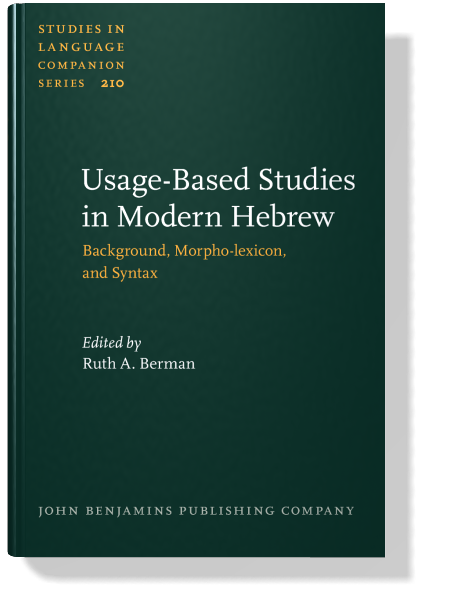
In:Usage-Based Studies in Modern Hebrew: Background, Morpho-lexicon, and Syntax
Edited by Ruth A. Berman
[Studies in Language Companion Series 210] 2020
► pp. 1–16
Introduction
Published online: 18 March 2020
https://doi.org/10.1075/slcs.210.01ber
https://doi.org/10.1075/slcs.210.01ber
Article outline
- Chapter summaries
- Part I.Background
- Part II.Morphology-lexicon
- Part III.Syntax
Notes References

References (46)
Armon-Lotem, Sharon, Danon, Gabi & Rothstein, Susan. 2008. Current Issues in Generative Hebrew Linguistics [Linguistik Aktuell/Linguistics Today 134]. Amsterdam: John Benjamins.
Bat-El, Outi. 2008. Morphologically conditioned V–Ø alternation in Hebrew: Distinction among nouns, adjectives & participles, and verbs. In Current Issues in Generative Hebrew Linguistics [Linguistik Aktuell/Linguistics Today 134], Sharon Armon-Lotem, Gabi Danon & Susan Rothstein (eds), 27–60. Amsterdam: John Benjamins.
Bat-El, Outi, Cohen, Evan G., & Faust, Noam. 2019. Phonetics and Phonology of Modern Hebrew. Brill’s Journal of Afroasiatic Languages and Linguistics [Special Issue of BJALL]. Leiden: Brill.
Beckner, Clay, Blythe, Richard, Bybee, Joan, Christiansen, Morten H., Croft, William, Ellis, Nick C., Holland, John, Ke, Jinyun, Larsen-Freeman, Diane & Schoenemann, Tom. 2009. Language is a complex adaptive system: Position paper. Language Learning 59(1): 1–26.
2008. The psycholinguistics of developing text construction. Journal of Child Language 35(4): 735–771.
2016. Typology, acquisition, and development: The view from Israeli
Hebrew. In Acquisition and Development of Hebrew: From Infancy to Adolescence [Trends In Language Acquisition Research 19], Berman Ruth A. (ed.), 1–38. Amsterdam: John Benjamins.
Berman, Ruth A. & Nir-Sagiv, Bracha. 2004. Linguistic indicators of inter-genre differentiation in later language
development. Journal of Child Language 31(2): 339–380.
Borer, Hagit. 1988. On the morphological parallelism between compounds and
constructs. In Yearbook of Morphology, Vol. I, Geert Booij & Jaap van Marle (eds), 45–65. Dordrecht: Foris.
. 2009. Compounds: Afro-Asiatic, Semitic: Hebrew. In The Oxford Handbook of Compounding, Rochelle Lieber & Pavol Štekauer (eds), 491–511. New York NY: OUP.
Bybee, Joan. 2009. Language universals and usage-based theory. In Language Universals, Morten H. Christiansen, Christopher Collins & Shimon Edelman (eds), 17–29. Oxford Scholarship Online.
Comrie, Bernard, Haspelmath, Martin & Bickel, Balthasar. 2015. The Leipzig Glossing Rules: Conventions for interlinear morpheme-by-morpheme
glosses. <
[URL]>
Corpus of Spoken Israeli Hebrew [CoSIH]. 2001–2002. <
[URL]> (5 February 2018).
Cristofaro, Sonia & Zúñiga, Fernando. 2018. Synchronic vs. diachronic approaches to typological
hierarchies. In Typological Hierarchies in Synchrony and Diachrony [Typological Studies in Language 121], Sonia Cristofaro & Fernando Zúñiga (eds), 3–27. Amsterdam: John Benjamins.
Croft, William, Bhattacharya, Tanmoy, Kleinschmidt, Dave, Smith, Eric D. & Jaeger, T. Florian. 2011. Greenbergian universals, diachrony and statistical analysis. Linguistic Typology 15(2): 433–453.
Dattner, Elitzur. 2008. Lower Transitivity Constructions in Hebrew: The Case of Motion Verbs. MA Thesis, Tel Aviv University.
. 2015. Enabling and allowing in Hebrew: A Usage-Based Construction Grammar
account. In Causation, Permission, and Transfer: Argument Realisation in get,
take, put, give and let Verbs [Studies in Language Companion Series 167], Brian Nolan, Gudrun Rawoens & Elike Diedrichsen (eds), 271–293. Amsterdam: John Benjamins. <
>
Doron, Edit. 2016. Language Contact and the Development of Modern Hebrew [Studies in Semitic Languages 84]. Leiden: Brill.
Doron, Edit & Meir, Irit. 2013. Construct state: Modern Hebrew. In The Encyclopedia of Hebrew Language and Linguistics, Vol. 1, Geoffrey Khan (ed.), 581–589. Leiden: Brill.
Evans, Nicholas & Levinson, Stephen. 2009. The myth of language universals: Language diversity and its importance for
cognitive science. Behavioral & Brain Sciences 32: 429–492.
Fillmore, Charles J., Kay, Paul & O’Connor, Catherine. 1988. Regularity and idiomaticity in grammatical constructions: The case of
let alone
. Language 64(3): 501–538.
Goldberg , Adele E. 1995. Constructions: A Construction Grammar Approach to Argument Structure. Chicago IL: University of Chicago Pres.
Greenberg, Joseph H. 1978. Diachrony, synchrony and language universals. In Universals of Human Language, Vol. 1, Joseph H. Greenberg, Charles F. Ferguson & Edith Moravcsik (eds), 61–91. Stanford CA: Stanford University Press.
Halevy, Rivka. 2013. Syntax: Modern Hebrew. In The Encyclopedia of Hebrew Language and Linguistics, Vol. 3, Geoffrey Khan (ed.), 707–723. Leiden: Brill.
Horvath, Julia, & Siloni, Tal. 2008. Active lexicon: Adjectival and verbal passives. In Current Issues in Generative Hebrew Linguistics [Linguistik Aktuell/Linguistics Today 134], Sharon Armon-Lotem, Gabi Danon & Susan Rothstein (eds), 105–134. Amsterdam: John Benjamins.
Jakubíček, Milos, Kilgarriff, Adam, Kovář, Vojtěch, Rychlý, Pavel & Suchomel, Vít. 2013. The TenTen corpus family. In
7th International Corpus Linguistics Conference CL
, 125–127.
Kemmer, Suzanne & Barlow, Michael. 2000. Introduction: A usage-based conception of language. In Usage-Based Models of Language, Michael Barlow & Suzanne Kemmer (eds), vii–xxviii. Stanford CA: CSLI.
Melnik, Nurit. 2006. A constructional approach to verb-initial constructions in Modern
Hebrew. Cognitive Linguistics 17(2): 153–198.
Nir (-Sagiv), Bracha. 2008. Clause-packages as Constructions in Developing Narrative Discourse. PhD dissertation, Tel Aviv University.
Preminger, Omer. 2009. Breaking agreements: Distinguishing agreement and clitic-doubling by their
failures. Linguistic Inquiry 40(4): 619–666.
Rabin, Chaim. 1963/2005. A Short History of the Hebrew Language. (Originally printed in 1963. Jerusalem: World Zionist Organization). <[URL]>
Rosén, Haiim B. 1956. haʕivrit šelanu – dmuta leʔor šitot habalšanut (Our Hebrew – Viewed in the Light of Linguistic Methodology). Tel Aviv: Am Oved.
Seroussi, Batia. 2011. The Morphology-Semantics Interface in the Mental Lexicon: The Case of Hebrew. PhD dissertation, Tel Aviv University.
Cited by (1)
Cited by one other publication
This list is based on CrossRef data as of 3 december 2025. Please note that it may not be complete. Sources presented here have been supplied by the respective publishers. Any errors therein should be reported to them.