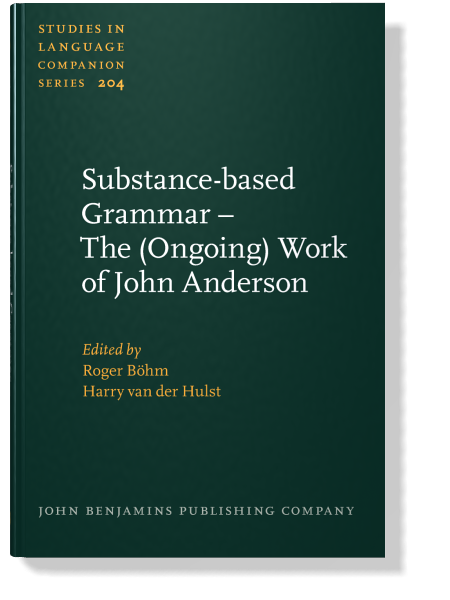
In:Substance-based Grammar – The (Ongoing) Work of John Anderson:
Edited by Roger Böhm and Harry van der Hulst
[Studies in Language Companion Series 204] 2018
► pp. 9–112
Investigating substance-based grammar
The grammar of semantic and grammatical relations – An interview with John M. Anderson
Published online: 12 December 2018
https://doi.org/10.1075/slcs.204.02and
https://doi.org/10.1075/slcs.204.02and
The interview, guided by Andor’s questions, focuses on the development of Anderson’s work and its relation to contemporaneous developments in linguistics. The topics covered include the evolution of case grammar and its localist manifestation, and the generalization of the latter into a re-statement of “notional grammar”. Anderson has proposed a grammar, both syntax and phonology, based on mental substance, crucially perceptional substance and its metaphorical application in lexicon and syntax to “abstract” mental domains, as illustrated by localism. Concepts invoked here are dependency, structural analogy between syntactic and phonological representations, valency, ergativity, and (cognitive) salience; and central is concern with the expression of semantic and grammatical relations, whether by morphological case, adpositions or syntactic sequence.

References (98)
Akimoto, Minoji & Brinton, Laurel. 1999. The origin of composite predicates in Old English. In Collocational and Idiomatic Aspects of Composite Predicates in the History of English [Studies in Language Companion Series 47], Laurel Brinton & Minoji Akimoto (eds), 21–58. Amsterdam: John Benjamins.
1998. The domain of semantic roles. In The Diversity of Linguistic Description: Studies in Linguistics in Honour of Béla Korponay, József Andor, Béla Hollósy, Tibor Laczkó & Péter Pelyvás (eds), 1–38. Debrecen: Kossuth University, Angol-Amerikai Intézet.
2005a. The argument structure of morphological causatives. Poznań Studies in Contemporary Linguistics 40: 27–89.
2005b. Structuralism and autonomy: From Saussure to Chomsky. Historiographia Linguistica 32: 117–148.
2012a. Types of lexical complexity in English: Syntactic categories and the lexicon. Studia Anglica Posnaniensia 47: 3–51.
2012b. Parasitic passives of intransitives in English. Token: A Journal of English Linguistics 1: 5–22.
2013a. What are ‘grammatical periphrases’? In Periphrasis, Replacement and Renewal: Studies in English Historical Linguistics, Irén Hegedűs & Dóra Pődör (eds), 14–33. Newcastle upon Tyne: Cambridge Scholars.
2013b. On so-called ‘conjunctions’ in English. Poznań Studies in Contemporary Linguistics 49: 41–77.
2014a. The grammar of figurativeness, with illustrations drawn from English. English Studies 95: 971–989.
2014b. Graphophonology and anachronic phonology: Notes on episodes in the history of pseudo-phonology. Folia Linguistica Historica 25: 1–53.
Anderson, John M. & Durand, Jacques (eds). 1987. Explorations in Dependency Phonology. Dordrecht: Foris.
Anderson, John M. & Jones, Charles 1974. Three theses concerning phonological representation. Journal of Linguistics 10: 1–26.
Anderson, Stephen R. 1976. The notion of subject in ergative languages. In Subject and Topic, Charles Li (ed), 3–23. New York NY: Academic Press.
Andor, József. 2010. The distribution of light verbs in English: An empirical, corpus-based study. British and American Studies 16: 189–201.
Böhm, Roger. 1993. Predicate-argument Structure, Relational Typology and (Anti)passives: Towards an Integrated Localist Case Grammar Account [Series A, No. 336]. Duisburg: LAUD.
Borg, Albert J. & Comrie, Bernard. 1984. Object diffuseness in Maltese. In Objects, Frans Plank (ed), 109–126. New York NY: Academic Press.
Bresnan, Joan & Kanerva, J. 1989. Locative inversion in Chicheva: A case study of factorization in grammar. Linguistic Inquiry 20: 1–50.
Carr, Philip, Durand, Jacques & Ewen, Colin (eds). 2005. Headhood, Elements, Specification and Contrastivity. Phonological papers in Honour of John Anderson [Current Issues in Linguistic Theory 259] Amsterdam: John Benjamins.
Colman, Fran. 2014. The grammar of Names in Anglo-Saxon England: The Linguistics and Culture of the Old English Onomasticon. Oxford: OUP.
Colman, Fran & Anderson, John M. 2004. On metonymy as word-formation: with special reference to Old English. English Studies 85: 547–565.
1982. Grammatical relations in Huichol. In Studies in Transitivity, Paul Hopper & Sandra Thompson (eds), 95–115. New York NY: Academic Press.
Cottingham, John. 1992. Cartesian dualism: Theology, metaphysics, and science. In The Cambridge Companion to Descartes, John Cottingham (ed), 236–257. Cambridge: CUP.
Darrigol, l’abbé J. P. 1829. Dissertation critique et apologétique sur la langue basque. Bayonne: Duhart-Fauvet.
Dumézil, Georges. 1967. Documents anatoliens sur les langues et les traditions du Caucase, V: Études abkhaz. Paris: Maisonneuve.
Fillmore, Charles J. 1966. A proposal concerning English prepositions. Georgetown University Monograph Series on Languages and Linguistics 19: 19–33.
1968. The case for case. In Universals in Linguistic Theory, Emmon Bach & Robert T. Harms (eds), 1–88. New York NY: Holt, Rinehart & Winston.
Fries, Charles C. 1952. The Structure of English: An Introduction to the Construction of English Sentences. London: Longmans, Green and Co.
Haspelmath, Martin. 2000. Periphrasis. In Morphologie/Morphology, Vol. I, Geert E. Booij, Christian Lehmann & Joachim Mugdan (eds), 654–664. Berlin: De Gruyter.
Hester, Thomas R. 1978. Some arguments against equi as a test for subject-of in Basque. Fontes Linguae Vasconum 28: 23–34.
Hjelmslev, Louis T. 1935/7. La catégorie des cas. Acta Jutlandica 7: i–xii, 1–184; 9: i–vii, 1–78. Reprinted 1972. Munich: Fink.
Hopper, Paul J. 1972. Verbless stative sentences in Indonesian. In The Verb ‘be’ and its Synonyms: Philosophical and Grammatical Studies, Vol. 5, John M. W. Verhaar (ed), 115–152. Dordrecht: Reidel.
Jespersen, Otto. 1942. A Modern English Grammar on Historical Principles, Vol. VI. London: Allen & Unwin & Copenhagen: Munksgaard.
Jessen, Marilyn E. 1975. A Semantic Study of Spatial and Temporal Expressions in English. PhD thesis, University of Edinburgh.
Keenan, Edward L. & Dryer, Matthew S. 2007. Passive in the world’s languages. In Language, Typology, and Syntactic Description (2nd edn.), Timothy Shopen (ed), 326–261. Cambridge: CUP.
Kiparsky, Paul. 2005. Blocking and periphrasis in inflectional paradigms. In Yearbook in Phonology 2004, Geert Booij & Jaap van Marle (eds), 115–135. Dordrecht: Springer.
Kleinschmidt, Samuel P. 1851. Grammatik der grönländischen sprache mit teilweisem einschluss des Labradordialekts. Berlin: G. Reimer.
Lafitte, Pierre. 1962. Grammaire basque (navarro-labourdin littéraire). Bayonne: Éditions des ‘Amis du Musée Basque’ et ‘Ikas’.
Law, Vivien. 1995. Wisdom, Authority and Grammar in the Seventh Century: Decoding Virgilius Maro Grammaticus. Cambridge: CUP.
Lazard, Gilbert. 1995. Typological research on actancy: The Paris RIVALC group. In Approaches to Language Typology, Masayoshi Shibatani & Theodora Bynon (eds), 167–213. Oxford: OUP.
Lepschy, Giulio (ed). 1998. History of Linguistics, III: Renaissance and Early Modern Linguistics. London: Longman.
Lyons, John. 1967. A note on possessive, existential and locative sentences. Foundations of Language 3: 390–396.
Marcus, Solomon. 1967. Algebraic Linguistics: Analytical Models [Mathematics in Science and Engineering 29]. New York NY: Academic Press.
Morpurgo Davies, Anna. 2014. History of Linguistics, IV: Nineteenth-century Linguistics. London: Routledge.
Pedersen, Holger. 1931. The Discovery of Language: Linguistic Science in the Nineteenth Century. Bloomington IN: Indiana University Press.
Percival, Keith W. 1972. On the non-existence of Cartesian linguistics. In Cartesian Studies, Ronald J. Butler (ed), 137–145. Oxford: Basil Blackwell.
Proceedings of the Philological Society, 6 Vols, 1842–1853. London: George Bell.
de Saussure, Ferdinand. 1922. Cours de linguistique générale, publié par Charles Bally et Albert Sechehaye, avec la collaboration de Albert Riedlinger, 2nd edn. Paris: Payot.
Starosta, Stanley. 1988. The Case for Lexicase: An Outline of Lexicase Grammatical Theory. London: Pinter.
van der Hulst, Harry. 1994. Radical CV phonology: The locational gesture. UCL Working Papers in Linguistics 6: 439–477.
. 1995. Radical CV phonology: The categorial gesture. In Frontiers of Phonology: Atoms, Structures, Derivations, Jacques Durand & Francis Katanga (eds), 80–116. London: Longman.
. 2005. The molecular structure of phonological segments. In Headhood, Elements, Specification and Contrast. Phonological Papers in Honour of John Anderson [Current Issues in Linguistic Theory 259], Philip Carr, Jacques Durand & Colin J. Ewen (eds), 193–234. Amsterdam: John Benjamins.
Cited by (7)
Cited by seven other publications
Aurnague, Michel
Bassac, Christian
2018. The substance of the lexicon in a Generative Lexicon. In Substance-based Grammar – The (Ongoing) Work of John Anderson [Studies in Language Companion Series, 204], ► pp. 201 ff.
Böhm, Roger
2018. Just for the record. In Substance-based Grammar – The (Ongoing) Work of John Anderson [Studies in Language Companion Series, 204], ► pp. 261 ff.
Colman, Fran
2018. Entitatives and Indo-European n-stems. In Substance-based Grammar – The (Ongoing) Work of John Anderson [Studies in Language Companion Series, 204], ► pp. 225 ff.
Fortis, Jean-Michel
2018. Anderson’s case grammar and the history of localism. In Substance-based Grammar – The (Ongoing) Work of John Anderson [Studies in Language Companion Series, 204], ► pp. 113 ff.
Trousdale, Graeme
2018. Figurativeness in English grammar. In Substance-based Grammar – The (Ongoing) Work of John Anderson [Studies in Language Companion Series, 204], ► pp. 311 ff.
This list is based on CrossRef data as of 3 december 2025. Please note that it may not be complete. Sources presented here have been supplied by the respective publishers. Any errors therein should be reported to them.