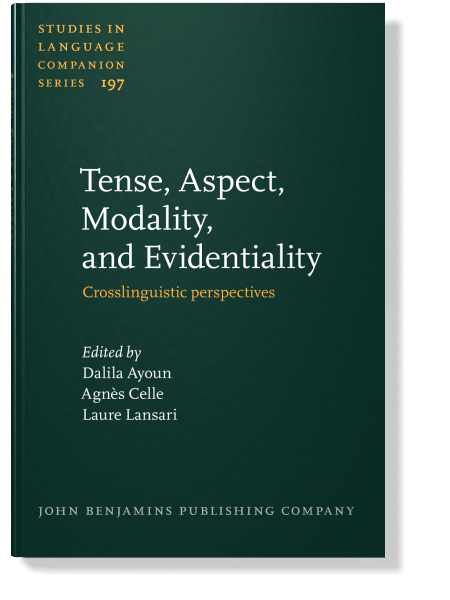
In:Tense, Aspect, Modality, and Evidentiality: Crosslinguistic perspectives
Edited by Dalila Ayoun, Agnès Celle and Laure Lansari
[Studies in Language Companion Series 197] 2018
► pp. 239–260
Chapter 11Non-finiteness, complementation and evidentiality
The Lithuanian Accusativus cum Participio in a cross-linguistic perspective
Published online: 2 August 2018
https://doi.org/10.1075/slcs.197.11uso
https://doi.org/10.1075/slcs.197.11uso
Abstract
The relatedness of non-finite constructions and evidentiality has been observed in various European languages. Passive matrix verbs plus infinitive in English, the corresponding though less productive pattern in Dutch, reportive passives in Danish, and evidential participial constructions in Lithuanian have all received attention in the literature. We continue this line of investigation, focussing on the Accusativus cum Participio, found in contemporary Lithuanian only with verbs of communication, cognition and perception. Our quantitative and qualitative corpus-based analysis investigates its distribution in different types of discourse and provides evidence to support the claim that the use of the non-agreeing ‘be’-participle is obligatory because it marks a proposition. We compare our account with similar uses of non-finite verb in other languages.
Keywords: Lithuanian, accusative plus participle, proposition, finiteness, Latin
Article outline
- 1.Introduction
- 2.Data and method
- 3.Types of participles and the AcP construction
- 4.Results and discussion
- 5.Concluding remarks
Acknowledgement List of abbreviations Notes Data sources References

References (37)
CCLLCorpus of the Contemporary Lithuanian Language – <[URL]>
CorALit Corpus of Academic Lithuanian (Corpus Academicum Lithuanicum – <[URL]>)
Ambrazas, Vytautas. 1990. Lietuvių kalbos dalyvių istorinė sintaksė [Historical Syntax of Participles in the Lithuanian Language]. Vilnius: Mokslas.
Arkadiev, Peter. 2012. Participial complementation in Lithuanian. In Clause-linkage in Cross- linguistic Perspective: Data-driven Approaches to Cross-clausal Syntax, Volker Gast & Holger Diessel (eds), 285–334. Berlin: Mouton de Gruyter.
Borkin, Ann. 1973.
To be or not to be
. Papers from the Ninth Regional Meeting Chicago Linguistic Society, Claudia Corum, T. Cedric Smith-Stark & Ann Weiser (eds), 44–56. Chicago IL: CLS.
Boye, Kasper & Harder, Peter. 2009. Evidentiality. Linguistic categories and grammaticalization. Functions of Language 6(1): 9–43.
Boye, Kasper. 2012. Epistemic Meaning. A Crosslinguistic and Functional-cognitive Study. Berlin: Mouton de Gruyter.
Cuzzolin, Pierluigi. 1994.
Sull’origine della costruzione dicere quod: Aspetti sintattici e semantici
. Florence: La nuova Italia.
Dik, Simon C. & Hengeveld, Kees. 1991. The hierarchical structure of the clause and the typology of perception-verb complements. Linguistics 29: 231–259.
Felser, Claudia. 1998. Perception and control: A Minimalist analysis of English direct perception complements. Journal of Linguistics 34: 351–385.
Greco, Paolo. 2013. Latin Accusativus cum Participio: Syntactic description, evidential values and diachronic development. Journal of Latin Linguistics 12: 173–198.
Lavine, E. James. 2010. Mood and a transitivity restriction in Lithuanian: The case of the inferential evidential. Baltic Linguistics 1: 115–142.
Lowe, John M. 2015. Participles in Rigvedic Sanskrit. The Syntax and Semantics of Adjectival Verb Forms. Oxford: OUP.Lyons, John. 1977. Semantics, Vol. 2. Cambridge: CUP.
Noël, Dik. 2001. The passive matrices of English infinitival complement clauses. Evidentials on the road to auxiliarihood. Studies in Language 25: 255–296.
Noël, Dirk & Colleman, Timothy. 2010.
Believe-type raising-to-object and raising-to-subject verbs in English and Dutch. A contrastive investigation in diachronic construction grammar. International Journal of Corpus Linguistics 15(2): 157–182.
Noonan, Michael. 1987. Complementation. In Language Typology and Syntactic Description. Vol. 2, Timothy Shopen (ed.), 42–140. Cambridge: CUP.
Nuyts, Jan. 2001. Epistemic Modality, Language, and Conceptualization. A Cognitive-Pragmatic Perspective [Human Cognitive Processing 5]. Amsterdam: John Benjamins.
Ørsnes, Bjarne. 2011. Passives and evidentiality: Danish reportive passives and their equivalents in German. Acta Linguistica Hafniensia 43(1): 21–59.
Spraunienė, Birutė, Razanovaitė, Auksė & Jasionytė, Erika. 2015. Solving the puzzle of the Lithuanian passive. In Voice and Argument Structure in Baltic [Valency, Argument Realization and Grammatical Relations in Baltic 3], Axel Holvoet & Nicole Nau (eds), 323–365. Amsterdam: John Benjamins.
Tasmowski, Liliane. 1989. A look at sembler + infinitive from different Angles. In Sentential Complementation and the Lexicon. Studies in Honour of Wim de Geest, Dany Jaspers, Dany, Wim Klooster, Yvan Putseys & Pieter Seuren (eds), 403–438. Dordrecht: Foris.
Usonienė, Aurelija & Šinkūnienė, Jolanta. 2017. Potential vs use: Revisiting an evidential participial construction in Lithuanian. In Evidentiality Revisited: Cognitive Grammar, Functional and Discourse-Pragmatic Perspectives [Pragmatics & Beyond New Series, 271], Juana I. Marín-Arrese, Gerda Haβler & Marta Carretero (eds), 297–340. Amsterdam: John Benjamins.
Verspoor, Marjolijn. 1996. The story of –ing: A subjective perspective. In The Construal of Space in Language and Thought, Martin Pütz & René Dirven (eds), 417–454. Berlin: Mouton de Gruyter.
. 2000. Iconicity in English complement constructions. In Complementation. Cognitive and Functional Perspectives [Converging Evidence in Language and Communication Research 1] Kaoru Horie (ed.), 199–225. Amsterdam: John Benjamins.
Wälchli, Bernhard. 2000. Infinite predication as a marker of evidentiality and modality in the languages of the Baltic Region. STUF 53(2): 186–210.
Wiemer, Björn. 2006. Grammatical evidentiality in Lithuanian (A typological assessment). Baltistica 36: 33–49.
. 2010. Hearsay in European languages: Toward an integrative account of grammatical and lexical marking. In Linguistic Realization of Evidentiality in European Languages, Gabriele Diewald & Elena Smirnova, 59–130. Berlin: Mouton de Gruyter.
Wiemer, Björn & Stathi, Katerina. 2010. The database of evidential markers in European languages. A bird’s eye view of the conception of the database (The template and problems hidden beneath it). STUF 63(4): 275–289.
Willett, Thomas. 1988. A cross-linguistic survey of the grammaticization of evidentiality. Studies in Language 12(1): 51–97.