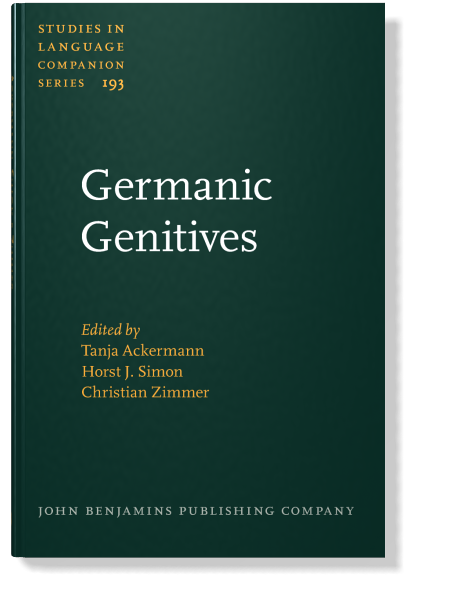
In:Germanic Genitives
Edited by Tanja Ackermann, Horst J. Simon and Christian Zimmer
[Studies in Language Companion Series 193] 2018
► pp. 275–299
Genitives and proper name compounds in German
Published online: 26 April 2018
https://doi.org/10.1075/slcs.193.10sch
https://doi.org/10.1075/slcs.193.10sch
Abstract
This paper deals with an issue related to the syntax-morphology interface, namely the comparison of proper name compounds and genitives in German. It has been claimed in the literature that proper name compounds have recently increased in use at the expense of the genitive. For this reason, proper name compounds are sometimes considered as competitors to the genitive. A prerequisite for this assumption is that both constructions are equivalent with respect to meaning and function. The paper examines the relevant properties of both constructions. It is argued that there is no true meaning equivalence between proper name compounds and genitives. However, specific subtypes of proper name compounds and genitives that exhibit a substantial amount of semantic overlap are identified. It is discussed under which circumstances they can be used interchangeably.
Article outline
- 1.Introduction
- 2.Genitives and compounds: Morphological and syntactic properties
- 2.1Genitives
- 2.2Compounds
- 3.Genitives and compounds: Semantic properties
- 4.Semantic overlap between proper name compounds and genitives
- 5.Restrictions on proper name compounding
- 6.Conclusion
Notes References

References (55)
Ackerman, Tanja. 2018. From genitive inflection to possessive marker? The development of German possessive -s with personal names. In this volume.
Ackermann, Tanja & Zimmer, Christian. 2017. Morphologische Schemakonstanz – Eine empirische Untersuchung zum funktionalen Vorteil nominalmorphologischer Wortschonung im Deutschen. In Sichtbare und hörbare Morphologie [Linguistische Arbeiten 565], Nanna Fuhrhop, Renata Szczepaniak & Karsten Schmidt (eds), 145–176. Berlin: De Gruyter.
Briegleb, Otto. 1928. Vom Wesen der Zusammensetzung. (Zusammensetzung mit der Mehrzahl?). Meinigen: Renßner’sche Hofbuchdruckerei.
. 1932. Wider die Entartung der Sprache durch Erstarrung – falsche Zusammensetzung – Wortverstümmelung. Leipzig: Brandstetter.
Carstensen, Broder. 1965. Englische Einflüsse auf die deutsche Sprache nach 1945. Heidelberg: Winter.
Carstensen, Broder & Galinsky, Hans. 1963. Amerikanismen der deutschen Gegenwartssprache. Entlehnungsvorgänge und ihre stilistischen Aspekte. Heidelberg: Winter.
Demske, Ulrike. 2001. Merkmale und Relationen. Diachrone Studien zur Nominalphrase des Deutschen [Studia Linguistica Germanica 56]. Berlin: De Gruyter.
Eisenberg, Peter. 2006. Grundriss der deutschen Grammatik, Band 2: Der Satz, 3rd edn. Stuttgart: Metzler.
Eisenberg, Peter & Smith, George. 2002. Der einfache Genitiv: Eigennamen als Attribute. In Grammatik und Grammatikvermittlung, Corinna Peschel (ed.), 113–126. Frankfurt: Peter Lang.
Fuhrhop, Nanna. 1998. Grenzfälle morphologischer Einheiten [Studien zur Deutschen Grammatik 57]. Tübingen: Stauffenburg.
Fuß, Eric. 2011. Eigennamen und adnominaler Genitiv im Deutschen. Linguistische Berichte 225: 19–42.
Gallmann, Peter. 1989. Syngrapheme an und in Wortformen. Bindestrich und Apostroph im Deutschen. In Schriftsystem und Orthographie [Reihe Germanistische Linguistik 97], Peter Eisenberg & Hartmut Günther (eds), 85–110. Tübingen: Niemeyer.
Gunkel, Lutz & Zifonun, Gisela. 2011. Klassifikatorische Modifikation im Deutschen und Französischen. In Comparatio Delectat: Akten der VI. Internationalen Arbeitstagung zum romanisch-deutschen und innerromanischen Sprachvergleich: Innsbruck, 3.‒5. September 2008, Eva Lavric, Wolfgang Pöckl & Florian Schallhart (eds), 549–562. Frankfurt: Peter Lang.
Haspelmath, Martin. 2011. The indeterminacy of word segmentation and the nature of morphology and syntax. Folia Linguistica 45: 31–80.
Huddleston, Rodney D. & Pullum, Geoffrey K. 2002. The Cambridge Grammar of the English Language. Cambridge: CUP.
Jackendoff, Ray. 2009. Compounding in the parallel architecture and conceptual semantics. In The Oxford Handbook of Compounding, Rochelle Lieber & Pavol Štekauer (eds), 105–128. Oxford: OUP.
Kann, Hans-Joachim. 1972. Bemerkungen zum Wortbildungsmuster “Name+Substantiv” (“Holland-Hähnchen”). Muttersprache 82: 290–298.
Koehn, Philipp. 2005. Europarl: A Parallel Corpus for Statistical Machine Translation. Ms, University of Edinburgh. <[URL]> (04 June 2017)
Koptjevskaja-Tamm, Maria. 2009. Proper-name compounds in Swedish between syntax and lexicon. Rivista di Linguistica/Italian Journal of Linguistics 21: 119–148.
. 2013. A Mozart sonata and the Palme murder: The structure and uses of proper-name compounds in Swedish. In Morphosyntactic Categories and the Expression of Possession [Linguistik Aktuell/Linguistics Today 199], Kersti Börjars, David Denison & Alan K. Scott (eds), 253–290. Amsterdam: John Benjamins.
Krott, Andrea, Schreuder, Robert, Baayen, Harald R. & Dressler, Wolfgang U. 2007. Analogical effects on linking elements in German compound words. Language and Cognitive Processes 22: 25–57.
Kürschner, Sebastian. 2005. Verfugung‑s-nutzung kontrastiv: Zur Funktion der Fugenelemente im Deutschen und Dänischen. Tijdschrift voor Skandinavistiek 26: 101–125.
Motsch, Wolfgang. 2004. Deutsche Wortbildung in Grundzügen [Schriften des Instituts für Deutsche Sprache 8], 2nd edn. Berlin: De Gruyter.
Nübling, Damaris. 2014. Sprachverfall? Sprachliche Evolution am Beispiel des diachronen Funktionszuwachses des Apostrophs im Deutschen. In Sprachverfall? Dynamik, Wandel, Variation [Institut für Deutsche Sprache Jahrbuch 2013], Albrecht Plewnia & Andreas Witt (eds), 99–123. Berlin: De Gruyter.
Nübling, Damaris, Fahlbusch, Fabian & Heuser, Rita. 2012. Namen. Eine Einführung in die Onomastik. Tübingen: Narr.
Nübling, Damaris & Schmuck, Miriam. 2010. Entstehung des s-Plural bei Eigennamen als Reanalyse vom Kasus- zum Numerusmarker. Evidenzen aus der deutschen und niederländischen Dialektologie. Zeitschrift für Dialektologie und Linguistik 77: 145–182.
Olsen, Susan. 2000. Composition. In Morphologie: ein internationales Handbuch zur Flexion und Wortbildung/Morphology: an International Handbook on Inflection and Word-Formation [Handbücher zur Sprach- und Kommunikationswissenschaft/ Handbooks of Linguistics and Communication Science 17/1], Geert Booij, Christian Lehmann & Joachim Mugdan (eds), 897–916. Berlin: De Gruyter.
Ortner, Lorelies & Müller-Bollhagen, Elgin. 1991. Deutsche Wortbildung: Typen und Tendenzen in der Gegenwartssprache. Vierter Hauptteil: Substantivkomposita [Sprache der Gegenwart: Schriften des Instituts für Deutsche Sprache 79], Berlin: De Gruyter.
Peschke, Simone. 2014.
Merkels Politik vs. die Politik Merkels
. In Linguistik der Familiennamen [Germanistische Linguistik 225‒227], Friedhelm Debus, Rita Heuser & Damaris Nübling (eds), 233–248. Hildesheim: Olms.
Plank, Frans. 2011. Differential time stability in categorial change: Family names from nouns and adjectives, illustrated from German. Journal of Historical Linguistics 1: 269–292.
Ronneberger-Sibold, Elke. 2004. Warennamen. In Namenarten und ihre Erforschung: Ein Lehrbuch für das Studium der Onomastik; Anlässlich des 70. Geburtstages von Karlheinz Hengst, Andrea Brendler & Silvio Brendler (eds), 557–603. Hamburg: Baar.
Rosenbach, Anette. 2006. Descriptive genitives in English: A case study on constructional gradience. English Language and Linguistics 10: 77–118.
. 2007. Emerging variation: Determiner genitives and noun modifiers in English. English Language and Linguistics 11: 143–189.
. 2010. How synchronic gradience makes sense in the light of language change. In Gradience, Gradualness and Grammaticalization [Typological Studies in Language 90], Elizabeth Closs Traugott & Graeme Trousdale (eds), 149–179. Amsterdam: John Benjamins.
Schäfer, Roland. 2015. Processing and querying large web corpora with the COW14 architecture. In Proceedings of the 3rd Workshop on Challenges in the Management of Large Corpora (CMLC-3), Piotr Bański, Hanno Biber, Evelyn Breiteneder, Marc Kupietz, Harald Lüngen & Andreas Witt (eds), 28–34. Mannheim: Institut für Deutsche Sprache.
Schäfer, Roland & Bildhauer, Felix. 2012. Building large corpora from the web using a new efficient tool chain. Proceedings of the LREC 2012, 20–27 May 2012, 486–493. Istanbul.
. 2017. Eigennamenkomposita im Deutschen. In Namengrammatik [Linguistische Berichte 21], Johannes Helmbrecht, Damaris Nübling & Barbara Schlücker (eds), 59–93. Hamburg: Buske.
Scott, Alan K. 2014. The Genitive Case in Dutch and German: A Study of Morphosyntactic Change in Codified Languages [Brill’s Studies in Historical Linguistics 2]. Leiden: Brill.
Sugarewa, Tekla. 1974. Adjektivderivate zu Eigennamen und ihre Konkurrenz mit Substantivkomposita und syntaktischen Wortverbindungen. Beiträge zur Geschichte der deutschen Sprache und Literatur (PBB) 94: 199–256.
Taylor, John R. 1996. Possessives in English. An Exploration in Cognitive Grammar. Oxford: Clarendon Press.
Ward, Gregory, Sproat, Richard & McKoon, Gail. 1991. A pragmatic analysis of so-called anaphoric islands. Language 67: 439–474.
Warren, Beatrice. 1978. Semantic Patterns of Noun-Noun Compounds. [Gothenburg Studies in English 41]. Göteborg: Acta Universitatis Gothoburgensis.
Wildgen, Wolfgang. 1981. Grundstrukturen und Variationsmöglichkeiten bei Eigennamenkomposita: Komposita mit den Eigennamen “Schmidt” und “Strauß” als Konstituenten in Wahlkampfberichten des SPIEGELs [Series A, Paper No. 82]. Trier: Linguistic Agency University of Trier.
Wustmann, Gustav. 1891. Allerlei Sprachdummheiten. Kleine deutsche Grammatik des Zweifelhaften, des Falschen und des Häßlichen. Leipzig: Grunow.
Zifonun, Gisela. 2010a. Von Bush administration zu Kohl-Regierung: Englische Einflüsse auf deutsche Nominalkonstruktionen? In Strategien der Integration und Isolation nicht-nativer Einheiten und Strukturen [Linguistische Arbeiten 532], Carmen Scherer & Anke Holler (eds), 165–182. Berlin: De Gruyter.
Zimmer, Christian. 2018. On the motivation of genitive-s omission in Contemporary German. In this volume.
Cited by (13)
Cited by 13 other publications
Frankowsky, Maximilian & Barbara Schlücker
Julien, Marit & Dorian Roehrs
Ursini, Francesco-Alessio & Giuseppe Samo
Ursini, Francesco-Alessio & Yue Sara Zhang
Kosmata, Eva & Barbara Schlücker
Schlücker, Barbara
BREBAN, TINE & JULIA KOLKMANN
BREBAN, TINE, JULIA KOLKMANN & JOHN PAYNE
ROSENBACH, ANETTE
ROSENBACH, ANETTE
Ackermann, Tanja
2018. From genitive inflection to possessive marker?. In Germanic Genitives [Studies in Language Companion Series, 193], ► pp. 189 ff.
Gallmann, Peter
2018. The Genitive Rule and its background. In Germanic Genitives [Studies in Language Companion Series, 193], ► pp. 149 ff.
Kopf, Kristin
2018. From genitive suffix to linking element. In Germanic Genitives [Studies in Language Companion Series, 193], ► pp. 91 ff.
This list is based on CrossRef data as of 3 december 2025. Please note that it may not be complete. Sources presented here have been supplied by the respective publishers. Any errors therein should be reported to them.