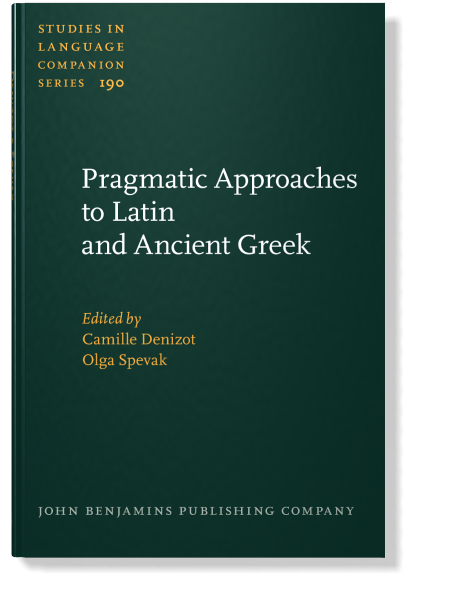
In:Pragmatic Approaches to Latin and Ancient Greek
Edited by Camille Denizot and Olga Spevak
[Studies in Language Companion Series 190] 2017
► pp. 273–302
Chapter 13Ancient Greek adversative particles in contrast
Published online: 1 November 2017
https://doi.org/10.1075/slcs.190.13all
https://doi.org/10.1075/slcs.190.13all
Abstract
Ancient Greek is a language which abounds in discourse particles showing a wide range of functions. This paper aims at analyzing the semantic differences between the most frequent adversative particles in Greek: allá, kaítoi, méntoi and mé:n. Drawing on a number of functionally and cognitively-oriented theoretical approaches to pragmatics, I will argue that these particles can best be analyzed as polysemous networks of semantic extensions resulting from the semanticization of contextually evoked pragmatic inferences. I will also argue that the semantic distinction between the various adversative particles can be insightfully described in terms of discourse-pragmatic notions such as common ground, topos, discourse act and move.
Article outline
- 1.Introduction and theoretical background
- 2.A typology of adversative relations
- 3. Allá
- 4. Méntoi
- 5. Kaítoi
- 6. Mé:n
- 7.Conclusions
Notes References

References (43)
Allan, Rutger J. 2013. Exploring modality’s semantic space: Grammaticalisation, subjectification and the case of ὀφείλω. Glotta: 1–46.
2016. Tense and aspect in classical Greek. Two historical developments: Augment and perfect. In The Greek Verb Revisited. A Fresh Approach to Biblical Exegesis, Steven E. Runge & Christopher J. Fresch (eds), 81–121. Bellingham: Lexham Press.
Forthcoming. The history of the future. In The Greek Future and its History, Frédéric Lambert, Rutger J. Allan & Theodore Markopoulos (eds). Louvain: Peeters.
Bakker, Egbert J. 1993. Boundaries, topics and the structure of discourse. An onvestigation of the Ancient Greek particle de
. Studies in Language 17(2): 275–311.
Basset, Louis. 1997. Ἀλλ’ ἐξόλοισθ’ αὐτῷ κοαξ. Réexamen des emplois de ἀλλά dans les Grenouilles d’Aristophane. In New Approaches to Greek particles, Albert Rijksbaron (ed.), 75–99. Amsterdam: J. C. Gieben.
Biber, Douglas. 1993. Co-occurrence patterns among collocations: A tool for corpus-based lexical knowledge acquisition. Computational Linguistics 19(3): 531–8.
Bonifazi, Anna. 2012. Homer’s Versicolored Fabric. The Evocative Power of Ancient Greek Epic Word-Making. Cambridge MA: Center for Hellenic Studies.
Drummen, Annemieke. 2009. Discourse cohesion in dialogue. Turn-initial ἀλλά in Greek Drama. In Discourse Cohesion in Ancient Greek, Stéphanie J. Bakker & Gerry C. Wakker (eds), 135–69. Leiden: Brill.
. 2015. Dramatic Pragmatics. A Discourse Approach to Particle Use in Ancient Greek Tragedy and Comedy. PhD dissertation, University of Heidelberg.
Gries, Stephan T. 2010. Behavioral profiles: A fine-grained and quantitative approach in corpus-based lexical semantics. The Mental Lexicon 5(3): 323–46.
2015. Polysemy. In Handbook of Cognitive Linguistics, Ewa Dąbrowska & Dagmar Divjak (eds), 472–490. Berlin: Mouton de Gruyter.
Hengeveld, Kees & Mackenzie, J. Lachlan. 2008. Functional Discourse Grammar. A Typologically-based Theory of Language Structure. Oxford: OUP.
Jacquinod, Bernard. 1997. Sur le rôle pragmatique de καίτοι. In New Approaches to Greek Particles, Albert Rijksbaron (ed.), 131–49. Amsterdam: J. C. Gieben.
Kroon, Caroline. 1995. Discourse Particles in Latin. A Study of nam, enim, autem, vero and at. Amsterdam: J. C. Gieben.
Langacker, Ronald W. 1987. Foundations of Cognitive Grammar, Vol I: Theoretical Prerequisites. Stanford CA: Stanford University Press.
Lakoff, Robin T. 1971. Ifs, ands and buts about conjunction. In Studies in Semantics, Charles Fillmore & Terence Langendoen (eds), 114–49. Berlin: De Gruyter.
Malchukov, Andrej. 2004. Towards a semantic typology of adversative and contrastive marking. Journal of Semantics 21: 177–198.
Mann, William C. & Thompson, Sandra. A. 1988. Rhetorical structure theory. Towards a functional theory of text organization. TEXT 8(3): 243–81.
Mauri, Caterina. 2008. Coordination Relations in the Languages of Europe and Beyond. Berlin: Mouton de Gruyter.
Mosegaard Hansen, Maj-Britt. 1998. The Function of Discourse Particles. A Study with Special Reference to Spoken Standard French. [Pragmatics and Beyond New Series 53]. Amsterdam: John Benjamins.
Riemer, Nick. 2005. The Semantics of Polysemy: Reading Meaning in English and Warlpiri. Berlin: Mouton de Gruyter.
Rudolph, Elisabeth. 1996. Contrast. Adversative and Concessive Expressions on Sentence and Text Level. Berlin: De Gruyter.
Sanders, Ted, Spooren, Wilbert & Noordman, Leo. 1992. Toward a taxonomy of coherence relations. Discourse processes 15(1): 1–35.
Sicking, Chistiaan & van Ophuijsen, Johannes M. 1993. Two Studies in Attic particle usage. Leiden: Brill.
Slings, Simon R. 1997. Adversative relators between PUSH and POP. In New Approaches to Greek Particles, Albert Rijksbaron (ed.), 101–29. Amsterdam: Gieben.
Strassler, Robert B. (ed.). 1998. The Landmark Thucydides. A Comprehensive Guide to the Peloponnesian War. New York NY: Touchstone.
Traugott, Elizabeth C. 1999. The role of pragmatics in semantic change. In Pragmatics in 1998: Selected Papers from the 6th International Pragmatics Conference, Vol. II, Jef Verschueren (ed.), 93–102, Antwerp: International Pragmatics Association.
2004. Historical pragmatics. In The Handbook of Pragmatics, Laurence R. Horn & Gregory Ward (eds), 538–61, Oxford: Blackwell.
Cited by (3)
Cited by three other publications
Breunesse, Merlijn & Margherita Fantoli
Sluiter, Ineke
This list is based on CrossRef data as of 3 december 2025. Please note that it may not be complete. Sources presented here have been supplied by the respective publishers. Any errors therein should be reported to them.