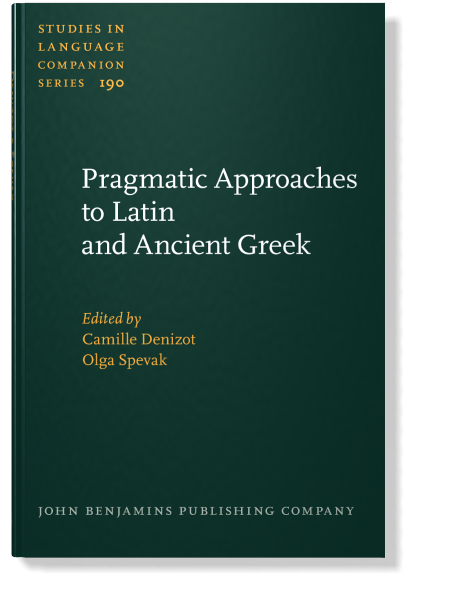
In:Pragmatic Approaches to Latin and Ancient Greek
Edited by Camille Denizot and Olga Spevak
[Studies in Language Companion Series 190] 2017
► pp. 1–14
Chapter 1Pragmatics in Latin and Ancient Greek
An introduction
Published online: 1 November 2017
https://doi.org/10.1075/slcs.190.01spe
https://doi.org/10.1075/slcs.190.01spe
Article outline
- 1.Introduction
- 2.Speech acts
- i.Interpersonal relations and politeness
- ii.Pragmatic markers
- 3.Constituent order
- 4.Conjunctions, connectors, and particles
- 5.Conclusions
Acknowledgements Notes References

References (65)
Abraham, Werner. 2016. Discourse marker = discourse particle = thetical = modal particle? A futile comparison. In Discourse Particles. Formal Approaches to their Syntax and Semantics [Linguistische Arbeiten 564], Josef Bayer & Volker Struckmeier (eds), 241–280. Berlin: Walter de Gruyter.
Aijmer, Karin. 2013. Understanding Pragmatic Markers: A Variational Pragmatic Approach. Edinburgh: EUP.
Allan, Keith & Jaszczolt, Kasia M. 2012 (eds). The Cambridge Handbook of Pragmatics. Cambridge: CUP.
Bakker, Stephanie. 2009. The Noun Phrase in Ancient Greek: A Functional Analysis of the Order and Articulation of NP Constituents in Herodotus [Amsterdam Studies in Classical Philology 15]. Leiden: Brill.
Bakker, Stephanie & Wakker, Gerry (eds). 2009. Discourse Cohesion in Ancient Greek [Amsterdam Studies in Classical Philology 16]. Leiden: Brill.
Biraud, Michèle. 2010. Les interjections du théâtre grec antique. Étude sémantique et pragmatique. Louvain-la-Neuve: Peeters.
Bolkestein, A. Machtelt. 1998. What to do with topic and focus? Evaluating pragmatic information. In Functional Grammar and Verbal Interaction [Studies in Language Companion Series 44], Mike Hannay & A. Machtelt, Bolkestein (eds), 193–214. Amsterdam: John Benjamins.
Bonifazi, Anna, Drummen, Annemieke & de Kreij, Mark. 2016. Particles in Ancient Greek Discourse: Five Volumes Exploring Particle Use across Genres [Hellenic Studies Series 74]. Washington DC: Center for Hellenic Studies. <[URL]> (24 November 2016).
Broth, Mathias & Mondada, Lorenza. 2013. Walking away: The embodied achievement of activity closings in mobile interaction. Journal of Pragmatics 47(1): 41–58.
Brown, Penelope & Levinson, Stephen C. 1987. Politeness, Some Universals in Language Usage, 2nd edn. Cambridge: CUP.
Cabrillana, Concepción. 1999. Type of text, pragmatic function and constituent order: A comparative study between the Mulomedicina Chironis and the Peregrinatio Egeriae
. In Latin vulgaire-latin tardif V, Hubert Petersmann & Rudolf Kettemann (eds), 319–30. Winter: Heidelberg.
Culpeper, Jonathan (ed.). 2011. Historical Sociopragmatics [Benjamins Current Topics 31]. Amsterdam: John Benjamins.
Denizot, Camille. 2011. Donner des ordres en grec ancien: Étude linguistique des formes de l’injonction. Mont-Saint-Aignan: Publications des Universités de Rouen et du Havre.
. 2012. Impolite orders in Ancient Greek? The οὐκ ἐρεῖς; type. Journal of Historical Pragmatics 13(1): 110–28.
Devine, Andrew M. & Stephens, Laurence D. 2006. Latin Word Order. Structured Meaning and Information. Oxford: OUP.
. 2012. The rules of politeness and Latin request formulae. In Laws and Rules in Indo-European, Philomen Probert & Andreas Willi (eds), 313–28. Oxford: OUP.
Dik, Helma. 1995. Word Order in Ancient Greek: A Pragmatic Account of Word Order Variation in Herodotus. Amsterdam: J. C. Gieben.
Dik, Simon. 1997. The Theory of Functional Grammar, 2 Vols., 2nd edn revised by Kees Hengeveld. Berlin: Mouton de Gruyter.
Dostie, Gaétane. 2004. Pragmaticalisation et marqueurs discursifs: Analyse sémantique et traitement lexicographique. Brussels: De Boeck-Duculot.
Ducrot, Oswald. 1998. Dire et ne pas dire. Principes de sémantique linguistique, 3rd edn. Paris: Hermann.
Fraser, Bruce. 1998. Pragmatic research: Methodological issues. In Concise Encyclopedia of Pragmatics, Jacob L. Mey (ed.), 710–12. Amsterdam: Elsevier.
Grice, H. Paul. 1975. Logic and conversation. In Syntax and Semantics 3: Speech Acts, Peter Cole & Jerry L. Morgan (eds), 41–58. New York NY: Academic Press.
Hand, Ferdinand G. 1829–1845. Tursellinus seu de particulis Latinis commentarii, 4 Vols. Leipzig: Weidmann (reprint 1969, Amsterdam, Hakkert).
Herring, Susan C., van Reenen, Pieter & Schøsler, Lene. 2000. Textual Parameters in Older Languages [Amsterdam Studies in the Theory and History of Linguistic Science. Series 4; Current Issues in Linguistic Theory 195]. Amsterdam: John Benjamins.
Jucker, Andreas H. 1994. The feasibility of historical pragmatics. Journal of Pragmatics 22: 533–536.
Kroon, Caroline. 1995. Discourse Particles in Latin: A Study of nam, enim, autem, vero and at. Amsterdam: Gieben.
Mey, Jacob L. 1998. Pragmatics. In Concise Encyclopedia of Pragmatics, Jacob L. Mey (ed.), 716–34. Amsterdam: Elsevier.
Muchnová, Dagmar. 2011. Entre conjonction, connecteur et particule: Le cas de ἐπεί en grec ancien. Étude syntaxique, sémantique et pragmatique. Prague: Karolinum.
Panhuis, Dirk. 1982. The Communicative Perspective in the Sentence: A Study of Latin Word Order [Studies in Language Companion Series 11]. Amsterdam: John Benjamins.
Pinkster, Harm. 1991. Evidence for SVO in Latin? In Latin and the Romance Languages in the Early Middle Ages, Roger Wright (ed.), 69–82. London: Routledge.
. 1990/1995.
Sintaxis y semántica del latín, revised and enhanced edn. of Latin Syntax and Semantics
. Madrid: Ed. Clásicas. <[URL]> (3 January 2017).
. (In preparation). The Oxford Latin Syntax, Vol. 2.
Rijksbaron, Albert (ed.). 1997. New Approaches to Greek Particles. Proceedings of the Colloquium held in Amsterdam, January 4–6, 1996, to Honour C. J. Ruijgh. Amsterdam: Gieben.
Risselada, Rodie. 1993. Imperatives and Other Directive Expressions in Latin: A Study in the Pragmatics of a Dead Language. Amsterdam: Gieben.
Rosén, Hannah. 2009. Coherence, sentence modification, and sentence-part modification: The contribution of particles. In New Perspectives on Historical Latin Syntax, Philip Baldi & Pierluigi Cuzzolin (eds), Vol. 1, 317–441. Berlin: De Gruyter.
Sadock, Jerrold. 2004. Speech acts. In The Handbook of Pragmatics, Laurence R. Horn & Gregory Ward (eds), 53–73. Oxford: Blackwell.
Scheppers, Frank. 2011. The Colon Hypothesis: Word Order, Discourse Segmentation and Discourse Coherence in Ancient Greek. Brussels: VUB Press.
Schrickx, Josine. 2011. Lateinische Modalpartikeln: Nempe, quippe, scilicet, videlicet und nimirum [Amsterdam Studies in Classical Philology 19]. Leiden: Brill.
Spevak, Olga. 2010. Constituent Order in Classical Latin Prose [Studies in Language Companion Series 117]. Amsterdam: John Benjamins.
. 2014. The Noun Phrase in Classical Latin Prose [Amsterdam Studies in Classical Philology 21]. Leiden: Brill.
Sweetser, Eve. 1990. From Etymology to Pragmatics: Metaphorical and Cultural Aspects of Semantic Structure. Cambridge: CUP.
Traugott, Elizabeth C. 2004. Historical Pragmatics. In The Handbook of Pragmatics, Laurence R. Horn & Gregory Ward (eds), 538–61. Oxford: Blackwell.
Torrego, Esperanza. 2009. Coordination. In New Perspectives on Historical Latin Syntax, Vol.1, Philip Baldi & Pierluigi Cuzzolin (eds), 443–87, Berlin: De Gruyter.
Unceta Gómez, Luis. 2014. La politesse linguistique en latin: Bilan d’une étude en cours. Dictionnaire Historique et Encyclopédie Linguistique du Latin, Paris-Sorbonne. <[URL]> (15 March 2017)
Weil, Henri. 1844. Question de grammaire générale: De l’ordre des mots dans les langues anciennes comparées aux langues modernes. Paris: de Crapelet (reprint Paris, Didier 1991; The Order of Words in the Ancient Languages Compared with the Modern Languages [Amsterdam Classics in Linguistics, 1800–1925, 14]; new ed. with an introduction by Aldo Scaglione. Amsterdam: John Benjamins, 1978).
Cited by (1)
Cited by one other publication
This list is based on CrossRef data as of 25 july 2025. Please note that it may not be complete. Sources presented here have been supplied by the respective publishers. Any errors therein should be reported to them.