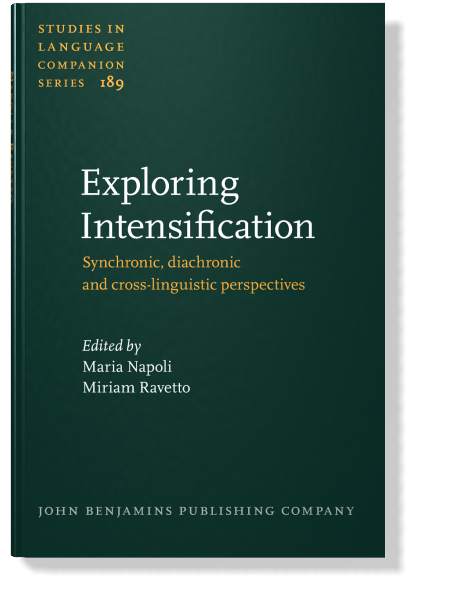
In:Exploring Intensification: Synchronic, diachronic and cross-linguistic perspectives
Edited by Maria Napoli and Miriam Ravetto
[Studies in Language Companion Series 189] 2017
► pp. 353–370
Chapter 17Augmentatives in Italian and German
From contrastive analysis to translation
Published online: 30 September 2017
https://doi.org/10.1075/slcs.189.18cos
https://doi.org/10.1075/slcs.189.18cos
Abstract
The present paper deals with Italian and German augmentation, analyzed both from a contrastive linguistic and translational perspective. It explores the Italian suffixes ‑one and ‑accio as well as German formatives conveying similar meaning (AUG and PEJ) paralleling the presentation of the Italian augmentation features in their formal, semantic features and pragmatic-interactive dimensions with the equivalent features in German in order to work out similarities and differences between the two languages. In a second step the analysis focuses the parole-level and investigates the bidirectional translation strategies of augmentatives (Italian-German; German-Italian) in bilingual lexicography and in an Italian-German translation corpus. The goal is to verify what happens on the parole-level, checking different possible solutions to translate and express augmentatives in context and contrasting them with the findings of the contrastive analysis on the langue-level.
Article outline
- 1.Introduction
- 2.Augmentation: A contrastive perspective
- 3.Methods and data
- 4.Contrastive linguistic approach
- 4.1Augmentation in Italian
- 4.1.1Formal features
- 4.1.2Semantic features
- 4.1.3Pragmatic dimensions of augmentatives
- 4.2Augmentation in German
- 4.2.1Formal features
- 4.2.2Semantic features
- 4.2.3Pragmatic aspects
- 4.3Résumé
- 4.1Augmentation in Italian
- 5.Potential translations and current equivalents
- 5.1Potential translations in bilingual lexicography
- 5.2Current equivalents Italian-German
- 6.Concluding remarks
Notes References

References (38)
Bazzanella, Carla & Gili Favela, Barbara. 2009. Fenomeni di intensità nell’italiano parlato. Firenze: Cesati.
Costa, Marcella. 2013. Morfologia valutativa. In Italiano e tedesco: Questioni di linguistica contrastiva, Sandra Bosco Coletsos & Marcella Costa (eds), 157–190. Alessandria: dell’Orso.
Dressler, Wolfgang & Merlini Barbaresi, Lavinia. 1994. Morphopragmatics: Diminutives and Intensifiers in Italian, German and Other Languages. Berlin: de Gruyter.
Ettinger, Stefan. 1974. Form und Funktion in der Wortbildung. Die Diminutiv‑ und Augmentativmodifikation im Lateinischen, Deutschen und Romanischen. Tübingen: Narr.
Fleischer, Wolfgang & Barz, Irmhild. 1995. Wortbildung der deutschen Gegenwartssprache. Tübingen: Niemeyer.
Giacoma, Luisa & Kolb, Susanne. 2009. Il Nuovo dizionario di Tedesco. Großwörterbuch Italienisch-Deutsch/Deutsch-Italienisch. Bologna: Zanichelli.
Grandi, Nicola. 2002. Morfologie in contatto. Le costruzioni valutative nelle lingue del Mediterraneo. Milano: Franco Angeli.
Grandi, Nicola & Kortvelyessy, Lydia. 2015. The Edinburgh Handbook of Evaluative Morphology. Edinburgh: EUP.
Günthner, Susanne. 2006. Grammatische Analysen der kommunikativen Praxis – “Dichte Konstruktionen” in der Interaktion. In Grammatik und Interaktion – Untersuchungen zum Zusammenhang von grammatischen Strukturen und Gesprächsprozessen, Arnulf Deppermann, Reinhard Fiehler & Thomas Spranz-Fogasy (eds), 95–122. Radolfzell: Verlag für Gesprächsforschung.
Karbelaschwili, Samson. 2001. Lexikon zur Wortbildung der deutschen Sprache (Augmentation und Diminution). Regensburg: Fachverband Deutsch als Fremdsprache.
Merlini Barbaresi, Lavinia. 2004. Alterazione. In La formazione delle parole in italiano, Maria Grossmann & Franz Rainer (eds), 264–292. Berlin: De Gruyter.
Montermini, Fabio. 2008. Il lato sinistro della morfologia. La prefissazione in italiano e nelle lingue del mondo. Milano: Franco Angeli.
Mutz, Karin. 2000. Die italienischen Modifikationssuffixe. Synchronie und Diachronie. Frankfurt: Peter Lang.
Ruf, Birgit. 1996. Augmentativbildungen mit Lehnpräfixen. Eine Untersuchung zur Wortbildung der deutschen Gegenwartssprache. Heidelberg: Winter.
Schreiber, Michael. 2004. Kontrastive Linguistik und sprachenpaarbezogene Translationswissenschaft. In Claims, Changes and Challenges in Translation Studies. Selected Contributions from the EST Congress (Copenhagen 2001) [Benjamins Translation Library 50], Gyde Hansen, Kirsten Malmkjaer & Daniel Gile (eds), 83–98. Amsterdam: John Benjamins.
Schwitalla, Johannes and Tiittula, Lisa. 2009. Mündlichkeit in literarischen Erzählungen. Sprach‑ und Dialoggestaltung in modernen deutschen und finnischen Romanen und deren Übersetzungen. Tübingen: Stauffenburg.
Selting, Margaret et al. 2009. Gesprächsanalytisches Transkriptionssystem (GAT 2). Gesprächsforschung – Online-Zeitschrift zur verbalen Interaktion 10: 152−83.
Starke, Günter. 1992. Der Übergang von Kompositionsgliedern zu Suffixen im Spiegel des einsprachigen Wörterbuch. In Beiträge zur Phraseologie – Wortbildung – Lexikologie. Festschrift für Wolfgang Fleischer zum 70. Geburtstag, Rudolf Große, Gotthard Lerchner & Marianne Schröder (eds), 115–124. Frankfurt: Peter Lang.
Waltereit, Richard. 2006. Abtönung. Zur Pragmatik und historischen Semantik von Modalpartikeln und ihren funktionalen Äquivalenten in romanischen Sprachen. Tübingen: Niemeyer.
Cited by (2)
Cited by two other publications
Cotgrove, Louis
This list is based on CrossRef data as of 3 december 2025. Please note that it may not be complete. Sources presented here have been supplied by the respective publishers. Any errors therein should be reported to them.