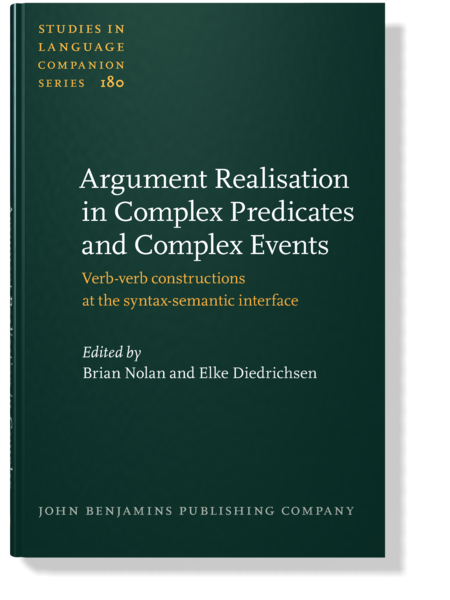
In:Argument Realisation in Complex Predicates and Complex Events: Verb-verb constructions at the syntax-semantic interface
Edited by Brian Nolan and Elke Diedrichsen
[Studies in Language Companion Series 180] 2017
► pp. 213–244
Chapter 8Complex verbs in Bohairic Coptic
Language contact and valency
Published online: 26 January 2017
https://doi.org/10.1075/slcs.180.08zak
https://doi.org/10.1075/slcs.180.08zak
Abstract
This chapter discusses second argument markers in Bohairic Coptic complex verbs constructed with the light verbs er‑ ‘do, make’ and
ti- ‘give’ and typically used to integrate verbal borrowings from Greek. The question is examined if Coptic argument marking can be considered a replica of Greek valency patterns. Enhancement of already existing marking strategies seems more plausible, however, whereby the rise of complex verbs has contributed to a radical restructuring of the transitivity system in Coptic. Two competing subsystems of transitivity are distinguished: a recessive one characterized by head marking and emphasis on the discriminating function of case and a productive one in which the characterizing function of case becomes prominent thanks to dependent marking by means of a preposition.
Article outline
- 1.Subject and aims of the present chapter
- 2.Structure of the chapter
-
3.Introduction
- 3.1Basic information about Egyptian-Coptic and the corpus examined
- 3.2Egyptian and Greek in contact
- 3.3Case: some preliminaries
- 3.3.1Case, its marking and its functions
- 3.3.2Case and language contact
- 3.3.3Case in Ancient Greek
- 4.Complex verbs and their arguments in Bohairic Coptic
- 4.1Formation strategies of complex verbs
- 4.2Complex verbs and their valency: An overview
- 4.3Greek valency patterns in Coptic?
- 4.4Discussion
- 5.Conclusions: Two subsystems of transitivity in Bohairic Coptic
Acknowledgements Notes Abbreviations References Appendix

References (88)
Aikhenvald, Alexandra Y. 2006. Grammars in contact: A cross-linguistic perspective. In Grammars in Contact: A Cross-Linguistic Typology, Alexandra Y. Aikhenvald & Robert M.W. Dixon (eds), 1–66. Oxford: OUP.
Bauer, Walter. 1988. Griechisch-deutsches Wörterbuch zu den Schriften des Neuen Testaments und der frühchristlichen Literatur, 6th edn, Kurt Aland & Barbara Aland (eds). Berlin: de Gruyter. (English language version: A Greek-English Lexicon of the New Testament and other Early Christian Literature, 2nd edn revised and augmented by F. Wilbur Gingrich and Frederick W. Danker from Walter Bauer’s fifth edition, 1958. Chicago IL: University of Chicago Press, 1979).
Blass, Friedrich & Debrunner, Albert. 1979. Grammatik des neutestamentlichen Griechisch. 15th rev. edn, Friedrich Rehkopf (ed.). Göttingen: Vandenhoeck und Ruprecht.
Broden, Thomas. 2006. Paradigm versus syntagm. In The Encyclopedia of Language and Linguistics, 2nd rev. edn, Vol. 9, Keith Brown (ed.), 173–175. Oxford: Elsevier.
Chanet, Anne-Marie. 1994. Sème négatif et génitif grec. In Cas et prépositions en grec ancien: contraintes syntaxiques et interprétations sémantiques: Actes du colloque international de Saint-Étienne (3–5 juin 1993), Bernard Jacquinod (ed.), 45–62. Saint-Étienne: Publications de l’Université de Saint-Étienne.
Delbecque, Nicole. 2002. A construction grammar approach to transitivity in Spanish. In The Nominative & Accusative and Their Counterparts [Case and Grammatical Relations 4], Kristin Davidse & Béatrice Lamiroy (eds), 81–130. Amsterdam: John Benjamins.
Depuydt, Leo. 1993. For the sake of ⲟⲩⲱϣ ‘love’: an exception to the Stern-Jernstedt Rule and its history. The Journal of Egyptian Archaeology 79: 282–286.
Dik, Simon. 1997. The Theory of Functional Grammar, Vols 1–2, Kees Hengeveld. Berlin: Mouton de Gryuter.
Dimmendaal, Gerrit J. 2005. Head marking, dependent marking and constituent order in the Nilotic area. In Studies in African Linguistic Typology [Typological Studies in Language 64], F.K. Erhard Voeltz (ed.), 71–92. Amsterdam: John Benjamins.
Engsheden, Åke. 2006. Über die Markierung des direkten Objekts im Koptischen. Lingua Aegyptia 14: 199–222.
. 2008. Differential object marking in Sahidic Coptic. In Interdependence of Diachronic and Synchronic Analyses [Studies in Language Companion Series 103], Folke Josephson & Ingmar Söhrman (eds), 323–344. Amsterdam: John Benjamins.
Gardner, Iain, Alcock, Anthony & Funk, Wolf-Peter (eds). 1997. Coptic Documentary Texts from Kellis, Part 1. Oxford: Oxbow.
Holvoet, Axel. 1991. Transitivity and Clause Structure in Polish: A Study in Case Marking. Warszawa: Slawistyczny Ośrodek Wydawniczy.
Holvoet, Axel & Nau, Nicole. 2014. Argument marking and grammatical relations in Baltic. In Grammatical Relations and their Non-Canonical Encoding in Baltic, Axel Holvoet & Nicole Nau (eds), 1–41. Amsterdam: John Benjamins.
Hopper, Paul J. & Thompson, Sandra A. 1980. Transitivity in grammar and discourse. Language 56(2): 251–299.
Hornberger, Nancy H. 2003. Introduction. In Continua of Biliteracy: An Ecological Framework for Educational Policy, Research, and Practice in Multilingual Settings, Nancy H. Hornberger (ed.), i-xxix. Clevedon: Multilingual Matters.
Horrocks, Geoffrey. 2010. Greek: A History of the Language and its Speakers. Chichester: Wiley-Blackwell.
Jannaris, Antonius, A. 1897[1968]. An Historical Grammar Chiefly of the Attic Dialect as Written and Spoken from Classical Antiquity down to the Present Time: Founded upon the Ancient Texts, Inscriptions, Papyri and Present Popular Greek. Reprint Hildesheim: Olms.
. 2013. Written language intertwining. In Contact Languages: A Comprehensive Guide, Peter Bakker & Yaron Matras (eds), 273–33. Boston: De Gruyter Mouton.
Kittilä, Seppo. 2008. Animacy effects on differential goal marking. Linguistic Typology 12(2): 245–268.
Kühner, Raphael, Blass, Friedrich W. & Gerth, Bernhard. 1890–1904[1963–1966]. Ausführliche Grammatik der griechischen Sprache. Reprint 3rd edn, Darmstadt: Wissenschaftliche Buchgesellschaft.
Lavidas, Nicolaos. 2009. Transitivity Alternations in Diachrony: Changes in Argument Structure and Voice Morphology. Newcastle upon Tyne: Cambridge Scholars.
Layton, Bentley. 2004. A Coptic Grammar: With Chrestomathy and Glossary; Sahidic Dialect, 2nd edn, revised and expanded. Wiesbaden: Harrassowitz.
Loprieno, Antonio. 2001. From ancient Egyptian to Coptic. In Language Typology and Language Universals: An International handbook [Handbücher zur Sprach- und Kommunikationswissenschaft 20], Martin Haspelmath, Ekkehard König, Wulf Oesterreicher & Wolfgang Raible (eds), 1742–1761. Berlin: De Gruyter.
. 2004. Egyptian and Coptic. In The Cambridge Encyclopedia of the World’s Ancient Languages, Roger D. Woodard (ed.), 160–217. Cambridge: CUP.
Loprieno, Antonio & Müller, Matthias. 2012. Ancient Egyptian and Coptic. In The Afroasiatic Languages, Zygmunt Frajzyngier & Erin Shay (eds), 102–144. Cambridge: CUP.
Luraghi, Silvia. 2003. On the Meaning of Prepositions and Cases: The Expression of Semantic Roles in Ancient Greek [Studies in Language Companion Series 67]. Amsterdam: John Benjamins.
Luraghi, Silvia & Narrog, Heiko. 2014. Perspectives on semantic roles: an introduction. In Perspectives on Semantic Roles [Typological Studies in Language 106], Silvia Luraghi & Heiko Narrog (eds), 1–21. Amsterdam: John Benjamins.
Malchukov, Andrej L. 2005. Case pattern splits, verb types and construction competition. In Competition and Variation in Natural Languages: The Case for Case, Mengistu Amberber & Helen de Hoop (eds), 73–117. Amsterdam: Elsevier.
Malchukov, Andrej L. & de Swart, Peter. 2009. Differential case marking and actancy variations. In Malchukov & Spencer (eds), 339–355.
Mallon, Alexis. 1956. Grammaire copte: Bibliographie, chrestomathie et vocabulaire, 4me éd., revue par Michel Malinine. Beyrouth: Imprimerie Catholique.
Matras, Yaron & Sakel, Jeanette (eds). 2007. Grammatical Borrowing in Cross-Linguistic Perspective. Berlin: Mouton de Gruyter.
Mayser, Edwin. 1926–1934. Grammatik der griechischen Papyri aus der Ptolemäerzeit. Berlin: De Gruyter.
Merlier, Octave. 1931. Le remplacement du datif par le génitif en grec moderne. Bulletin de Correspondance Hellénique 55(1): 207–228.
. 2007. Mixed codes. In Handbook of Multilingualism and Multilingual Communication, Peter Auer & Li Wei (eds), 325–340. Berlin: Mouton de Gruyter.
Næss, Åshild. 2007. Prototypical Transitivity [Typological Studies in Language 72]. Amsterdam: John Benjamins.
Panagl, Oswald. 2006. Zur verbaler Konstruktion deverbativer Nomina. In Word Classes and Related Topics in Ancient Greek: Proceedings of the Conference on ‘Greek Syntax and Word Classes’ Held in Madrid on 18–21, June 2003, Emilio Crespo, Jesús De la Villa & A.R. Revuelta (eds), 47–57. Louvain-la-Neuve: Peeters.
Panévová, Jarmila. 2014. Contribution of valency to the analysis of language. In Spevak (ed.), 1–17.
Reintges, Chris H. 2001. Aspects of the morphosyntax of subjects and objects in Coptic Egyptian. Linguistics in the Netherlands 18: 177–188.
Rice, Susan & Kabata, Kaori. 2007. Crosslinguistic grammaticalization patterns of the ALLATIVE. Linguistic Typology 11(3): 451–514.
Richter, Tonio Sebastian. 2014. Neue koptische medizinische Rezepte. Zeitschrift für Ägyptische Sprache und Altertumskunde 141(2): 154–194.
Roegiest, Eugeen. 2007. Transitivity and referentiality in Spanish and Rumanian. In On Interpreting Constructions Schemas: From Action and Motion to Transitivity and Causality, Nicole Delbecque & Bert Cornillie (eds), 39–59. Berlin: Mouton de Gruyter.
Siewierska, Anna & Bakker, Dik. 2009. Case and alternative strategies: Word order and agreement marking. In Malchukov & Spencer (eds), 290–303.
Simpson, R.S. 1996. Demotic Grammar in the Ptolemaic Sacerdotal Decrees. Oxford: Griffith Institute, Ashmolean Museum.
(ed.). 2014. Noun Valency [Studies in Language Companion Series 158]. Amsterdam: John Benjamins.
Tadmor, Uri. 2009. Loanwords in the world’s languages: Findings and results. In Loanwords in the World’s Languages: A Comparative Handbook, Martin Haspelmath & Uri Tadmor (eds), 55–75. Berlin: De Gruyter Mouton.
Wierzbicka, Anna. 1988. The Semantics of Grammar [Studies in Language Companion Series 18]. Amsterdam: John Benjamins.
Vierros, Marja. 2012. Bilingual Notaries in Hellenistic Egypt: A Study of Greek as a Second Language. Brussel: KVAB.
Worp, Klaas A. 2011–2012.
(Dia)phylassō + DAT.: A linguistic regionalism in inscription from Christian Egypt? Analecta Papyrologica 23–24: 237–239.
Zakrzewska, Ewa D. 2006. The hero, the villain and the mob: Topicality and focality in Bohairic narrative discourse. Lingua Aegyptia 14: 325–346.
2011. Masterplots and martyrs: Narrative techniques in Bohairic hagiography. In Narratives of Egypt and the Ancient Near East: Literary and Linguistic Approaches [Orientalia Lovaniensia Analecta 189], Fredrik Hagen, John Johnstone, Wendy Monkhouse, Kathryn Piquette, John Tait & Martin Worthington (eds), 499–523. Leuven: Peeters.
2015a. GIVE and its arguments in Bohairic Coptic. In Causation, Permission and Transfer: Argument Realisation in GET, TAKE, PUT, GIVE and LET Verbs [Studies in Language Companion Series 167], Brian Nolan, Gudrun Rawoens & Elke Diedrichsen (eds), 227–252. Amsterdam: John Benjamins.
2015b.
L* as a secret language: Social functions of early Coptic. In Christianity and Monasticism in Middle Egypt: Al-Minya and Asyut, Gawdat Gabra and Hany N. Takla (eds), 185–198. Cairo: American University in Cairo Press.
Forthcoming 1. A ‘bilingual language variety’ or ‘the language of the pharaohs’? Coptic from the perspective of contact linguistic. In Language Contact and Bilingualism in Antiquity: What Linguistic Borrowing into Coptic Can Tell Us about it. Papers Read at the Inaugural Conference of the DDGLC Project, Sächsische Akademie der Wissenschaften zu Leipzig, April 2010 [Lingua Aegyptia Studia Monographica], Peter Dils, Eitan Grossman, Tonio Sebastian Richter & Wolfgang Schenkel (eds). Hamburg: Widmaier Verlag.
Fortcoming 2. Why did Egyptians write Coptic? The rise of Coptic as a literary language. In Copts and Society: Documentary-historical Studies. Proceedings of the First International Coptic Studies Conference “Life in Egypt during the Coptic Period:Towns and Villages, Laymen and Clergy, Bishops and Dioceses”, Alexandria 21–23 September 2010, Ahmed Mansour (ed.), 227–236. Alexandria: Bibliotheca Alexandrina.
Zanchi, Chiara, Sausa, Eleonora & Luraghi, Silvia (eds). 2015. The Homeric Dependency Lexicon (HoDeL). <[URL]> (23 December 2015).
Cited by (17)
Cited by 17 other publications
Fendel, Victoria Beatrix
Fendel, Victoria Beatrix Maria
Fendel, Victoria Beatrix Maria
Fendel, Victoria Beatrix Maria
Fendel, Victoria Beatrix Maria
Fendel, Victoria Beatrix Maria
Fendel, Victoria Beatrix Maria
Fendel, Victoria Beatrix Maria
Fendel, Victoria Beatrix Maria
Fendel, Victoria Beatrix Maria
Fendel, Victoria Beatrix Maria
Fendel, Victoria Beatrix Maria
Fendel, Victoria Beatrix Maria
Fendel, Victoria Beatrix Maria
Fendel, Victoria Beatrix Maria
This list is based on CrossRef data as of 3 december 2025. Please note that it may not be complete. Sources presented here have been supplied by the respective publishers. Any errors therein should be reported to them.