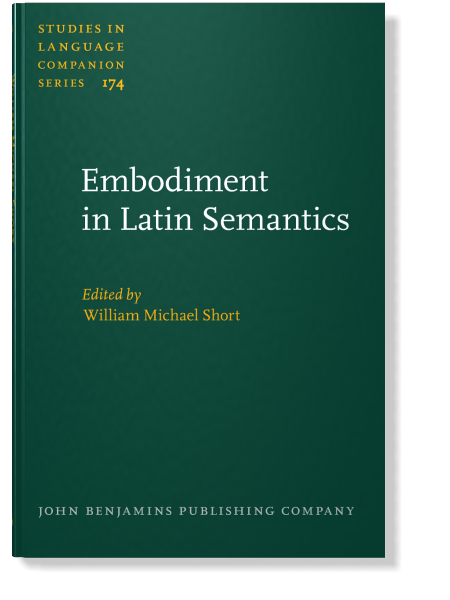
In:Embodiment in Latin Semantics
Edited by William Michael Short
[Studies in Language Companion Series 174] 2016
► pp. 115–140
Ontological and orientational metaphors in Latin
Evidence from the semantics of feelings and emotions
Published online: 11 May 2016
https://doi.org/10.1075/slcs.174.05fed
https://doi.org/10.1075/slcs.174.05fed
Ontological and orientational metaphors arise from general cognitive processes and rely on our embodied experience of the physico-spatial world, providing us with image schemas that we commonly exploit in order to interpret and express abstract notions in terms of spatial configurations. This is particularly true in the case of emotions and feelings, which are much less clearly defined than our bodily functions. Indeed, recurrent embodied patterns building bridges between spatial orientations and feelings occur in a great variety of languages. It has long been noted, for instance, that the vertical axis up vs. down offers the basis for portraying many experiential metaphors in terms of ‘happy/positive is up’, ‘sad/negative is down’. This paper shows that both ontological and orientational metaphorization is largely attested in this domain of experience in Latin, and provides corpus-based evidence for frequency and productivity effects and cross-linguistic comparisons that testify how the human body is a universal cognitive key to interpret and categorize emotions in modern as well as in ancient languages.
Keywords: emotions, feelings, image schemas, metaphor, ontological metaphors, orientational metaphors, space

References (56)
Ameka, Felix. 1990. The grammatical packaging of experiencers in Ewe: A study in the semantics of syntax. Australian Journal of Linguistics 10: 139–181.
Babiniotis, George Demetrius. 2002. Lexikó tēs Néas Ellēnikḗs Glṓssas (Dictionary of the Modern Greek language). Athens: Centre of Lexicology.
Bakos, Ferenc. 1991. Román-magyar kéziszótár (Romanian-Hungarian dictionary). Budapest: Akadémiai Kiadó.
Becher, Jutta. 2003. Experiencer Constructions in Wolof. Hamburg: Universität Hamburg, Institut für Afrikanistik und Äthopistik.
Bickel, Balthasar. 2004. The syntax of experiencers in the Himalayas. In Non Nominative Subjects [Typological Studies in Language 60], Peri Bhaskararao & Karumuri Venkata Subbarao (eds), 77–111. Amsterdam: John Benjamins.
Buarque de Holanda Ferreira, Aurélio. 1975. Novo dicionário da língua portuguesa. Rio de Janeiro: Nova Fronteira.
Cairns, Douglas. 1993. Aidôs: The Psychology and Ethics of Honour and Shame in Ancient Greek Literature. Oxford: OUP.
. 2012. Vêtu d’impudeur et enveloppé de chagrin. Le rôle des métaphores de “l’habillement” dans les concepts d’émotion en Grèce ancienne. In Les vêtements antiques: s’habiller, se déshabiller dans les mondes anciens, Florence Gherchanoc & Valérie Huet (eds), 175–88. Paris: Errance.
Casasanto, Daniel. 2013. Experiential origins of mental metaphors: Language, culture, and the body. In The Power of Metaphor: Examining Its Influence on Social Life, Mark Landau, Michael Robinson & Brian Meier (eds), 249–268. Washington DC: American Psychological Association Books.
Casasanto, Daniel & Dijkstra, Katinka. 2010. Motor action and emotional memory. Cognition 115(1): 179–185.
Clausner Timothy & Croft, William. 1997. Productivity and schematicity in metaphors. Cognitive Science 21: 247–282.
Deignan, Alice. 2005. Metaphor and Corpus Linguistics [Converging Evidence in Language and Communication Research 6]. Amsterdam: John Benjamins.
Dewell, Robert. 2005. Dynamic patterns of containmnt. In From Perception to Meaning: Image Schemas in Cognitive Linguistics, Beate Hampe & Joseph Grady (ed.), 369–394. Berlin: De Gruyter.
Ernout, Alfred & Meillet, Antoine. 1959. Dictionnaire etymologique de la langue latine. Histoire des mots. Paris: Klincksieck.
Evans, Nicholas. 2004. Experiencer objects in Iwaidjan languages (Australia). In Non nominative subjects [Typological Studies in Language 60], Peri Bhaskararao & Karumuri Venkata Subbarao (eds), 169–192. Amsterdam: John Benjamins.
Fedriani, Chiara. 2011. Experiential metaphors in Latin: Feelings were containers, movements and things possessed. Transactions of the Philological Society 109(3): 307–326.
Fedriani, Chiara, Manzelli, Gianguido & Ramat, Paolo. 2013. Gradualness in contact-induced grammatical replication: The case of the abstract possession construction in the Circum-Mediterranean area. In Synchrony and Diachrony: A Dynamic Interface [Studies in Language Companion Series 133], Anna Giacalone Ramat, Caterina Mauri & Piera Molinelli (eds), 391–418. Amsterdam: John Benjamins.
García Jurado, Francisco. 2000. Las ‘metáforas de la vida cotidiana’ en latín y su proyección etimológica en castellano. In Cien años de investigación semántica, de Michel Breal a la actualidad: Actas del Congreso Internacional de Semántica, Vol. 2, José Manuel Oliver Frade (ed.), 1571–1584. Madrid: Ediciones Clásicas.
García Jurado, Francisco & López Gregoris, Rosario. 1995. Las ‘metáforas de la vida cotidiana’ en el lenguaje plautino como procedimiento de caracterización de los personajes. SIFC 13: 233–245.
Gibbs, Raymond & Colston, Herbert. 1995. The cognitive psychological reality of image schemas and their transformations. Cognitive Linguistics 6: 347–78.
Hampe, Beate. 2005. Image schemas in cognitive linguistics. In From Perception to Meaning: Image Schemas in Cognitive Linguistics, Beate Hampe & Joseph Grady (eds), 1–12. Berlin: De Gruyter.
Johnson, Mark. 1987. The Body in the Mind: The Bodily Basis of Meaning, Imagination and Reason. Chicago IL: University of Chicago Press.
Johnson, Mark & Rohrer, Tim. 2007. We are live creatures: Embodiment, American pragmatism, and the cognitive organism. In Body, Language, and Mind, Vol. 1, Jordan Zlatev, Tom Ziemke, Roz Frank & René Dirven (eds), 17–54. Berlin: De Gruyter.
Kavaleto-Petrova, Margarita, Todorov, Simeon, Bertoli-Simeonova, Marija & Tonkin, Ivan. 1992. Bălgarsko-italianski rečnik. Sofija: Nauka i izkustvo.
Koltay-Kastner, Jenő. 1963. Magyar-olasz szótár (Hungarian-Italian dictionary). Budapest: Akadémiai Kiadó.
Konstan, David. 2006. The Emotions of the Ancient Greeks: Studies in Aristotle and Classical Literature. Toronto: University of Toronto Press.
Kovalev, Vladimir. 1995. Russo, Russkij. Dizionario russo italiano, italiano russo. Bologna: Zanichelli.
Kövecses, Zoltán. 2000. Metaphor and Emotion: Language, Culture and Body in Human Body. Cambridge: CUP.
Lakoff, George. 1987. Women, Fire, and Dangerous Things. What Categories Reveal about the Mind. Chicago IL: The University of Chicago Press.
Lakoff, George & Johnson, Mark. 1980. Metaphors We Live By. Chicago IL: University of Chicago Press.
Langacker, Ronald W. 1987. Foundations of Cognitive Grammar, Vol. 1. Stanford CA: Stanford University Press.
Lichtenberk, Frantisek. 1985. Possessive constructions in Oceanic languages and Proto-Oceanic. In Austronesian Linguistics at the 15th Pacific Science Congress, Andrew Pawley & Lois Carrington (eds), 93–140. Canberra: Pacific Linguistics Series C.
Leka, Ferdinand & Simoni, Zef. 1996. Dizionario albanese-italiano. Fjalor shqip-italisht, Tiranë: Çabej / Besa.
Luraghi, Silvia. 2003. On the Meaning of Prepositions and Cases. A Study of the Expression of Semantic Roles in Ancient Greek [Studies in Language Companion Series 67]. Amsterdam: John Benjamins.
Nikiforidou, Kiki. 1991. The meanings of the genitive: A case study in semantic structure and semantic change. Cognitive Linguistics 2(2): 149–205.
Padel, Ruth. 1992. In and Out of the Mind: Greek Images of the Tragic Self. Princeton NJ: Princeton University Press.
Prandi, Michele. 2012. A plea for Living Metaphors: Conflictual Metaphors and Metaphorical Swarms. Metaphor and Symbol 27(2): 148–170.
Redhouse, James. 1994[2003]. Redhouse büyük elsözlüğü. İngilizce-Türkçe. Türkçe-İngilizce. The Larger Redhouse Portable Dictionary. English-Turkish, Turkish-English, On Sekizinci Baskı. İstanbul: SEV Matbaalacılık ve Yayıncılık Eğitim.
Sinha, Chris & De López, Kristine Jensen. 2000. Language, culture and the embodiment of spatial cognition. Cognitive Linguistics 11(1-2): 17–41.
Short, William. 2012. Latin De: A view from cognitive semantics. Classical Antiquity 32(2): 378–405.
Stafford, Emma & Herrin, Judith (eds). 2005. Personification in the Greek World: From Antiquity to Byzantium. Aldershot: Ashgate.
Stefanowitsch, Anatol. 2006. Corpus-based approaches to metaphor and metonymy. In Corpus-Based Approaches to Metaphor and Metonymy, Anatol Stefanowitsch & Stefan T. Gries (eds), 1–16. Berlin: De Gruyter.
Stolz, Thomas, Kettler, Sonja, Stroh, Cornelia & Urdze, Aina. 2008. Split Possession: An Areal-linguistic Study of the Alienability Correlation and Related Phenomena in the Languages of Europe. Amsterdam: John Benjamins.
Tyler, Andrea & Evans, Vyvyan. 2003. The Semantics of English Prepositions: Spatial Scenes, Embodied Meaning, and Cognition. Cambridge: CUP.
Verma, Manindra, Mohanan, Karuvannur Puthanveettil & Verma Mahendra (eds). 1991. Experiencer Subjects in South Asian Languages. Stanford CA: CSLI.
Wheeler, Max, Yates, Alan & Dols, Nicolau. 1999. Catalan. A Comprehensive Grammar. London: Routledge.
Cited by (8)
Cited by eight other publications
Jiménez López, M. Dolores
Shan, Weijia & Zhengjun Lin
2024. The analysis of orientational metaphor of ‘Zhōng’ (中) in Chinese traditional classic The Doctrine of the Mean
. International Journal of Language and Culture 11:2 ► pp. 153 ff.
Tur, Cristina
Tur, Cristina
Buccheri, Alessandro, Irene De Felice, Chiara Fedriani & William M. Short
Jiménez Martínez, María Isabel
Huang, Wen-Yi & Wen-yu Chiang
This list is based on CrossRef data as of 3 december 2025. Please note that it may not be complete. Sources presented here have been supplied by the respective publishers. Any errors therein should be reported to them.