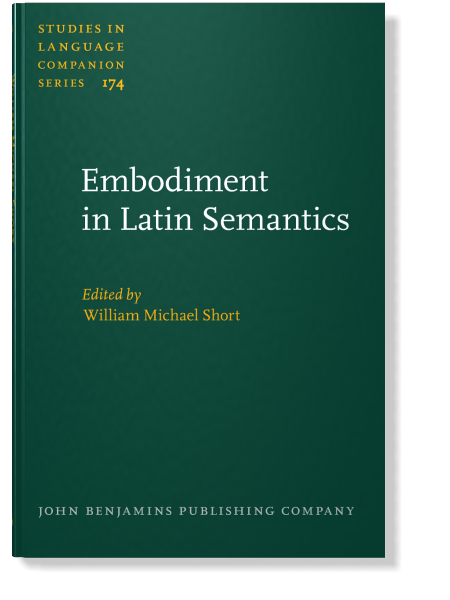
In:Embodiment in Latin Semantics
Edited by William Michael Short
[Studies in Language Companion Series 174] 2016
► pp. 85–114
The embodied sources of purpose expressions in Latin
Published online: 11 May 2016
https://doi.org/10.1075/slcs.174.04bru
https://doi.org/10.1075/slcs.174.04bru
This chapter examines the phrasal means of encoding the semantic role of purpose in Latin. After discussing the notion of semantic role and its use in cognitive linguistics, we illustrate the conceptual relation between the notional domains of space and causation. On this basis, we analyze the source of purpose expressions in Latin, which are mainly based on direction (bare dative and the allative markers, i.e. ad/in + accusative), but also include prepositional phrases metaphorically derived from location (e.g. per + accusative, prō + ablative, propter + accusative), or metonymically spreading from reason to purpose (as in the case of causal markers such as genitive + causā and gratiā).
Keywords: causation, direction, location, metaphor, metonymy, phrasal constructions, prepositional phrases, purpose, reason, space

References (50)
Brucale, Luisa & Mocciaro, Egle. 2011. Continuity and discontinuity in the semantics of the Latin preposition per: A cognitive hypothesis. Language Typology and Universals 64(2): 148‒169.
Cabrillana, Concepción. 2011. Purpose and result clauses. In New Perspectives on Historical Latin Syntax IV, Philip Baldi & Pierluigi Cuzzolin (eds), 19‒92. Berlin: De Gruyter.
Calboli, Gualtiero. 2009. Latin syntax and Greek. In New Perspectives on Historical Latin Syntax 1, Philip Baldi & Pierluigi Cuzzolin (eds), 65-193. Berlin: De Gruyter.
Croft, William. 1991. Syntactic Categories and Grammatical Relations. Chicago IL: University of Chicago Press.
Dirven, René. 1993. Dividing up physical and mental space into conceptual categories by means of English prepositions. In The Semantics of Prepositions, Cornelia Zelinski-Wibelt (ed.), 73-98. Berlin: De Gruyter.
Ernout, Alfred & Meillet, Antoine. 1959. Dictionnaire étymologique de la langue latine: Histoire de mots. Paris: Klincksieck.
Haspelmath, Martin. 2003. The geometry of grammatical meaning: Semantic maps and cross-linguistic comparison. In The New Psychology of Language, Vol. 2, Michael Tomasello (ed.), 211-42. Mahwah, NJ: Lawrence Erlbaum Associates.
Haudry, Jean. 1968. Les emplois double du datif et la fonction du datif indo-européen. Bulletin de la Societé de Linguistique de Paris 63: 141-59.
Heine, Bernd, Ulrike, Claudi & Hünnemeyer, Friederike. 1991. Grammaticalization: A Conceptual Framework. Chicago IL: University of Chicago Press.
van Hoecke, Willy. 1996. The Latin dative. In The Dative, Vol.1: Descriptive Studies [Case and Grammatical Relations Across Languages 2], William Van Belle & Willy Van Langendonck (eds), 3-38. Amsterdam: John Benjamins.
Kühner, Raphael & Stegmann, Carl. 1912. Ausführliche Grammatik der lateinischen Sprache. Hannover: Hahn.
Lakoff, George. 1993. The contemporary theory of metaphor. In Metaphor and Thought, Andrew Ortony (ed.), 202-251. Cambridge: CUP.
. 1987. Women, Fire, and Dangerous Things: What Categories Reveal about the Mind. Chicago IL: University of Chicago Press.
Lakoff, George & Johnson, Mark. 1999. Philosophy in the Flesh: The Embodied Mind and its Challenge to Western Thought. New York NY: Basic Books.
Lakoff, George, Espenson, Jane, and Schwartz, Alan. 1991. Master Metaphor List (second edition). Cognitive Linguistics Group, University of California at Berkeley. [URL].
Langacker, Ronald. 1987. Foundations of Cognitive Grammar, Vol. I: Theoretical Prerequisites, Stanford CA: Stanford University Press.
León Araúz, Pilar, Faber, Pamela & Montero Martínez, Silvia. 2012. Specialized language semantics. In A Cognitive Linguistics View of Terminology and Specialized Language, Pamela Faber (ed.), 95-175. Berlin: De Gruyter.
Löfstedt, Einar. 1911. Philologischer Kommentar zur Peregrinatio Aetheriae: Untersuchungen zur Geschichte der lateinischen Sprache. Uppsala: Almqvist und Wiksell.
Luraghi, Silvia. 2001. Syncretism and the classification of semantic roles. Sprachtypologie und Universalienforschung 54(1): 35-51.
. 2005a. Paths of semantic extension. From cause to beneficiary and purpose. In Historical Linguistics 2003 [Current Issues in Linguistic Theory 257], Michael Fortescue, Eva Skafte Jensen, Jens Erik Mogensen & Lene Schøsler (eds), 141‒57. Amsterdam: John Benjamins.
. 2005b. Prepositions in cause expressions. In Papers on Grammar, Gualtiero Calboli (ed.), 609‒619. Rome: Herder.
. 2008. Case in Cognitive Linguistics. In The Oxford Handbook of Case, Andrej Malchukov & Andrew Spencer (eds), 136‒150. Oxford: OUP.
. 2010. Adverbial phrases. In New Perspectives on Historical Latin Syntax, Philip Baldi & Pierluigi Cuzzolin (eds), 19‒108. Berlin: De Gruyter Mouton.
. 2014. Plotting diachronic semantic maps: The role of metaphor. In Perspectives on Semantic Roles [Typological Studies in Language 106], Silvia Luraghi & Heiko Narrog (eds), 101-152. Amsterdam: John Benjamins.
Pottier, Bernard. 1962. Systématique des éléments de relation: Étude de morphosyntaxe structurale romane. Paris: Klincksieck.
Prandi, Michele, Gross, Gaston & De Santis, Cristiana. 2005. La Finalità. Strutture concettuali e forme d’espressione in italiano. Florence: Olschki.
Radden, Günter & Dirven, René. 2007. Cognitive English Grammar. Amsterdam: John Benjamins.
Radden, Gunther. 2003. The metaphor time as space across languages. Zeitschrift für Interkulturellen Fremdsprachenunterricht 8(2-3): 226-239.
Radden, Günter. 1985. Spatial metaphors underlying prepositions of causality. In The Ubiquity of Metaphor [Current Issues in Linguistic Theory 23], Wolf Paprotté & René Dirven (eds), 177-207. Amsterdam: John Benjamins.
Rohlfs, Gerhard. 1969. Grammatica storica della lingua italiana e dei suoi dialetti. Sintassi e formazione delle parole. Turin: Einaudi.
Rudzka-Ostyn, Brygida. 1995. Case and semantic roles. In Handbook of Pragmatics, Jef Verschueren, Jan-Ola Östman, Jan Blommaert & Chris Bulcaen (eds), 1-32. Amsterdam: John Benjamins.
. 1996. The Polish dative. In The Dative, Vol.1: Descriptive Studies [Case and Grammatical Relations Across Languages 2], William Van Belle & Willy Van Langendonck (eds), 341-394. Amsterdam: John Benjamins.
Rudzka-Ostyn, Brigida. 2003. Word Power: Phrasal Verbs and Compounds. A Cognitive ApproachBerlin. De Gruyter.
Schmidtke-Bode, Karsten. 2009. A Typology of Purpose Clauses [Typological Studies in Language 88]. Amsterdam: John Benjamins.
. 2010. The role of benefactives and related notions in the typology of purpose clauses. In Benefactives and Malefactives [Typological Studies in Language 92], Fernando Zúñiga & Seppo Kittilä (eds), 121‒146. Amsterdam: John Benjamins.
Taylor, John R. 1993. Prepositions: Patterns of polysemization and strategies of disambiguation. In The Semantics of Prepositions, Cornelia Zelinsky-Wibbelt (ed.), 151-175. Berlin: De Gruyter.
Torrego, Maria Esperanza. 1989. Caracterización funcional de los sintagmas preposicionales en latín: “pro - Abl., contra, aduersus, in + Ac”. In Actas del VII Congreso Español de Estudios Clásicos, Vol. 1, 609-616. Madrid: Universidad Complutense.
Tyler, Andrea & Evans, V. 2003. The Semantics of English Prepositions. Spatial Scenes, Embodied Meaning and Cognition. Cambridge: CUP.