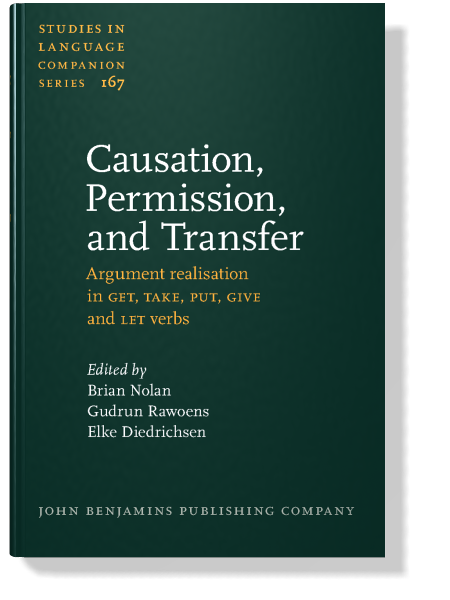
In:Causation, Permission, and Transfer: Argument realisation in GET, TAKE, PUT, GIVE and LET verbs
Edited by Brian Nolan, Gudrun Rawoens and Elke Diedrichsen
[Studies in Language Companion Series 167] 2015
► pp. 253–269
Giving is receiving
The polysemy of the GET/GIVE verb [tie53] in Shaowu
Published online: 14 January 2015
https://doi.org/10.1075/slcs.167.09nga
https://doi.org/10.1075/slcs.167.09nga
This paper looks at the polysemous, multifunctional Shaowu verb [tie53] which means ‘to get’ in a mono-transitive construction, and which is relexified to mean ‘to give’ in a ditransitive construction through the process of semantically coerced syntactic change. The morpheme then grammaticalises along a bifurcated pathway to become possibility modal suffix, verb complement marker, dative, benefactive, causative and passive markers, among other things. This poly-functionality may in part be due to language internal change, but may also be attributed to contact-induced grammaticalisation. Various historical documents are examined to follow the diachronic change, whereas languages from neighbouring dialect groups and language families are considered for the likelihood of areal diffusion of certain constructions and functions of the Shaowu GET/GIVE verb of [tie53].

References (28)
Bisang, Walter. 2014. Problems with primary vs. secondary grammaticalization: the case of East and mainland Southeast Asian languages. Language Sciences.
Chappell, Hilary. 2012a. The role of language contact and hybridization in Sinitic languages. In the Conference Proceedings of the Fourth International Conference on Sinology
. Taipei: Academia Sinica.
. 2012b. Typology of an isolated Sinitic language: Waxiang, a language of North-western Hunan, China. Plenary talk given at the 45th Conference on Sino-Tibetan Languages and Linguistics, Nanyang Technological University, 25–28 September.
Chappell, Hilary & Peyraube, Alain. 2006. The analytic causatives of Early Modern Southern Min in diachronic perspective. In Linguistic Studies in Chinese and Neighboring Languages, Dah-An Ho, H. Samuel Cheung, Wuyun Pan & Fuxiang Wu (eds), 973–1012. Taipei: Academia Sinica, Institute of Linguistics.
Craig, Colette. 1991. Ways to go in Rama: A case study in polygrammaticalization. In Approaches to Grammaticalization, Vol. II [Typological Studies in Language 19], Elisabeth Closs Traugott & Bernd Heine (eds), 455. Amsterdam: John Benjamins.
Dahl, Östen. 2000a. The grammar of future time reference in European languages. In Circum-Baltic Languages: Typology and Contact, Vol. I: Past and Present [Studies in Language and Companion Series 54], Östen Dahl & Maria Koptjevkaja-Tamm (eds), 309–328.
Amsterdam: John Benjamins.
. 2001. Principles of areal typology. In Language Typology and Language Universals: An International Handbook, Martin Haspelmath, Ekkehard König, Wulf Oesterreicher & Wolfgang Raible (eds.), 1456–1470. Berlin: De Gruyter
Enfield, Nicolas. 2001. On genetic and areal linguistics in mainland South-East Asia: Parallel polyfunctionality of ‘acquire’. In Areal Diffusion and Genetic Inheritance: Problems in Comparative Linguistics, Alexandra Y. Aikhenvald & Robert M.W. Dixon (eds), Oxford: OUP.
. 2004. Areal grammaticalisation of postverbal ‘acquire’ in mainland Southeast Asia. In Proceedings of the 11th Southeast Asia Linguistics Society Meeting, Somsonge
Burusphat (ed.), 275–296. Tempe AZ: Arizona State University.
Goddard, Cliff & Wierzbicka, Anna (eds). 2002. Meaning and Universal Grammar: Theory and Empirical Findings, 2 Vols [Studies in Language Companion Series 60–61]. Amsterdam: John Benjamins.
Gronemeyer, Claire. 1999. On deriving complex polysemy: The grammaticalisation of get. English Language and Linguistics 3: 1–39.
Güldemann, Tom. 2013. Using minority languages to inform the historical analysis of major written languages: A Tuu perspective on the ‘give’~ object marker polysemy in Sinitic. Journal of Asian and African Studies 85: 41–59.
Lord, Carol, Yap, Foong Ha & Iwasaki, Shoichi. 2002. Grammaticalization of ‘give’: African and Asian perspectives. In New Reflections on Grammaticalization [Typological Studies in Language 49], Ilse Wischer & Gabriele Diewald (eds), 217–236. Amsterdam: John Benjamins.
Newman, John. 1996. Give: A Cognitive Linguistic Study [Cognitive Linguistics Research 7]. Berlin: Mouton de Gruyter
Ohta, Tatsuo. 太田辰夫. 1957.
Shuō gěi “说‘给’” (Concerning gěi). Níng Jǔ 宁榘, trans. 语文汇编 Yǔwén huìbiān (Collections in linguistics) 25, 84: 127–143, Beijing 北京: Zhōnghuá Shūjú 中华书局. Originally published in 1956 as “Gěi ni tsuite” 《「給」について》 in 《神戶外大論叢》 (Kobe Foreign Languages University Anthology) 7(1–3): 177–197
Peyraube, Alain. 1996. Recent issues in Chinese historical syntax. In New Horizon in Chinese Linguistics, James C.-T. Huang & Y.-H. Audrey Li (eds), 161–214. Dordrecht: Kluwer.
. 1999. Historical change in Chinese grammar. Cahiers de Linguistique – Asie Orientale 28(2): 177–226.
Sun, Chaofen. 1996. Word Order Change and Grammaticalisation in the History of Chinese. Stanford CA: Stanford University Press.
Sybesma, Rint. 2008. Zhuang: A Tai language with some Sinitic characteristics. Postverbal ‘can’ in Zhuang, Cantonese, Vietnamese and Lao. In [Studies in Language Companion Series 90], Pieter Muysken (ed.), 221–274. Amsterdam: John Benjamins.
Würm, Stephen, et al. 1987. Language Atlas of China. Hong Kong: Longman Group (Far East) on behalf of the Australian Academy of the Humanities and the Chinese Academy of Social Sciences.
Xu, Baohua & Miyata, Ichiroo (eds). 1999. 汉语方言大词典 (Hanyu fangyan da cidian [A comprehensive dictionary of Chinese dialects]). Beijing: Zhonghua Shuzhu.
Yap, Foong Ha & Iwasaki, Shoichi. 2003. From causative to passive: A passage in some East and Southeast Asian languages. In Cognitive Linguistics and Non-Indo-European Languages [Cognitive Linguistics Research 18], Eugene Casad & Gary Palmer (eds), 419–446. Berlin: Mouton de Gruyter.
Zhang, Min. 2000. 语法化的类型学及认知语言学考量:从使役与被动兼用现象谈起 (Yufahua de leixingxue ji renzhi yuyanxue kaoliang – cong shiyi yu beidong biaoji jianyong xianxiang tanqi [Typology, grammaticalization and cognition – Study of the causative and passive markers]). Paper presented at the 9th Conference on Modern Chinese. Wenzhou, China.
. 2009. How to give in a language without ‘give’: Towards a new typology of ditransitives in Sinitic languages. Paper presented at the 17th Annual Meeting of the International Association of Chinese Linguistics (IACL-11), Ecole des Hautes Etudes en Sciences Sociales, Paris, July 2–4.
. 2011. 漢語方言雙及物結構南北差異的成因:類型學研究引發的新問題 (Hanyu fangyan shuangjiwu dongci jiegou nan-bei chayi de chengyin: Leixingxue yanjiu yinfa de xin wenti [The reasons for the North-South difference for ditransitives in Chinese dialects: New issues arising in typological research]). Bulletin of Chinese Linguistics 4(2): 87–270.
Cited by (1)
Cited by one other publication
Lu, Wen & Man-Shan Hui
This list is based on CrossRef data as of 3 december 2025. Please note that it may not be complete. Sources presented here have been supplied by the respective publishers. Any errors therein should be reported to them.