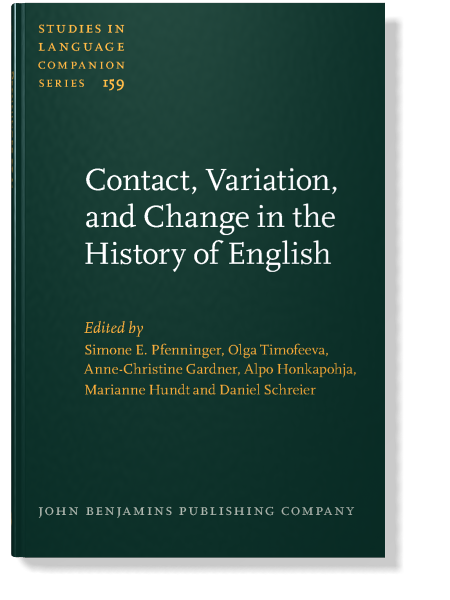
In:Contact, Variation, and Change in the History of English
Edited by Simone E. Pfenninger, Olga Timofeeva, Anne-Christine Gardner, Alpo Honkapohja, Marianne Hundt and Daniel Schreier
[Studies in Language Companion Series 159] 2014
► pp. v–vi
Get fulltext
This article is available free of charge.
Published online: 11 September 2014
https://doi.org/10.1075/slcs.159.toc
https://doi.org/10.1075/slcs.159.toc
Table of contents
Preface
At the crossroads of language change, variation, and contact
PART I: Language change
Knitting and splitting information: Medial placement of linking adverbials in the history of English
The order of adverbials of time and place in Old English
The demise of a preterite-present verb: Why was unnan lost?
Gradience in an abrupt change: Stress shift in English disyllabic noun-verb pairs
Vowels before /r/ in the history of English
PART II: Language variation
“Pained the eye and stunned the ear”: Language ideology and the progressive passive in the nineteenth century
Watching as-clauses in Late Modern English
Colloquialization and “decolloquialization”: Phrasal verbs in formal contexts, 1650–1990
Letters of Artisans and the Labouring Poor (England, c. 1750–1835): Approaching linguistic diversity in Late Modern English
New-dialect formation in medieval Ireland: A corpus-based study of Irish English pre-modal verbs
Tracing uses of will and would in Late Modern British and Irish English
PART III: Variation and change in contact situations
The subjunctive mood in Philippine English: A diachronic analysis
Revisiting a millennium of migrations: Contextualizing Dutch/Low-German influence on English dialect lexis
<U> or <o>: A dilemma of the Middle English scribal practice
Index
