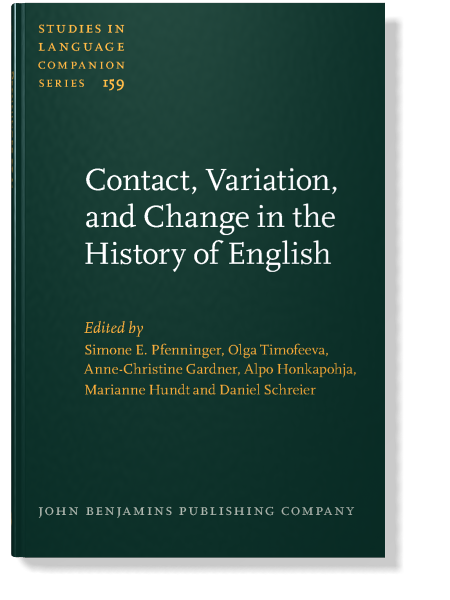
In:Contact, Variation, and Change in the History of English
Edited by Simone E. Pfenninger, Olga Timofeeva, Anne-Christine Gardner, Alpo Honkapohja, Marianne Hundt and Daniel Schreier
[Studies in Language Companion Series 159] 2014
► pp. 259–280
The subjunctive mood in Philippine English
A diachronic analysis
Published online: 11 September 2014
https://doi.org/10.1075/slcs.159.13col
https://doi.org/10.1075/slcs.159.13col
American English has been observed to be leading the way in the revival of the (mandative) subjunctive, leaving behind British English and its postcolonial “children”. Drawing on data from two sets of corpora, sampled in the 1960s and the 1990s, this paper examines the extent to which Philippine English, a distinctively American-rooted variety, has been following American patterns in its use of the subjunctive (both the mandative and the hypothetical were-subjunctive). Some of the findings reflect the historical exonormative dependence of Philippine English on its American “parent” (notably, its continuing preference for the subjunctive over should-periphrasis, and its dispreference for the indicative, in mandative constructions), while others reflect its evolutionary progression towards endonormative stability (for example its disregard for American maintenance of the traditional formality connotations of the mandative subjunctive, and for the American preference for subjunctive were over indicative was in subordinate counterfactual clauses).

References (30)
Bautista, Ma. Lourdes S. 2004. The verb in Philippine English: A preliminary analysis of the modal would
. World Englishes 23(1):113–128.
. 2009. Exemplary analyses of the Philippine English corpus. In Piakandatu ami Dr Howard P. McKaughan(In Honour of Dr Howard P. McKaughan), Loren Billings & Nelleke Goudswaard (eds), 5–23. Manila: Linguistics Society of the Philippines and SIL Philippines.
. 2010. Comparing spoken and written text types in Singapore English and Philippine English. In Inter/Sections: Isagani R. Cruz and Friends, David Jonathan Y. Bayot (ed.), 175–200. Manila: Anvil.
. 2011. Introducing the Philippine component of the International Corpus of English circa 2010. In Studies of Philippine English: Exploring the Philippine Component of the International Corpus of English, Ma. Lourdes S. Bautista (ed.), 3–22. Manila: Anvil.
Borlongan, Ariane Macalinga. 2009. A survey on language use, attitudes, and identity in relation to Philippine English among young generation Filipinos: An initial sample from a private university. The Philippine ESL Journal 3:74–107.
. 2011. Relocating Philippine English in Schneider’s dynamic model. Paper presented at the 17th International Association of World Englishes Conference, Melbourne, Australia.
Borlongan, Ariane Macalinga & Lim, Joo-Hyuk. 2012. Distinctive grammatical features of Philippine English: A meta-synthesis of corpus-based studies. Poster presented at the 33rd International Computer Archive of Modern and Medieval English (ICAME) Conference, Louvain, Belgium.
Collins, Peter, Borlongan, Ariane & Yao, Xinyue. 2014Modality in Philippine English: A diachronic study.Journal of English Linguistics42(1): 68–88.
Depraetere, Ilse & Reed, Susan. 2006. Mood and modality in English. In The Handbook of English Linguistics, Bas Aarts & April McMahon (eds), 269–290. Oxford: Blackwell.
Deuber, Dagmar, Biewer, Carolin, Hackert, Stephanie & Hilbert, Michaela. 2012.
Will and would in selected New Englishes: General and variety-specific tendencies. In Mapping Unity and Diversity World-Wide [Varieties of English around the World G43], Marianne Hundt & Ulrike Gut (eds), 77–102. Amsterdam: John Benjamins.
Gonzales, Andrew. 1997. Philippine English: A variety in search of legitimation. In Englishes Around the World. Studies in Honour of Manfred Görlach, Vol.2 [Varieties of English around the World G19], Edgar Schneider (ed.), 205–212. Amsterdam: John Benjamins.
Hundt, Marianne. 1998a. It is important that this study (should) be based on the analysis of parallel corpora: On the use of the mandative subjunctive in four major varieties of English. In The Major Varieties of English (Papers from MAVEN 1997), Hans Lindquist, Staffan Klintborg, Magnus Levin & Maria Estling (eds), 159–175. Vaxjo: Acta Wexionensia.
. 1998b. New Zealand English Grammar: Fact or Fiction? [Varieties of English around the World G23]. Amsterdam: John Benjamins.
. 2009. Colonial lag, colonial innovation, or simply language change? In One Language, Two Grammars, Gunter Rohdenburg & Julia Schlüter (eds), 13–37. Cambridge: CUP.
Hundt, Marianne, Hoffmann, Sebastian & Mukherjee, Joybrato. 2012. The hypothetical subjunctive in South Asian Englishes: Local developments in the use of a global construction. English World-Wide 33(2):147–164.
Johansson, Stig & Norheim, Else Helene. 1988. The subjunctive in British and American English. ICAME Journal 12: 27–36.
Leech, Geoffrey, Hundt, Marianne, Mair, Christian & Smith, Nicholas. 2009.
Change in Contemporary English
. A Grammatical Study. Cambridge: CUP.
Övergaard, Gerd. 1995. The Mandative Subjunctive in American and British English in the 20th Century. Uppsala: Acta Universitatis Upsaliensis.
Peters, Pam. 1998. The survival of the subjunctive: Evidence of its use in Australia and elsewhere. English World-Wide 19: 87–103.
. 2009. The mandative subjunctive in spoken English. In Comparative Studies in Australian and New Zealand English: Grammar and Beyond [Varieties of English around the World G39], Pam Peters, Peter Collins & Adam Smith (eds), 125–137. Amsterdam: John Benjamins.
Quirk, Randolph, Greenbaum, Sidney, Leech, Geoffrey & Svartvik, Jan. 1985. A Comprehensive Grammar of the English Language. London: Longman.
Schneider, Edgar W. 2000. Corpus linguistics in the Asian context: Exemplary analyses of the Kolhapur Corpus of Indian English. In Parangol Cang Brother Andrew: Festschrift for Andrew Gonzalez on His Sixtieth Birthday, Ma. Lourdes S. Bautista, Teodoro A. Llamzon & Bonifacio P. Sibayan (eds), 115–137. Manila: Linguistic Society of the Philippines.
. 2005. The subjunctive in Philippine English. In Linguistics and Language Education in the Philippines and Beyond: A Festschrift in Honor of Ma. Lourdes S Bautista, Danilo T. Dayag & Stephen Quackenbush (eds), 27–40. Manila: Linguistic Society of the Philippines.
Cited by (12)
Cited by 12 other publications
Martinez, Julius C. & Isabel Pefianco Martín
Schmidt, Karola
Schmidt, Karola & Nina Funke
Gonzales, Wilkinson Daniel Wong
2023. Broadening horizons in the diachronic and sociolinguistic study of Philippine English with the Twitter Corpus of
Philippine Englishes (TCOPE). English World-Wide. A Journal of Varieties of English 44:3 ► pp. 403 ff.
Gonzales, Wilkinson Daniel Wong
Gonzales, Wilkinson Daniel Wong
Collins, Peter & Xinyue Yao
Hundt, Marianne
2018. It is time that this(should) be studiedacross a broader range of Englishes. In Modeling World Englishes [Varieties of English Around the World, G61], ► pp. 217 ff.
Borlongan, Ariane Macalinga
Borlongan, Ariane Macalinga & Shirley N. Dita
Collins, Peter
2015. Recent diachronic change in the progressive in Philippine English. In Grammatical Change in English World-Wide [Studies in Corpus Linguistics, 67], ► pp. 271 ff.
Collins, Peter
2023. Grammatical variation in World Englishes. English World-Wide. A Journal of Varieties of English 44:2 ► pp. 184 ff.
This list is based on CrossRef data as of 3 december 2025. Please note that it may not be complete. Sources presented here have been supplied by the respective publishers. Any errors therein should be reported to them.