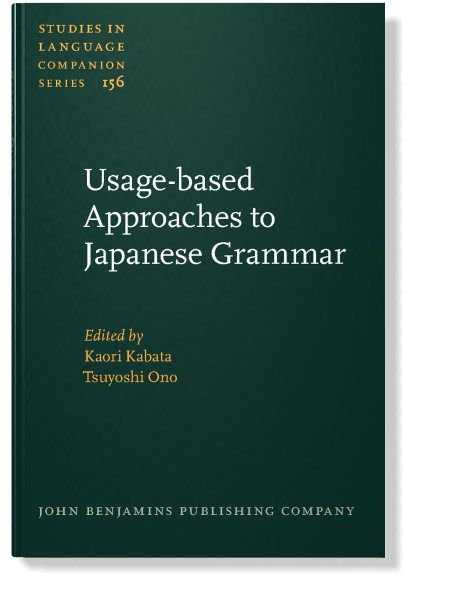
In:Usage-based Approaches to Japanese Grammar: Towards the understanding of human language
Edited by Kaori Kabata and Tsuyoshi Ono
[Studies in Language Companion Series 156] 2014
► pp. 13–36
Subordination and information status
A case of To and Koto complement clauses in Japanese
Published online: 10 June 2014
https://doi.org/10.1075/slcs.156.05mcg
https://doi.org/10.1075/slcs.156.05mcg
This paper examines one type of subordinate construction in Japanese, namely, complement clauses, in particular those where two different complementizers, to and koto, are interchangeable. Despite the general notion that main clauses code foreground information (or express a main assertion) while subordinate clauses code background information (or less profiled information), our examination shows that some subordinate clauses do code more important foreground information. Subordinate clauses are not by any means a unitary category; they display differing degrees of subordination. My goals, therefore, are to delineate differences between the two complementizer uses, and to show that clauses with to and koto present differing degrees of subordination, and that there is a correlation between degree of subordination and information status.

References (57)
Bever, Thomas G. 1969. The comprehension and memory of sentences with temporal relations.
Advances in Psycholinguistics
, Giovanni B. Flores d’Arcais & Willem J.M. Levelt (eds), 285-293. Amsterdam: North Holland.
. 1970. The cognitive basis for linguistic structures.
Cognition and the Development of Language
, John R. Hayes (ed.), 279-263. New York NY: John Wiley.
Bybee, Joan. 2002. Main clauses are innovative, subordinate clauses are conservative: Consequences for the nature of constructions. In
Complex Sentences in Grammar and Discourse: Essays in Honor of Sandra A. Thompson
, Joan Bybee & Michael Noonan (eds), 1-17. Amsterdam: John Benjamins.
Coulmas, Florian. 1985. Direct and indirect speech: General problems and problems of Japanese.
Journal of Pragmatics
9: 41-63.
Davidson, Alice. 1979. Some mysteries of subordination.
Studies in the Linguistic Science
9(1): 105-128.
Englebretson, Robert. 2003.
Searching for Structure: The Problem of Complementation in Colloquial Indonesian Conversation
[Studies in Discourse and Grammar 13]. Amsterdam: John Benjamins.
Fox, Barbara & Thompson, Sandra A. 1990. A discourse explanation of the grammar of relative clauses.
Language
66: 297-316.
Frajzynger, Zygmunt. 1991. The de dicto domain in language. In
Approaches to Grammaticalization
, Vol. 1 [Typoloical Studies in Language 19(1)], Elizabeth Closs Traugott & Bernd Heine (eds), 219-251. Amsterdam: John Benjamins.
Goldsmith, John & Woisetschlaeger, Erich. 1982. The logic of the English progressive.
Linguistic Inquiry
13: 79-90.
Haiman, John. 1985.
Natural Syntax: Iconicity and Erosion
. Cambridge: CUP.
Hayashi, Makoto. 1997. An exploration of sentence-final uses of the quotative particle in Japanese spoken discourse. In
Japanese/Korean Linguistics 6
, Ho-Min Sohn & John Haig (eds), 565-581. Stanford CA: CSLI.
Hooper, Joan B. 1975. On assertive predicates. In
Syntax and Semantics 4
, John Kimball (ed.), 91-124. New York NY: Academic Press.
Hopper, Paul. 1979. Aspect and foregrounding in discourse.
Syntax and Semantics 12
, T. Givón (ed.), 213-241. New York NY: Academic Press.
Ide, Sachiko, Ikuta, Shôko, Kawasaki, Akiko, Hori, Motoko & Haga, Hitomi. 1984.
Syuhu no Issyuukan no Danwa Siryoo
. Tokyo: Shuuei-shuppan.
Iwasaki, Shoichi. 1993.
Subjectivity in Grammar and Discourse. Theoretical Considerations and a Case Study of Japanese Spoken Discourse
[Studies in Discourse and Grammar 2]. Amsterdam: John Benjamins.
Iwasaki, Shoichi & Ono, Tsuyohi. 2002. ‘Sentence’ in spontaneous spoken Japanese discourse. In
Complex Sentence in Grammar and Discourse: Essays in Honor of Sandra A. Thompson
, Joan L. Bybee & Michael Noonan (eds), 175-202. Amsterdam: John Benjamins.
Kamada, Osamu. 1994. Nihongo no dentatsu hyoogen (Reportive expressions in Japanese).
Nihongogaku
7: 59-72.
. 1976. Subject raising. In
Syntax and Semantics, 5: Japanese Generative Grammar
, Masayoshi Shibatani (ed.), 17-49. New York NY: Academic Press.
Langacker, Ronald. 1991.
Foundations of Cognitive Grammar, Vol II: Descriptive Applications
. Stanford CA: Stanford University Press.
Longacre, Robert E. 1976. The discourse structure of the flood narrative. In
Society of Biblical Literature: 1976 Seminar Papers
, George W. MacRae (ed.), 235-262. Missoula MO: Scholars Press.
Matsuda, Kenjirô. 1998. On the conservatism of embedded clauses.
Theoretical and Applied linguistics at Kobe Shoin
1: 1-13.
Matthiessen, Christian M.I.M. & Thompson, Sandra A. 1988. The structure of discourse and ‘subordination’. In
Clause Combining in Grammar and Discourse
[Typological Studies in Language 18], John Haiman & Sandra A. Thompson (eds), 275-329. Amsterdam: John Benjamins.
Maynard, Senko. 1986. The particle –o and content-oriented indirect speech in Japanese written discourse. In
Direct and Indirect Speech
, Florian Coulmas (ed.), 179-200. Berlin: Mouton de Gruyter.
. 1996. Multivoicedness in speech and thought representation: The case of self-quotation in Japanese.
Journal of Pragmatics
25: 207-226.
McCawley, Noriko Akatsuka. 1978. Another look at no, koto and to: Epistemology and complementizer choice in Japanese. In
Problems in Japanese Syntax and Semantics
, John Hinds & Irwin Howard, 178-212. Tokyo: Kaitakusha.
McGloin, Naomi H. 1977. The Speaker’s Attitude and the Conditionals to, tara and ba
.
Papers in Japanese Linguistics
5:181-191.
. 1999. Pragmatic and discourse functions of the rhetorical negative question form, Zyanai desu ka
. In
Search of the Human Mind
, Masatake Muraki & Enoch Iwamoto (eds), 452-469. Tokyo: Kaitakusha
. 2005. Hobun hyooshiki toshite no TO no imi-saikoo (The complementizer TO revisited). In
Gengo Kyooiku no Shin-tenkai
, Osamu Kamada et al. (eds), 49-60. Tokyo: Hitsuji-shobo.
Ohori, Toshio. 1997. Framing effects in Japanese non-final clauses: Toward an optimal grammar pragmatics interface.
BLS
23: 471-480.
Okamoto, Shigeko. 1995. Pragmaticization of meaning in some sentence-final particles in Japanese. In
Essays in Semantics and Pragmatics. In Honor of Charles J. Fillmore
[Pragmatics & Beyond New Series 32], Masayoshi Shibatani & Sandra A. Thompson (eds), 219-246. Amsterdam: John Benjamins.
Okamoto, Shigeko & Ono, Tsuyoshi. 2008. Quotative –tte in Japanese: Its multifaceted functions and degrees of ‘subordination’. In
Crosslinguistic Studies of Clause Combining: The Multifunctionality of Conjunctions
[Typological Studies in Language Series 80], Ritva Laury (ed.), 205-230. Amsterdam: John Benjamins.
Ono, Tsuyoshi & Thompson, Sandra A. 1996. Interaction and syntax in the structure of conversational discourse: Collaboration, overlap, and syntactic dissociation. In
Computational and Conversational Discourse Burning Issues—An Interdisciplinary Account
, Eduard Hovy & David W. Scott (eds), 67-96. Berlin: Springer.
Prideaux, Gary D. 1993. Subordination and information distribution in oral and written narratives.
Pragmatics & Cognition
1(1): 51-69.
Schleppegrell, Mary. 1992. Subordination and linguistic complexity.
Discourse Processes
15(2): 117-131.
Sunakawa, Yuriko. 1988. In’yoobun ni okeru ba no nijuusei ni tsuite (On the duality of ‘place’ in quotation).
Nihongogaku
7: 14-29.
Suzuki, Ryoko. 1999.
Grammaticalization in Japanese: A Study of Pragmatic Particle-Ization
. PhD dissertation, University of California, Santa Barbara.
Suzuki, Satoko. 1997. The relevance of factivity to complementizer choice in Japanese.
Studies in Language
21(2): 287-311.
. 2001.
De dicto complementation in Japanese. In
Complementation: Cognitive and Functional Perspectives
[Converging Evidence in Language and Communication Research 1], Kaoru Horie (ed.), 33-57. Amsterdam: John Benjamins.
Thompson, Sandra A. 2002. ‘Object complements’ and conversation: Towards a realistic account.
Studies in Language
26(1): 125-163.
Thompson, Sandra A. & Hopper, Paul. 2001. Transitivity, clause structure, and argument structure: Evidence from conversation. In
Frequency and the Emergence of Linguistic Structure
[Typological Studies in Lanuage 45], Joan L. Bybee & Paul Hopper (eds), 27-60. Amsterdam: John Benjamins.
Cited by (2)
Cited by two other publications
Matsumoto, Yoshiko
2018. The form and meaning of the dangling mitaina construction in a network of constructions. In Pragmatics of Japanese [Pragmatics & Beyond New Series, 285], ► pp. 75 ff.
[no author supplied]
This list is based on CrossRef data as of 3 december 2025. Please note that it may not be complete. Sources presented here have been supplied by the respective publishers. Any errors therein should be reported to them.