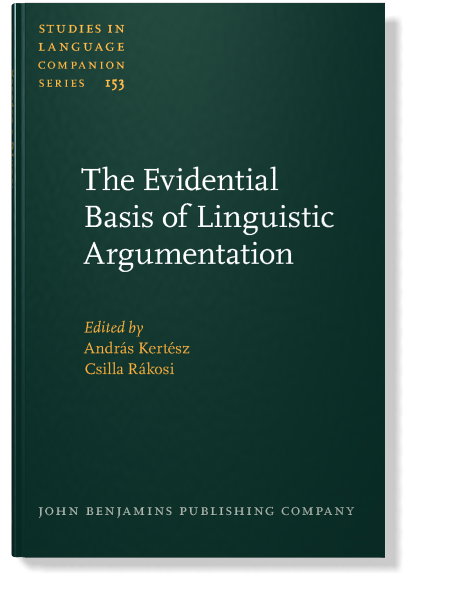
In:The Evidential Basis of Linguistic Argumentation
Edited by András Kertész and Csilla Rákosi
[Studies in Language Companion Series 153] 2014
► pp. 15–48
Chapter 2. The p-model of data and evidence in linguistics
Published online: 23 April 2014
https://doi.org/10.1075/slcs.153.02ker
https://doi.org/10.1075/slcs.153.02ker
The p-model is a metatheoretical approach to linguistic theorising that has been designed to capture the nature of linguistic data and evidence in an unorthodox and novel, but well-motivated and effective way. Its starting point is the insight that the latest literature on linguistic data and evidence acknowledged the uncertainty of the latter as their key feature. Since the main characteristic of plausible inferences is that they facilitate drawing conclusions from uncertain premises, and since chains of plausible inferences constitute the main body of the process of plausible argumentation, the basic idea of the p-model is that the structure of linguistic theories is based on various techniques of plausible argumentation. This chapter summarises the main hypotheses of the p-model, which the case studies in the volume are expected to apply to various linguistic theories.

References (39)
Anand, Pranav & Nevins, Andrew. 2004. Shifty operators in changing contexts. In
Proceedings of the 14th Conference on Semantics and Linguistic Theory
, Kazuha Watanabe & Robert B. Young.(eds), 20–37. Ithaca NY: CLC Publications.
Baltin, Mark R. 1987. Degree Complements. In
Discontinuous Constituency
[Syntax and semantics 20], Geoffrey J. Huck & Almerindo E. Ojeda, (eds), 11–26. Orlando FL: Academic Press.
Bibok, Károly. This volume. The plausibility of approaches to syntactic alternation of Hungarian verbs.
Colon, Germà. 1978a [1959]. El perfet perifràstic català “va + infinitiu”. (The Catalan periphrastic perfect “va + infinitive”). In
La llengua catalana en els seus textos
(The Catalan language of texts),Vol.2, Germà Colon (ed), 119–130. Barcelona: Curial.
. 1978b[1976]. Sobre el perfet perifràstic ‘vado + infinitiu’, en català, en provençal i en francès (On the periphrastic perfect ‘vado + infinitive’ in Catalan, Provençal and, French). In
La llengua catalana en els seus textos
(The Catalan language of texts), Vol. 2, Germà Colon (ed.), 131–174. Barcelona: Curial.
Detges, Ulrich. 2004. How cognitive is grammaticalization? The history of the Catalan perfet perifràstic
. In
Up and Down the Cline – The Nature of Grammaticalization
[Typological Studies in Language 59], Olga Fischer, Muriel Norde & Harry Perridon (eds), 211–227. Amsterdam: John Benjamins.
Gougenheim, Georges. 1971 [1929].
Étude sur les périphrases verbales de la langue française
. Paris: Nizet.
Juge, Matthew L. 2006. Morphological factors in the grammaticalization of the Catalan “go” past.
Diachronica
23(2): 313–339.
Kaplan, David. 1989. Demonstratives. In
Themes from Kaplan,
Joseph Almog, John Perry & Howard Wettstein (eds), 481–563. Oxford: OUP.
(eds). 2005.
Linguistic Evidence. Empirical, Theoretical and Computational Perspectives
. Berlin: De Gruyter.
Kertész, András. 1993.
Heuristik der deutschen Phonologie. Eine elementare Einführung in Strategien der Problemlösung
. Budapest: Akadémiai Kiadó.
. 2004a.
Philosophie der Linguistik. Studien zur naturalisierten Wissenschaftstheorie
. Tübingen: Narr.
. 2004b.
Cognitive Semantics and Scientific Knowledge. Case studies in the Cognitive Science of Science
[Converging Evidence in Languag and Communication Research 4]. Amsterdam: John Benjamins.
Kertész, András & Rákosi, Csilla. 2006. Inconsistency and plausible reasoning in an analysis of German affricates. A case study in the philosophy of linguistics.
Language Sciences
28: 386–423.
. 2009. Cyclic vs. circular argumentation in the conceptual metaphor theory.
Cognitive Linguistics
20(4): 703–732.
. 2013. Paraconsistency and plausible argumentation in generative grammar: A case study.
Journal of Logic, Language and Information
22(2): 195–230.
Keszler, Borbála (ed.). 2000.
Magyar grammatika
(Hungarian grammar). Budapest: Nemzeti Tankönyvkiadó.
Komlósy, András. 1994. Complements and adjuncts. In
Syntax and Semantics
27, Ferenc Kiefer & Katalin É. Kiss (eds), 91–178. New York NY: Academic Press.
Nagy C., Katalin. This volume. Methods and argumentation in historical linguistics: A case study.
Németh T., Enikő. This volume. Hungarian verbs of natural phenomena with explicit and implicit subject arguments: their use and occurrence in the light of data.
Pinker, Steven. 1989.
Learnability and Cognition: The Acquisition of Argument Structure
. Cambridge MA: The MIT Press.
Rákosi, Csilla. This volume. Data and the resolution of inconsistency in Optimality Theory.
Sárik, Pál. 1998. A határozói igenevek néhány problémája (Some problems of adverbial participles).
Magyar Nyelv
94: 423–435.
von Stechow, Arnim. 2003. Feature deletion under semantic binding: Tense, person, and mood under verbal quantifiers. In NELS 33: Proceedings of the Thirty-Third Annual Meeting of the North East Linguistic Society, GLSA, Makoto Kadowaki & Shigeto Kawahara (eds), 379–404. Amherst MA: University of Massachusetts.
Tóth, Ildikó. 2001. Impersonal constructions and null expletives. In
Argument structure in Hungarian,
Istvan Kenesei (ed.), 51–78. Budapest: Akadémiai Kiadó.
Vecsey, Zoltán. This volume. A plausibility-based model of shifted in dexicals.
Cited by (7)
Cited by seven other publications
Furkó, Péter B.
Furkó, Péter, András Kertész & Ágnes Abuczki
Rákosi, Csilla
Kertész, András
Kertész, András
This list is based on CrossRef data as of 3 december 2025. Please note that it may not be complete. Sources presented here have been supplied by the respective publishers. Any errors therein should be reported to them.