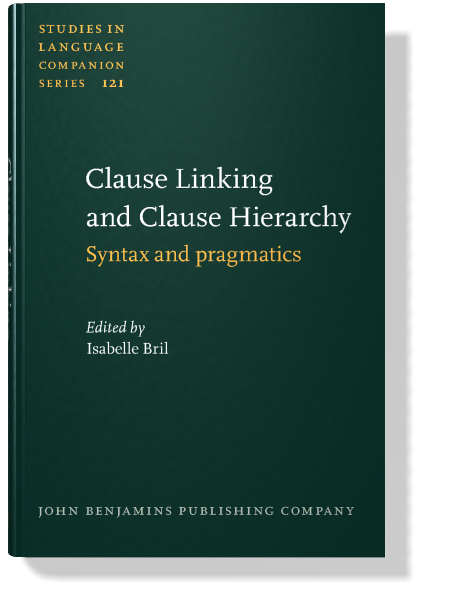
In:Clause Linking and Clause Hierarchy: Syntax and pragmatics
Edited by Isabelle Bril
[Studies in Language Companion Series 121] 2010
► pp. 203–266
Coordination, converbs and clause chaining in Coptic Egyptian typology and structural analysis
Published online: 25 November 2010
https://doi.org/10.1075/slcs.121.07rei
https://doi.org/10.1075/slcs.121.07rei
Coptic Egyptian (3rd–13th c. CE) possesses a large variety of coordinating constructions. The most central pattern for symmetric clause linkage involves the coordinating conjunction awɔː ‘and’. Symmetric awɔː-coordinations at different levels (phrasal, clausal, discourse paragraph) differ systematically in meaning. In the domain of asymmetric clause coordination the language employs special verb conjugations. The focus of this study is on converbs and conjunctive verbs. Coordinating converbs belong to the paradigm of relative tenses, which formally distinguish a large family of focus-sensitive constructions from pragmatically neutral declarative sentences. The conjunctive covers a broad spectrum of semantic relations between clauses, crossing the traditional distinction between coordination and subordination.

Cited by (2)
Cited by two other publications
Cristofaro, Sonia
2016. Chapter 15. Routes to insubordination. In Insubordination [Typological Studies in Language, 115], ► pp. 393 ff.
Jantunen, Tommi
This list is based on CrossRef data as of 3 december 2025. Please note that it may not be complete. Sources presented here have been supplied by the respective publishers. Any errors therein should be reported to them.