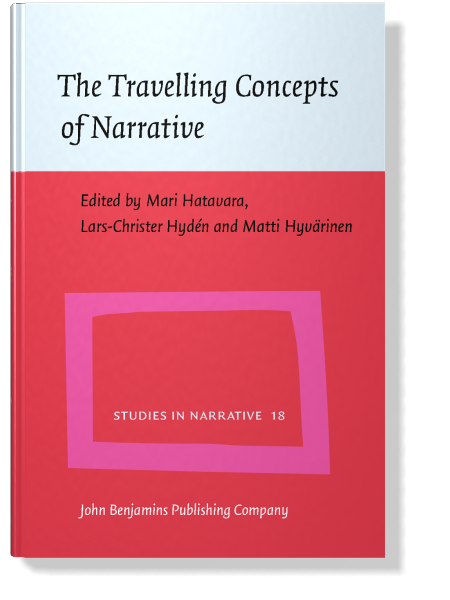
In:The Travelling Concepts of Narrative
Edited by Mari Hatavara, Lars-Christer Hydén and Matti Hyvärinen
[Studies in Narrative 18] 2013
► pp. 13–42
Travelling metaphors, transforming concepts
Published online: 27 June 2013
https://doi.org/10.1075/sin.18.03hyv
https://doi.org/10.1075/sin.18.03hyv
This volume discusses the travelling concepts of narrative. But what do we understand by “travelling concepts”? I address this issue by reading Mieke Bal, who originally suggested the term, and by scrutinizing the metaphor of travel itself. Do we assume that the concept of narrative has remained the same over the course of its travels? The chapter suggests that there are many levels to consider in using the term travellers: the abstract idea and metaphor of narrative, the concept, the narrative theory. Instead of mere travel, the concept of narrative itself has changed, often covertly, but with substantial consequences. The chapter discusses the difference between top-down and bottom-up approaches to narrativity in social research. The metaphorical discourse on narrative has enlarged the concept’s range of reference substantially and too far afield for many commentators, while keeping the criteria of the concept formal and conventional. The end of the chapter examines these narrative metaphors of life critically, finally by discussing the manner in which Ian McEwan’s novel On Chesil Beach thematizes and contests ubiquity and portability of narrative as a concept and metaphor.

Cited by (11)
Cited by 11 other publications
Asboth, Eva Tamara
Dollinger, Bernd, Holger Schmidt & Daniel Stein
Heikkinen, Hannu L. T. & Raili Keränen-Pantsu
Arizmendi González, Graciela, Rebecca Day Babcock & Amy Hodges
Murray, Lesley, Amanda Holt, Sian Lewis & Jessica Moriarty
Eiranen, Reetta, Mari Hatavara, Ville Kivimäki, Maria Mäkelä & Raisa Maria Toivo
Lingua, Valeria
Flink, Tim & Tobias Peter
This list is based on CrossRef data as of 2 december 2025. Please note that it may not be complete. Sources presented here have been supplied by the respective publishers. Any errors therein should be reported to them.