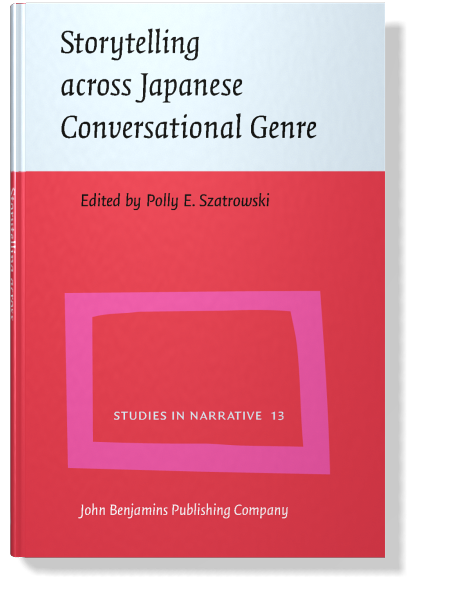
In:Storytelling across Japanese Conversational Genre
Edited by Polly E. Szatrowski
[Studies in Narrative 13] 2010
► pp. 241–266
Chapter 8. The functions of narratives in Japanese university lecture discourse
Published online: 29 September 2010
https://doi.org/10.1075/sin.13.13ch8
https://doi.org/10.1075/sin.13.13ch8
In this paper I present a new perspective on narratives in university
lectures by suggesting criteria for categorizing narratives in relation to
the preceding and following context. Based on an analysis of the narratives
in four Japanese university lectures on Buddhism, Statistics, Eastern
European History and Education, I address the questions of how narratives in
university lectures are introduced, how they function and how they relate to
the preceding and subsequent discourse. I categorized the narratives in my
data into 4 types and 3 subtypes based on their textual and interpersonal
functions: (1) Illustration, (2) Elaboration (a. Detail, b. Review/Preview,
c. Epitome), (3) Presentation of Topic/Problem, and (4) Rapport.
Illustration narratives are preceded by an abstract idea and provide an
explanation for or give an example related to that idea. Elaboration
narratives provide important details that create the very content of the
lecture, and can be further divided into three types: Detail, Review/Preview
and Epitome. Presentation of Topic/Problem narratives introduce a topic or
provide a problem to be interpreted subsequently in the lecture. Finally, in
Rapport narratives, the professor relates his/her personal experiences in
order to help bring the professor and students together. By analyzing the
discourse organization in which the narratives are embedded, I demonstrate
how the narratives connect to and contribute to the lecture content.
