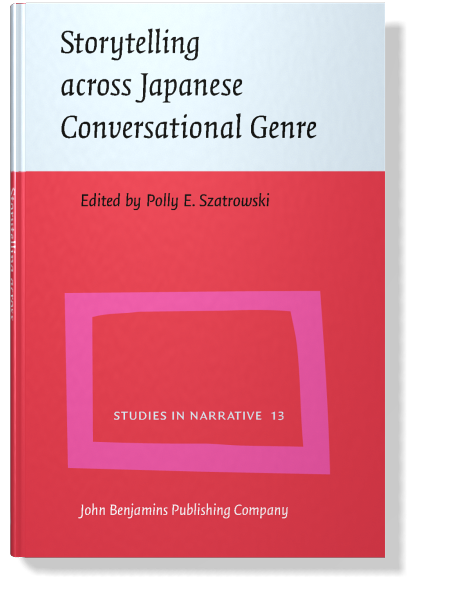
In:Storytelling across Japanese Conversational Genre
Edited by Polly E. Szatrowski
[Studies in Narrative 13] 2010
► pp. 183–210
Chapter 6. Storytelling in a Japanese television talk show
A host’s responsive behavior as a resource for shaping the guest’s story
Published online: 29 September 2010
https://doi.org/10.1075/sin.13.10ch6
https://doi.org/10.1075/sin.13.10ch6
The present study investigates the host’s responsive behavior (continuers,
repetition, and stance displays) in a Japanese talk show segment and
demonstrates how the host contributes to the construction of the guest’s
story. The analysis shows that the host uses continuers to keep the guest
talking, and repetition in clarification requests to help make the guest’s
talk more comprehensible to the audience. While the host does the above to
maintain an objective stance as facilitator of the show, other devices/body
behavior allow her to go beyond this stance. By using the disalignment
markers E- ‘What?’ and A ‘Oh’ before repeating a part or all of the guest’s
preceding utterance, and accompanying her repetition with laughter and
posture changes, the host indicates that a positive image of the guest
should be promoted. In addition, the host uses lengthened vocalizations
(e.g., Ha:::::::: ‘O::::::::h’) to express a stance of
strong appreciation and agreement at the end of the guest’s story, which
also supports the guest in a positive way. In sum, by using various
strategies, the host in the talk show does much more than just remain a
passive listener, and indeed plays an active role in helping to shape the
guest’s story.

Cited by (1)
Cited by one other publication
This list is based on CrossRef data as of 2 december 2025. Please note that it may not be complete. Sources presented here have been supplied by the respective publishers. Any errors therein should be reported to them.