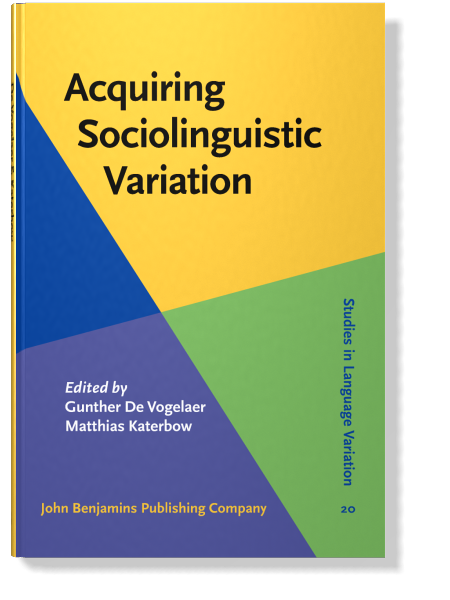
In:Acquiring Sociolinguistic Variation
Edited by Gunther De Vogelaer and Matthias Katerbow
[Studies in Language Variation 20] 2017
► pp. 1–41
Chapter 1Bridging the gap between language acquisition and sociolinguistics
Introduction to an interdisciplinary topic
Published online: 30 September 2017
https://doi.org/10.1075/silv.20.01dev
https://doi.org/10.1075/silv.20.01dev
Abstract
Despite repeated calls for in-depth research, the acquisition of patterns of sociolinguistic variation has long been an underinvestigated topic both in sociolinguistics and in language acquisition research. With the exception of a few exploratory studies, most notably Labov (1964), it has long been rare for sociolinguistic research to focus on non-adults, whereas most research on language acquisition tended to take place in a sociolinguistic vacuum (see, e.g. Mills 1985: 142 and Labov 1989: 96 for statements to this effect). Over the last few years, however, the situation seems to be changing. Two reasons may be given for this: first, and quite trivially perhaps, technical advancements are making it possible to gather, store and explore data in cheap and efficient ways, providing researchers with the necessary data to conduct empirically sound research on the topic. And second, parallel to a paradigm shift from rule-based to usage-based conceptions of grammar, linguistic variation has moved into the centre of the attention of theoretical linguistics. As a result, the acquisition of variation can now be considered an ‘emergent topic’ in research on language variation in general.
The aim of this book is to offer a state-of-the-art of current research on the topic, thereby focusing on two particular objectives: (1) the acquisition of sociolinguistic variation presents itself as an interesting research topic for sociolinguists and psycholinguists working on acquisition, but also for a broad range of other sub-disciplines of linguistics, including historical linguistics, dialectology, and for researchers working in different theoretical frameworks. This book aims at bridging the gap between these disciplines and frameworks and allowing an interdisciplinary perspective on the topic; and (2) in order to enable cross-linguistic comparison, the book wants to bring together research carried out in different sociolinguistic constellations, as most obviously found in different language areas or different countries.
Article outline
- 1.Introduction
- 2.Research on the acquisition of variation before 2000
- 2.1General characterisation: Three important lines of research
- 2.2Second dialect acquisition and other attainment issues
- 2.3Transmitting attitudes from caregivers to children
- 2.4Children, adults, and language change
- 3.Current trends in research on acquisition of variation
- 3.1The acquisition of sociolinguistic variation as an emerging research field
- 3.2From generative grammar to variable rules
- 3.3Usage- and exemplar-based models
- 3.4Sociolinguistic cognition and cognitive sociolinguistics
- 3.4.1When sociolinguistics meets psycholinguistics
- 3.4.2Cognitive sociolinguistics, sociolinguistic cognition, acquisition of variation
- 3.4.3What sociolinguistics and psycholinguistics could bring to each other
- 4.The need for cross-linguistic research: This book
- 4.1Article summaries
- 4.2General characterisation and future perspectives
Notes References

References (159)
Allerup, Peter, Mogens Jansen, Henrik Löb, and Børge Prien. 1979. Retstavning: Nogle første analyser af folkeskolens afgangsprøve i 1978: Vol. III: Nogle statistiske analyser. København: Danmarks Pædagogiske Institut.
Ambridge, Ben, and Lieven, Elena V.M. 2011. Child Language Acquisition: Contrasting Theoretical Approaches. Cambridge: Cambridge University Press.
Ammon, Ulrich. 1989. “Aspects of Dialect and School in the Federal Republic of Germany.” In Dialect and Education: Some European Perspectives, ed. by Jenny Cheshire, Viv Edwards, Henk Münstermann, and Bert Weltens, 113–138. Clevedon, and Philadelphia: Multilingual matters.
Andler, Daniel. 2006. “Sciences Cognitives. Encyclopædia Universalis.” Accessed October 11, 2016. [URL]
Auer, Peter. 2005. “Europe's Sociolinguistic Unity, or: A Typology of European Dialect/Standard Constellations.” In Perspectives on Variation: Sociolinguistic, Historical, Comparative, ed. by Nicole Delbecque, Johan van der Auwera, and Dirk Geeraerts, 7–42. Berlin: Mouton de Gruyter.
Auer, Peter, and Frans Hinskens. 2005. “The Role of Interpersonal Accommodation in a Theory of Language Change.” In Dialect Change: The Convergence and Divergence of Dialects in Contemporary Societies, ed. by Peter Auer, Frans Hinskens, and Paul Kerswill, 335–357. Cambridge: Cambridge University Press.
Barbu, Stéphanie, Aurélie Nardy, Jean-Pierre Chevrot, and Jacques Juhel. 2013. “Language Evaluation and Use during Early Childhood: Adhesion to Social Norms or Integration of Environmental Regularities?” Linguistics 51 (2): 381–411.
Beller, Sieghard, Andrea Bender, and Douglas L. Medin. 2012. “Should Anthropology Be Part of Cognitive Science?” Topics in Cognitive Science 4 (3): 342–353.
Berthele, Raphael. 2002. “Learning a Second Dialect. A Model of Idiolectal Dissonance.” : Multilingual 21 (4): 327–344.
Blakemore, Sarah-Jayne, Joel Winston, and Uta Frith. 2004. “Social Cognitive Neuroscience: Where Are We Heading?” Trends in Cognitive Sciences 8 (5): 216–222.
Blom, Jan-Petter, and John J. Gumperz. 1972. “Social Meaning in Linguistic Structures: Code Switching in Northern Norway.” In Directions in Sociolinguistics, ed. by John J. Gumperz, and Dell Hymes, 407–434. New York: Holt, Rinehart and Winston.
Blum-Kulka, Shoshana. 2004. “The Role of Peer Interaction in Later Pragmatic Development: The Case of Speech Representation.” In Language Development across Childhood and Adolescence, ed. by Ruth A. Berman, 191–210. Amsterdam: John Benjamins.
Bucholtz, Mary. 1999. “‘Why Be Normal?’ Language and Identity Practices in a Community of Nerd Girls.” Language in Society 28 (2): 203–223.
Buson, Laurence. 2009. Variation stylistique entre 5 et 11 ans et réseaux de socialisation scolaire: Usages, représentations, acquisition et prise en compte éducative. Ph.D. Dissertation University of Grenoble.
Bybee, Joan L. 2001a. “Frequency Effects on French Liaison.” In Frequency and the Emergence of Linguistic Structure, ed. by Joan L. Bybee, and Paul J. Hopper, 337–359. Philadelphia: John Benjamins.
Bybee, Joan L., and Dan I. Slobin. 1982. “Rules and Schemas in the Development and Use of the English Past Tense.” Language 58 (2): 265–289.
Campbell-Kibler, Kathryn. 2010. “New Directions in sociolinguistic cognition.” In University of Pennsylvania Working Papers in Linguistics 15 (2): 31–39.
Chambers, J.K. 1988. “Acquisition of Phonological Variants.” In Methods in Dialectology: Proceedings of the 6. Internat. Conference Held at the Univ. College of North Wales, 3rd–7th August 1987, ed. by Alan Thomas, and Martin Ball, 650–665. Clevedon.
2003. Sociolinguistic Theory: Linguistic Variation and Its Social Significance. 2nd ed. Oxford: Blackwell.
Cheshire, Jenny, Viv Edwards, Henk Münstermann, and Bert Weltens. 1989. “Introduction.” In Dialect and Education: Some European Perspectives, ed. by Jenny Cheshire, Viv Edwards, Henk Münstermann, and Bert Weltens, 113–138. Clevedon, and Philadelphia: Multilingual matters.
Cheshire, Jenny, Jacomine Nortier, and David Adger. 2015. Emerging Multiethnolects in Europe. London: University of London.
Chevrot, Jean-Pierre. 1994. “La variation phonétique: Un point de vue cognitif.” Langage et société 70 (1): 5–33.
. 2012. “Que reste-t-il de la distinction compétence-performance dans les théories fondées sur l’usage?” Mémoires de la Société de Linguistique de Paris 22 (‘L’éventail des compétences linguistiques et la (dé)valorisation des performances’): 49–68.
Chevrot, Jean-Pierre, Aurélie Nardy, and Stéphanie Barbu. 2011. “Developmental Dynamics of SES-Related Differences in Children’s Production of Obligatory and Variable Phonological Alternations.” Language Sciences 33 (1): 180–191.
Chevrot, Jean-Pierre, Laurence Beaud, and Renata Varga. 2001. “Developmental Data on a French Sociolinguistic Variable: The Word-Final Post-Consonantal /R/.” Language Variation and Change 12 (3): 295–319.
Chevrot, Jean-Pierre, and Paul Foulkes. 2013. “Introduction: Language Acquisition and Sociolinguistic Variation.” Linguistics 51 (2): 251–254.
Clark, Lynn. 2009. “Cognitive Sociolinguistics: A Viable Approach to Variation in Linguistic Theory.” Lacus Forum 33: 105–118.
Clyne, Michael. 2000. “Lingua Franca and Ethnolects in Europe and Beyond.” Sociolinguistica 14 (1): 83–89.
Cole, Roger L. 1975. “Divergent and Convergent Attitudes towards the Alsatian Dialect.” Anthropological Linguistics 17 (6): 293–304.
Cornelissen, Georg. 1998. “Taal en onderwijs in Noord-Limburg in de Franse tijd (1794–1814).” Vereniging voor Limburgse Dialect- en Naamkunde 96: 3–30.
Cornips, Leonie, and Aafke Hulk. 2006. “External and Internal Factors in Bilingual and Bidialectal Language Development: Grammatical Gender of the Dutch Definite Determiner.” In L2 Acquisition and Creole Genesis: Dialogues, ed. by Claire Lefebvre, Lydia White, and Christine Jourdan, 355–378. Amsterdam: John Benjamins.
Cremona, Cristiana, and Elizabeth Bates. 1977. “The Development of Attitudes toward Dialect in Italian Children.” Journal of Psycholinguistic Research 6: 223–232.
Croft, William. 2000. Explaining language change. An evolutionary approach. Harlow: Pearson Longman.
Croft, William, and D. Alan Cruse. 2004. Cognitive Linguistics. Cambridge: Cambridge University Press.
Daan, Jo, Kas Deprez, Roeland van Hout, and Jan Stroop. 1985. Onze veranderende taal. Utrecht: Spectrum.
Day, Richard R. 1980. “The Development of Linguistic Attitudes and Preferences.” TESOL Quarterly 14 (1): 27–37.
De Houwer, Annick. 2003. “Language Variation and Local Elements in Family Discourse.” Language Variation and Change 15 (3): 329–349.
De Saussure, Ferdinand. 1916. Cours de linguistique générale, ed. by Charles Bally, and Albert Sechehaye. Paris: Payot.
De Vogelaer, Gunther, and Guido Seiler. 2012. “The Dialect Laboratory: Introductory Remarks.” In The Dialect Lab: Using Dialects as a Testing Ground for Theories of Language Change, ed. by Gunther De Vogelaer, and Guido Seiler, 1–31. Amsterdam: John Benjamins.
De Vogelaer, Gunther, and Jan Klom. 2013. “Mikrovariation beim Erwerb des niederländischen Genussystems.” In Dialektologie in neuem Gewand: Zu Mikro-/Varietätenlinguistik, Sprachenvergleich und Universalgrammatik, ed. by Werner Abraham, and Elisabeth Leiss, 141–169. Hamburg: Helmut Buske Verlag.
Díaz-Campos, Manuel. 2004. “Acquisition of Sociolinguistic Variables in Spanish: Do Children Acquire Individual Lexical Forms or Variable Rules.” In Laboratory Approaches to Spanish Phonology, ed. by Timothy L. Face, 221–236. Berlin, and New York: Mouton de Gruyter.
. 2005. “The Emergence of Adult-like Command of Sociolinguistic Variables: A Study of Consonant Weakening in Spanish-Speaking Children.” In Selected Proceedings of the 6th Conference on the Acquisition of Spanish and Portuguese as First and Second Languages, ed. by David Eddington, 56–65. Somerville: Cascadilla Proceedings Project.
Diessel, Holger. 2012. “New Perspectives, Theories and Methods: Diachronic Change and Language Acquisition.” In Historical Linguistics of English: An International Handbook, ed. by Alexander Bergs, and Laurel Brinton, 1599–1613. Berlin, and New York: Mouton de Gruyter.
Docherty, Gerard J., and Paul Foulkes. 2014. “An Evaluation of Usage-Based Approaches to the Modelling of Sociophonetic Variability.” Lingua 142: 42–56.
Dorleijn, Margreet, Maarten Mous, and Jacomine Nortier. 2015. “Urban Youth Speech in Kenya and the Netherlands.” In Language, Youth and Identity in the 21st Century: Linguistic Practices across Urban Spaces, ed. by Jacomine Nortier, and Bente A. Svendsen, 271–289. Cambridge: Cambridge University Press.
Eckert, Penelope. 1989. Jocks and Burnouts: Social Identity in the High School. New York: Teachers College Press.
. 1997. “Why Ethnography?” In Ungdomssprak i Norden, ed. by Ulla-Britt Kotsinas, Anna-Brita Stenstrom, and Anna-Malin Karlsson, 52–62. Stockholm: Stockholm University.
. 2004. “Adolescent Language.” In Language in the USA, ed. by Edward Finegan, and John R. Rickford, 361–374. New York: Cambridge University Press.
. 2012. “Three Waves of Variation Study: The Emergence of Meaning in the Study of Sociolinguistic Variation.” Annual Review of Anthropology 41: 87–100.
Ervin-Tripp, Susan M. 1973. “The Structure of Communicative Choice.” In Language Acquisition and communicative choice, ed. by Susan M. Ervin-Tripp, and Anwar S. Dil, 302–373. Stanford: Stanford University Press.
Foulkes, Paul. 2010. “Exploring Social-Indexical Knowledge: A Long Past but a Short History.” Laboratory Phonology 1 (1): 5–40.
Foulkes, Paul, and Gerard J. Docherty. 2006. “The Social Life of Phonetics and Phonology.” Journal of Phonetics 34: 409–438.
Foulkes, Paul, Gerard J. Docherty, and Dominic J.L. Watt. 2001. “The Emergence of Structured Variation.” University of Pennsylvania Working Papers in Linguistics 7.3 – A Selection of Papers from NWAV 29: 67–84.
Garrett, Peter. 2007. “Language attitudes.” In The Routledge Companion to Sociolinguistics, ed. by Carmen Llamas, Louise Mullany, and Peter Stockwell, 116–121. London, and New York: Routledge.
Garrod, Simon, and Martin J. Pickering. 2004. “Why is conversation so easy?” Trends in Cognitive Sciences 8 (1): 8–11.
Geeraerts, Dirk. 2003. “Cultural Models of Linguistic Standardization.” In Cognitive Models in Language and Thought: Ideology, Metaphors, and Meaning, ed. by René Dirven, Roselyn Frank, and Martin Pütz, 25–68. Berlin: Mouton de Gruyter.
Geerts, Guido, Johan Nootens, and Jef van den Broeck. 1978. “Flemish Attitudes towards Dialect and Standard Language: A Public Opinion Poll.” International Journal of the Sociology of Language 15 (1): 33–46.
Ghimenton, Anna, Jean-Pierre Chevrot, and Jacqueline Billiez. 2013. “Language Choice Adjustments in Child Production during Dyadic and Multiparty Interactions: A Quantitative Approach to Multilingual Interactions.” Linguistics 51 (2): 413–438.
Giesbers, Herman. 1989. Code-switching tussen dialect en standaardtaal. Amsterdam: P.J. Meertens-Instituut.
Giles, Howard, Richard Bourhis, Alan Lewis, and Peter Trudgill. 1974. “The Imposed Norm Hypothesis: A Validation.” Quarterly Journal of Speech 60 (4): 405–410.
Goodman, Yetla, and Kenneth Goodman. 1981. “Twenty Questions about Teaching Language.” Educational Leadership 38: 437–443.
Gregoire, Henri-Baptiste. 1794. Rapport sur la nécessité et les moyens d'anéantir les patois et d'universaliser la langue française. Paris.
Gülzow, Insa, and Natalia Gagarina. 2011. Frequency Effects in Language Acquisition: Defining the Limits of Frequency as an Explanatory Concept. Berlin, and Boston: De Gruyter Mouton.
Häcki Buhofer, Annelies, and Harald Burger. 1998. Wie Deutschschweizer Kinder Hochdeutsch lernen: Der ungesteuerte Erwerb des gesprochenen Hochdeutschen durch Deutschschweizer Kinder zwischen sechs und acht Jahren. Stuttgart: Franz Steiner Verlag.
Henry, Alison. 1995. Belfast English and Standard English: Dialect Variation and Parameter Setting. Oxford, and New York: Oxford University Press.
Hinskens, Frans, Peter Auer, and Paul Kerswill. 2005. “The Study of Dialect Convergence and Divergence: Conceptual and Methodological Considerations.” In The Convergence and Divergence of Dialects in Contemporary Societies, ed. by Peter Auer, Frans Hinskens, and Paul Kerswill, 1–48. Cambridge: Cambridge University Press.
Hollingworth, Brian. 1989. “Education and the Vernacular.” In Dialect and Education: Some European Perspectives, ed. by Cheshire, Jenny, Viv Edwards, Henk Münstermann, and Bert Weltens, 293–302. Clevedon: Multilingual matters.
Hoyle, Susan M., and Carolyn T. Adger. 1998. “Introduction.” In Kids Talk: Strategic Language Use in Later Childhood, ed. by Susan M. Hoyle, and Carolyn T. Adger, 3–22. Oxford: Oxford University Press.
Jones, Peter E. 2013. “Bernstein’s ‘Codes’ and the Linguistics of ‘Deficit’.” Language and Education 27 (2): 161–179.
Katerbow, Matthias. 2013. Spracherwerb und Sprachvariation: Eine phonetisch-phonologische Analyse zum regionalen Erstspracherwerb im Moselfränkischen. Berlin, and New York: Mouton de Gruyter.
Katerbow, Matthias, Lena Eichele, and Christina Kauschke. 2011. “Einstellungen zu kindlicher Sprachvariation: Eine empirische Studie zur Fremdbewertung regionalsprachlicher und/oder störungsbedingter Variation von Kindern.” Linguistische Berichte 228: 467–484.
Kaufmann, Laurence, and Fabrice Clément. 2011. “L’esprit des sociétés. Bilan et perspectives en sociologie cognitive.” In La sociologie cognitive, ed. by Laurence Kaufmann, and Fabrice Clément, 7–40. Paris: Ophrys.
Kemmer, Suzanne, and Michael Barlow. 2000. “Introduction: A Usage-Based Conception of Language.” In Usage-based Models of Language Use, ed. by Michael Barlow, and Suzanne Kemmer, VII–XXVIII. Stanford: CSLI Publications.
Kemmer, Suzanne, and Michael Israel. 1994. “Variation and the Usage-Based Model.” In Papers from the 30th Regional Meeting of the Chicago Linguistics Society: Para-Session on Variation and Linguistic Theory: Vol. 2, ed. by Katherine Beals, Jeannette Denton, Robert Knippen, Lynette Melnar, Hisami Suzuki, and Erica Zeinfeld, 165–179. Chicago: Chicago Linguistics Society.
Kern, Friederike, and Margret Selting. 2011. Ethnic Styles in European Metropolitan Areas. Amsterdam: John Benjamins.
Kerswill, Paul. 1996. “Children, Adolescents, and Language Change.” Language Variation and Change 8 (2): 177–202.
. 2007. “Social Class.” In The Routledge Companion to Sociolinguistics, ed. by Carmen Llamas, Louise Mullany and Peter Stockwell, 51–61. London, and New York: Routledge.
Kerswill, Paul, and Ann Williams. 2000. “Creating a New Town Koine: Children and Language Change in Milton Keynes.” Language in Society 29 (1): 65–115.
Kinzler, Katherine D., and Jasmine M. DeJesus. 2013. “Northern = Smart and Southern = Nice: The Development of Accent Attitudes in the United States.” The Quarterly Journal of Experimental Psychology 66 (6): 1146–1158.
Kristiansen, Gitte, and René Dirven. 2008. Cognitive Sociolinguistics: Language Variation, Cultural Models, Social Systems. Berlin: Mouton De Gruyter.
Kristiansen, Tore, and Jens Normann Jørgensen. 2011. “Subjective Factors in Dialect Convergence and Divergence.” In Dialect Change: Convergence and Divergence in European Languages, ed. by Peter Auer, Frans Hinskens, and Paul Kerswill, 287–302. Cambridge: Cambridge University Press.
Kroon, Sjaak, and Ton Vallen. 2009. “Discoursen over dialect en school.” In De klank van de stad: Stedelijke meertaligheid en interculturele communicatie, ed. by Jürgen Jaspers, 165–181. Leuven: Acco.
Labov, William. 1964. “Stages in the Acquisition of Standard English.” In Social Dialects and Language Learning, ed. by Roger W. Shuy, Alva Davis, Robert Hogan, 77–103. Champaign: National Council of Teachers of English.
. 1972a. Language in the Inner City: Studies in the Black English Vernacular. Philadelphia: University of Pennsylvania Press.
. 2014. “What Is to Be Learned? The Community as the Focus of Social Cognition.” In Cognitive Sociolinguistics: Social and Cultural Variation in Cognition and Language Use, ed. by Martin Pütz, Justyna A. Robinson, and Monika Reif, 23–51. Amsterdam: John Benjamins.
Lacoste, Véronique, and Lisa Green. 2016. “Child Language Variation: Sociolinguistic and Formal Approaches.” Linguistic Variation 16: 1–11.
Levinson, Stephen C. 2012. “The Original Sin of Cognitive Science.” Topics in Cognitive Science 4 (3): 396–403.
Lightfoot, David. 1999. The Development of Language: Acquisition, Change, and Evolution. Oxford: Blackwell.
Loudermilk, Brandon C. 2013. “Psycholinguistic Approaches.” In The Oxford Handbook of Sociolinguistics, ed. by Robert Bayley, Richard Cameron, and Ceil Lucas, 132–152. Oxford: Oxford University Press.
Macaulay, Ronald K.S. 1977. Language, Social Class, and Education: A Glasgow Study. Edinburgh: Edinburgh University Press.
Makoni, Sinfree, and Alastair Pennycook. 2007. “Disinventing and Reconstituting Languages.” In Disinventing and Reconstituting Languages, ed. by Sinfree Makoni, and Alastair Pennycook, 1–41. Clevedon: Multilingual Matters.
Martin, Nathaël. 2005. Réseaux sociaux et variations phonétiques. Grenoble: Université Stendhal Master 1 dissertation.
Martin, Nathaël, Jean-Pierre Chevrot, and Stéphanie Barbu. 2010. “Stylistic Variations in the Social Network of a 10-Year-Old Child: Pragmatic Adjustments or Automatic Alignment?” Journal of Sociolinguistics 14 (5): 678–692.
Martino, Josephine. 1982. “The Phoneme /θ/ and Its Alternative Realization as /f/: A Study of Variation in Australian English among Primary School Boys, According to Socio-Economic Background.” Working Papers in Linguistics 8: 39–42.
Mattheier, Klaus J. 1980. Pragmatik und Soziologie der Dialekte: Einführung in die kommunikative Dialektologie des Deutschen. Heidelberg: Quelle & Meyer.
Mills, Anne E. 1985. “The Acquisition of German.” In: The Crosslinguistic Study of Language Acquisition, ed. by Dan I. Slobin, 141–254. Hillsdals: Lawrence Erlbaum.
Møller, Janus Spindler, and Jens Normann Jørgensen. 2009. “From Language to Languaging: Changing Relations between Humans and Linguistic Features.” Acta Linguistica Hafniensia 41: 143–166.
Morgan, David L., and Michael L. Schwalbe. 1990. “Mind and Self in Society: Linking Social Structure and Social Cognition.” Social Psychology Quarterly 3 (2): 148–164.
Munson, Benjamin. 2010. “Levels of Phonological Abstraction and Knowledge of Socially Motivated Speech-Sound Variation.” Laboratory Phonology 1 (1): 157–177.
Nardy, Aurélie. 2008. Acquisition des variables sociolinguistiques entre 2 et 6 ans: facteurs sociologiques et influences des interactions au sein du réseau social. Grenoble: Université Stendhal Ph.D. dissertation.
Nardy, Aurélie, Jean-Pierre Chevrot, and Stéphanie Barbu. 2013. “The Acquisition of Sociolinguistic Variation: Looking Back and thinking Ahead.” Linguistics 51 (2): 255–284.
. 2014. “Sociolinguistic Convergence and Social Interactions within a Group of Preschoolers: A Longitudinal Study.” Language Variation and Change 26 (3): 273–301.
Ostermai, Guido. 2000. Sprachvariation im Grenzbereich: Eine Untersuchung zur Standardsprache nordwestschweizerischer und südbadischer PrimarschülerInnen. Aarau: Sauerländer.
Patterson, Janet Lee. 1992. The Development of Sociolinguistic Phonological Variation Patterns for (ing) in Young Children. Albuquerque: University of New Mexico Ph.D. dissertation.
Payne, Arvilla. 1976. The Acquisition of the Phonological System of a Second Dialect. Ph.D. Dissertation, University of Pennsylvania.
. 2002. “Word-Specific Phonetics.” In Laboratory Phonology: Vol. VII, ed. by Carlos Gussenhoven, and Natasha Warner, 101–139. Berlin: Mouton de Gruyter.
. 2003. “Phonetic Diversity, Statistical Learning, and Acquisition of Phonology.” Language and Speech 46 (2–3): 115–154.
Poplack, Shana, Lauren Zentz, and Nathalie Dion. 2012. “Phrase-Final Prepositions in Quebec French: An Empirical Study of Contact, Code-Switching and Resistance to Convergence.” Bilingualism: Language and Cognition 15 (2): 203–225.
Reid, Euan. 1978. “Social and Stylistic Variation in the Speech of Children: Some Evidence from Edinburgh.” In Sociolinguistic Patterns in British English, ed. by Peter Trudgill, 158–171. London: Edward Arnold.
Roberts, Julie. 1994. Acquisition of Variable Rules: (-t,d) Deletion and (ing) Production in Preschool Children. Philadelphia: Ph.D. Dissertation, University of Pennsylvania.
. 1997. “Acquisition of Variable Rules: A study of (-t, d) Deletion in Preschool Children.” Journal of Child Language 24 (2): 351–372.
Rodina, Yulia, and Marit Westergaard. 2013. “The Acquisition of Gender and Declension Class in a Non-Transparent System: Monolinguals and Bilinguals.” Studia Linguistica 67 (1): 47–67.
Romaine, Suzanne. 1984. The Language of Children and Adolescents: The Acquisition of Communicative Competence. Oxford: Blackwell.
Rosenberg, Peter. 1989. “Dialect and Education in West Germany.” In Dialect and Education: Some European Perspectives, ed. by Jenny Cheshire, Viv Edwards, Henk Münstermann, and Bert Weltens, 62–93. Clevedon, and Philadelphia: Multilingual matters.
Rys, Kathy. 2007. Dialect as a Second Language: Linguistic and Non-Linguistic Factors in Secondary Dialect Acquisition by Children and Adolescents. Ph.D. Dissertation, Ghent University.
Sankoff, Gillian, and Hélène Blondeau. 2007. “Longitudinal Change across the Lifespan: R in Montreal French.” Language 83 (3): 560–588.
Schulte Kemminghausen, Karl. 1939. Mundart und Hochsprache in Norddeutschland. Neumünster: Karl Wachholtz Verlag.
Schultze, Fritz. 1880. “Die Sprache des Kindes: Eine Anregung zur Erforschung des Gegenstandes.” Darwinistische Schriften 10: 1–46.
Smith, Jennifer, Mercedes Durham, and Liane Fortune. 2007. ““Mam, My Trousers is Fa’in Doon!”: Community, Caregiver, and Child in the Acquisition of Variation in a Scottish Dialect.” Language Variation and Change 19 (1): 63–99.
Smith, Jennifer, Mercedes Durham, and Hazel M. Richards. 2013. “The social and linguistic in the acquisition of sociolinguistic variation.” Linguistics 51 (2): 258–324.
Squires, Lauren. 2013. “It Don’t Go Both Ways: Limited Bidirectionality in Sociolinguistic Perception.” Journal of Sociolinguistics 17 (2): 200–237.
Stern, Otto. 1988. “Divergence and Convergence of Dialect and Standard from the Perspective of the Language Learner. Standard Language Acquisition by the Swiss-German Dialect Speaking Child.” In Variation and Convergence: Studies in Social Dialectology, ed. by Peter Auer, and Aldo Di Luzio, 134–156. Berlin: Mouton De Gruyter.
Tesink, Cathelijne, Karl-Magnus Petersson, Jos Van Berkum, Danielle Van den Brink, Jan Buitelaar, and Peter Hagoort. 2009. “Unification of Speaker and Meaning in Language Comprehension: An fMRI Study.” Journal of Cognitive Neuroscience 21 (11): 2085–2099.
Tomasello, Michael. 2003. Constructing a Language: A Usage-Based Theory of Language Acquisition. Cambridge, and London: Harvard University Press.
Valian Virginia, and Andrea Levitt. 1996. Prosody and Adults’ Learning of Syntactic Structure. Journal of Memory and Language 35: 497–516.
Van Berkum, Jos, Danielle Van den Brink, Cathelijne Tesink, Miriam Kos, and Peter Hagoort. 2008. “The Neural Integration of Speaker and Message.” Journal of Cognitive Neuroscience 20 (4): 580–591.
Vihman, Marilyn M. 1980. “Sound Change and Child Language.” In Papers from the 4th International Conference on Historical Linguistics, ed. by Elizabeth C. Traugott, Rebecca La Brum, and Susan Shepherd, 303–320. Amsterdam: John Benjamins.
Weijnen, Antoon. 1967. “Sociodialectologische onderzoekingen in Limburg.” In ‘Taalsociologie’: Bijdragen en Mededelingen der Dialectencommissie van de Koninklijke Nederlandse Akademie van Wetenschappen, ed. by Jo Daan, and Antoon Weijnen, 16–27. Amsterdam: Noord-Hollandse Uitgeversmaatschappij.
Weinreich, Uriel, William Labov, and Marvin Herzog. 1968. “Empirical Foundations for a Theory of Language Change.” Directions for Historical Linguistics, ed. by Winfried Lehmann, and Yakov Malkiel, 95–195. Austin: University of Texas Press.
Westergaard, Marit R. 2004. “The Interaction of Input and UG in the Acquisition of Verb Movement in a Dialect of Norwegian.” Nordlyd 32: 110–134.
Wiese, Heike. 2013. “What Can New Urban Dialects Tell Us about Internal Language Dynamics? The Power of Language Diversity.” In Dialektologie in neuem Gewand: Zu Mikro-/Varietätenlinguistik, Sprachenvergleich und Universalgrammatik, ed. by Werner Abraham, and Elisabeth Leiss, 207–245. Hamburg: Helmut Buske Verlag.
Wilson, John, and Alison Henry. 1998. “Parameter Setting within a Socially Realistic Linguistics.” Language in Society 27: 1–21.
Cited by (13)
Cited by 13 other publications
Blom, Elma, Leonie Cornips & Øystein A. Vangsnes
Burnette, Jessie, Andreea S. Calude & Hēmi Whaanga
2025. Words on Walls. In Variation in Language Acquisition [Trends in Language Acquisition Research, 34], ► pp. 175 ff.
Kaiser, Irmtraud
2025. A holistic view on children’s acquisition of sociolinguistic competence. In Variation in Language Acquisition [Trends in Language Acquisition Research, 34], ► pp. 24 ff.
Rosseel, Laura & Eline Zenner
2025. Introduction: Variation in language acquisition. In Variation in Language Acquisition [Trends in Language Acquisition Research, 34], ► pp. 1 ff.
Schmalz, Mirjam
Jeffries, Ella
Riverin-Coutlée, Josiane, Enkeleida Kapia, Conceição Cunha & Jonathan Harrington
Shin, Naomi & Karen Miller
Ender, Andrea
2021. The standard-dialect repertoire of second language users in
German-speaking Switzerland. In Sociolinguistic Variation and Language Acquisition across the
Lifespan [Studies in Language Variation, 26], ► pp. 251 ff.
Smith, Jennifer
2021. Child language acquisition and sociolinguistic variation. In Sociolinguistic Variation and Language Acquisition across the
Lifespan [Studies in Language Variation, 26], ► pp. 11 ff.
Zenner, Eline, Laura Rosseel & Dirk Speelman
Chevrot, Jean‐Pierre, Katie Drager & Paul Foulkes
This list is based on CrossRef data as of 2 december 2025. Please note that it may not be complete. Sources presented here have been supplied by the respective publishers. Any errors therein should be reported to them.