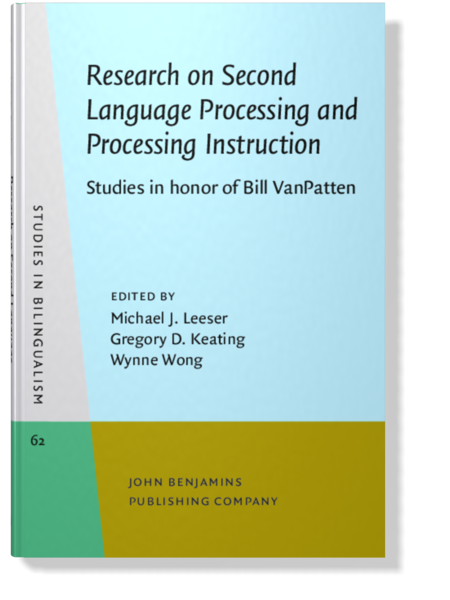
In:Research on Second Language Processing and Processing Instruction: Studies in honor of Bill VanPatten
Edited by Michael J. Leeser, Gregory D. Keating and Wynne Wong
[Studies in Bilingualism 62] 2021
► pp. 183–200
Chapter 6Contextual effects in processing OVS constructions in Spanish
A partial replication of VanPatten and Houston (1998) and Malovrh (2006)
Published online: 17 March 2021
https://doi.org/10.1075/sibil.62.06isa
https://doi.org/10.1075/sibil.62.06isa
Abstract
This study investigates the contextual constraint principle in input processing, which states that learners may rely less on a first-noun-as-subject/agent strategy if preceding context constrains the interpretation of a clause or sentence. Second language learners of Spanish (N = 39) completed a sentence interpretation task in which they heard OVS sentences in various context conditions: neutral versus constraining context appearing prior to and after OVS clauses. Results revealed greater accuracy on OVS sentence interpretation when constraining context was available, particularly when it appeared prior to the target OVS clause. The results suggest that first noun reliance is significantly weakened when constraining context is available, and that the contextual constraint principle should be expanded to include context in post target-clause position.
Article outline
- Introduction
- Background: Contextual effects on sentence processing
- The current study
- Method
- Participants
- Experimental task
- Data collection
- Method
- Results
- Discussion and conclusion
Acknowledgements References Appendix

References (18)
Altmann, G., & Steedman, M. (1988). Interaction with context during human sentence processing. Cognition, 30, 191–238.
Clahsen, H., & Felser, C. (2006). How native-like is non-native language processing? Trends in Cognitive Sciences, 10, 564–570.
Crain, S., & Steedman, M. (1985). On not being led up the garden path: The use of context by the psychological syntax process. In D. R. Dowty, L. Kartunnen, & A. M. Zwicky (Eds.), Natural language parsing: Psychological, computational, and theoretical perspective (pp. 320–358). Cambridge, UK: Cambridge University Press.
Gass, S. M. (1989). How do learners resolve linguistic conflicts? In S. M. Gass & J. Schachter (Eds.), Linguistic perspectives on second language acquisition (pp. 183–199). Cambridge, UK: Cambridge University Press.
Houston, T. (1997). Sentence processing in Spanish as a second language: A study of word order and background knowledge. In W. Glass & A. T. Pérez-Leroux (Eds.), Contemporary perspectives on the acquisition of Spanish, Volume 2: Production, processing and comprehension (pp. 123–134). Somerville, MA: Cascadilla Press.
Malovrh, P. (2006). L2 sentence processing of Spanish OVS word order and direct object pronouns: An analysis of contextual constraints. In N. Sagarra, & A. J. Toribio (Eds.), Selected proceedings of the 9th Hispanic Linguistics Symposium (pp. 169–179). Somerville, MA: Cascadilla Proceedings Project.
Marinis, T. (2010). Using on-line processing methods in language acquisition research. In S. Unsworth & E. Blom (Eds.), Experimental methods in language acquisition research (pp. 139–162). Amsterdam, Netherlands: John Benjamins.
Murray, W., & Liversedge, S. (1994). Referential context effects on syntactic processing. In C. Clifton, Jr., L. Frazier, & K. Rayner (Eds.), Perspectives on sentence processing (pp. 359–388). Hillsdale, NJ: Lawrence Erlbaum Associates.
Pan, H.-Y., & Felser, C. (2011). Referential context effects on L2 ambiguity resolution: Evidence from self-paced reading. Lingua, 121, 221–236.
Pan, H.-Y., Schimke, S., & Felser, C. (2015). Referential context effects in non-native relative clause ambiguity resolution. International Journal of Bilingualism, 19, 298–313.
Roberts, L. (2012). Psycholinguistic techniques and resources in second language acquisition research. Second Language Research, 28, 113–127.
Sorace, A., & Filiaci, F. (2006). Anaphora resolution in near-native speakers of Italian. Second Language Research, 22, 239–368.
VanPatten, B. (1984). Learners’ comprehension of clitic pronouns: More evidence for a word-order strategy. Hispanic Linguistics, 1, 57–67.
(2004). Input processing in second language acquisition. In B. VanPatten (Ed.), Processing instruction: Theory, research, and commentary (pp. 5–31). Mahwah, NJ: Lawrence Erlbaum Associates.
(2015). Input processing in adult SLA. In B. VanPatten & J. Williams (Eds.), Theories in second language acquisition: An introduction (2nd ed.) (pp. 113–134). New York, NY: Routledge.
Cited by (1)
Cited by one other publication
This list is based on CrossRef data as of 1 december 2025. Please note that it may not be complete. Sources presented here have been supplied by the respective publishers. Any errors therein should be reported to them.