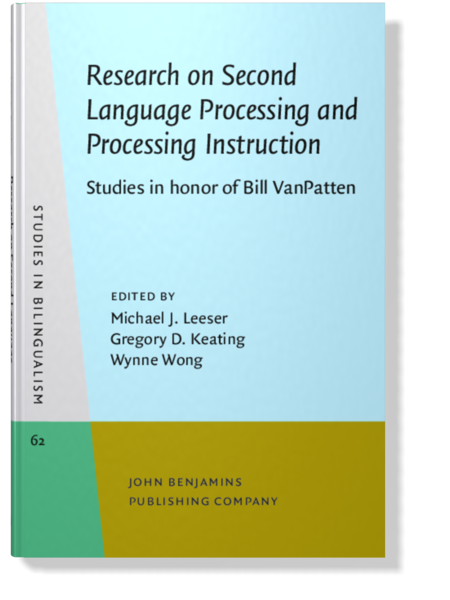
In:Research on Second Language Processing and Processing Instruction: Studies in honor of Bill VanPatten
Edited by Michael J. Leeser, Gregory D. Keating and Wynne Wong
[Studies in Bilingualism 62] 2021
► pp. 27–52
Chapter 2The processing of case in intermediate L2 Spanish
Published online: 17 March 2021
https://doi.org/10.1075/sibil.62.02jeg
https://doi.org/10.1075/sibil.62.02jeg
Abstract
This self-paced reading study investigated the processing of case marking with the particle a in non-native Spanish. Experiment 1 tested online sensitivity to case marking on direct and indirect objects. Unlike native speakers, intermediate L2 learners showed effects only with indirect objects. For Experiment 2, direct objects were doubled with a preverbal clitic, to see if the addition was associated with more native-like processing, as has been shown in previous research with very advanced L2 learners (Jegerski, 2015). Again, online sensitivity to case marking was only observed with the ditransitive stimuli. Thus, clitic doubling only seems to make a difference at sufficiently high levels of proficiency, perhaps because of increasingly robust representations of grammatical forms in the developing L2 system.
Article outline
- Introduction
- Differential object marking in Spanish
- The non-native processing of Spanish case
- Experiment 1
- Participants
- Material
- Procedure
- Results
- Interim discussion
- Experiment 2
- Participants
- Materials
- Procedure
- Results
- Interim discussion
- General discussion
Note References Appendix

References (45)
Aissen, J. (2003). Differential object marking: Iconicity vs. economy. Natural Language and Linguistic Theory, 21, 435–83.
Barr, D. J., Levy, R., Scheepers, C., & Tily, H. (2013). Random-effects structure for confirmatory hypothesis testing: Keep it maximal. Journal of Memory and Language, 68, 255–278.
Bates, D., Maechler, M., Bolker, B., & Walker, S. (2015). Fitting linear mixed-effects models using lme4. Journal of Statistical Software, 67, 1–48.
Belloro, V. A. (2015). To the right of the verb: An investigation of clitic doubling and right dislocation in three Spanish dialects. Newcastle upon Tyne, UK: Cambridge Scholars.
Bossong, G. (1991). Differential object marking in Romance and beyond. In D. Wanner & D. Kibbee (Eds.), New analyses in Romance linguistics: Selected papers from the XVIII Linguistic Symposium on Romance Languages (pp. 143–170). Amsterdam, Netherlands: John Benjamins.
Company Company, C. (2006). El objeto indirecto. In C. Company Company (Ed.), Sintaxis histórica de la lengua española [Historical syntax of the Spanish language] (pp. 477–572). Mexico City, Mexico: Universidad Nacional Autónoma de México, Fondo de Cultura Económica.
Cuervo, M. C. (2003). Structural asymmetries but same word order: The dative alternation in Spanish. In A. M. DiSciullo (Ed.), Asymmetry in grammar (pp. 117–144). Amsterdam, Netherlands: John Benjamins.
Eisenbeiss, S., Bartke, S., & Clahsen, H. (2006). Structural and lexical case in child German: Evidence from language-impaired and typically developing children. Language Acquisition, 13, 3–32.
Escandell-Vidal, V. (2009). Differential object marking and topicality: The case of Balearic Catalan. Studies in Language, 33, 832–884.
Fábregas, A. (2013). Differential object marking in Spanish: State of the art. Borealis: An International Journal of Hispanic Linguistics, 2, 1–80.
Franco, J. (2000). Agreement as a continuum: The case of Spanish pronominal clitics. In F. Beukem & M. den Dikken (Eds.), Clitic phenomena in European languages (pp. 147–190). Amsterdam, Netherlands: John Benjamins.
García García, M. (2005). Differential object marking and informativeness. In K. von Heusinger, G. A. Kaiser, & E. Stark (Eds.), Proceedings from the workshop “Specificity and the Evolution/Emergence of Nominal Determination in Romance” (pp. 17–31). Konstanz, Germany: Fachbereich Sprachwissenschaft, Universität Konstanz.
Gutiérrez-Rexach, J. (2000). The formal semantics of clitic doubling. Journal of Semantics, 16, 315–380.
Hopp, H. (2006). Syntactic features and reanalysis in near-native processing. Second Language Research, 22, 369–97.
Hopp, H., & León Arriaga, M. (2016). Structural and inherent case in the non-native processing of Spanish: Constraints on inflectional variability. Second Language Research, 32, 75–108.
Jackson, C. N., & Van Hell, J. G. (2011). The effects of L2 proficiency level on the processing of wh-questions among Dutch second language speakers of English. International Review of Applied Linguistics in Language Teaching, 49, 195–219.
Jaeger, T. F. (2008). Categorical data analysis: Away from ANOVAs (transformation or not) and towards logit mixed models. Journal of Memory and Language, 59, 434–446.
Jegerski, J. (2014). Self-paced reading. In J. Jegerski & B. VanPatten (Eds.), Research methods in second language psycholinguistics (pp. 20–49). New York, NY: Routledge.
(2016). Number attraction effects in near-native Spanish sentence comprehension. Studies in Second Language Acquisition, 38, 5–33.
(2018). The processing of the object marker a by heritage Spanish speakers. International Journal of Bilingualism, 22, 585–602.
Jegerski, J., & Fernández Cuenca, S. (2018, October). Lexical access and morphosyntactic processes in the online sentence comprehension of second language learners of Spanish. Paper presented at the Hispanic Linguistics Symposium, University of Texas, Austin, TX.
Keating, G. D., & Jegerski, J. (2015). Experimental designs in sentence processing research: A methodological review and user’s guide. Studies in Second Language Acquisition, 37, 1–32.
Kuznetsova, A., Brockoff, P. B., & Christensen, R. H. B. (2014). lmerTest: Tests for random and fixed effects for linear mixed effect models (lmer objects of lme4 package). Available at <[URL]>
Lenth, R., Singmann, H., Love, J., Buerkner, P., & Herve, M. (2019). emmeans (Version 1.3.5.1): estimated marginal means, aka least-squares means. Available at <[URL]>
Montrul, S. (2005). Second language acquisition and first language loss in adult early bilinguals: Exploring some differences and similarities. Second Language Research, 21, 199–249.
(2013). La marcación diferencial del objeto directo en el español de Argentina: Un estudio experimental [Differential object marking in Argentine Spanish: An experimental study]. In L. Colantoni & C. Rodriguez-Louro (Eds.), Perspectivas teóricas y experimentales sobre el español de la Argentina [Theoretical and experimental perspectives on Argentine Spanish] (pp. 207–228). Frankfurt, Germany/Madrid, Spain: Vervuert/Iberoamericana.
(2014). Structural changes in Spanish in the United States: Differential object marking in Spanish heritage speakers across generations. Lingua, 151B, 177–196.
Montrul, S., & Sánchez-Walker, N. (2013). Incomplete acquisition of differential object marking in child and adult Spanish heritage speakers. Language Acquisition, 20, 1–31.
O’Grady, W. (2003). The radical middle: Nativism with Universal Grammar. In C. J. Doughty & M. H. Long (Eds.), The handbook of second language acquisition (pp. 19–42). Oxford, UK: Blackwell.
Pienemann, M. (2007). Processibility theory. In B. VanPatten & J. Williams (Eds.), Theories in second language acquisition (pp. 137–154). Mahwah, NJ: Lawrence Erlbaum Associates.
Real Academia Española. (2019). Uso de los pronombres lo(s), la(s), le(s). Leísmo, laísmo, loísmo [Use of the pronouns lo.
lo(s), la(s), le(s). Leismo, laísmo, loísmo]. Retrieved from <[URL]>
R Development Core Team. (2014). R: A language and environment for statistical computing. Vienna, Austria: R Foundation for Statistical Computing. Available at <[URL]>
Sagarra, N., & Herschensohn, J. (2013). Processing of gender and number agreement in late Spanish bilinguals. International Journal of Bilingualism, 17, 607–627.
Suñer, M. (1988). The role of agreement in clitic-doubled constructions. Natural Language and Linguistic Theory, 6, 391–434.
Tanner, D., & Bulkes, N. Z. (2015). Cues, quantification, and agreement in language comprehension. Psychonomic Bulletin and Review, 22, 1753–1763.
VanPatten, B. (1996). Input processing and grammar instruction in second language acquisition: Theory and research. Norwood, NJ: Ablex.
(2009). Processing matters in input enhancement. In T. Piske & M. Young-Scholten (Eds.), Input matters (pp. 57–61). Clevedon, UK: Multilingual Matters.
(2015). Input processing in adult SLA. In B. VanPatten & J. Williams (Eds.), Theories in second language acquisition: An introduction (2nd ed.) (pp.113–134). New York, NY: Routledge.
Cited by (1)
Cited by one other publication
This list is based on CrossRef data as of 1 december 2025. Please note that it may not be complete. Sources presented here have been supplied by the respective publishers. Any errors therein should be reported to them.