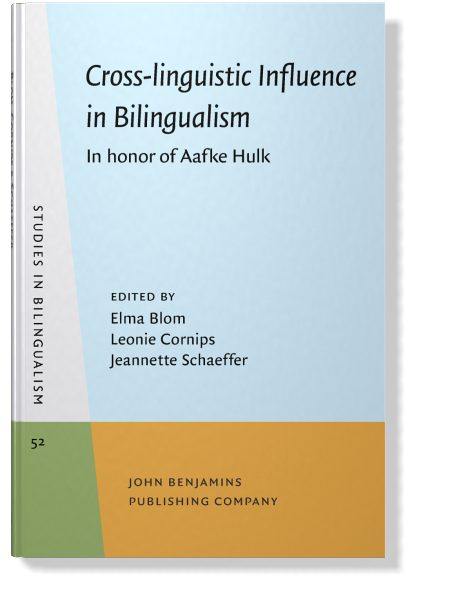
In:Cross-linguistic Influence in Bilingualism: In honor of Aafke Hulk
Edited by Elma Blom, Leonie Cornips and Jeannette Schaeffer
[Studies in Bilingualism 52] 2017
► pp. 25–48
Extended use of demonstrative pronouns in two generations of Mandarin Chinese speakers in the Netherlands
Evidence of convergence?
Published online: 19 December 2017
https://doi.org/10.1075/sibil.52.03aal
https://doi.org/10.1075/sibil.52.03aal
Abstract
This study investigated the use of demonstratives in encoding already mentioned referents in two generations of Mandarin Chinese speakers in the Netherlands. Data from twelve families was compared to baseline data from eight native controls in China. Previous literature suggests that languages without dedicated morphology to encode definiteness might develop such morphemes in contact with a language with articles (cf. Backus, Doğruöz, & Heine, 2011). Demonstrative pronouns may be reinterpreted as articles and this process could result in an increase in demonstrative use. We accordingly expected to find such an increase in Mandarin Chinese spoken in the Netherlands and found confirmation for this in both generations of speakers. A preference for the distal demonstrative was observed only in the second generation.
Article outline
- 1.Introduction
- 2.Theoretical framework
- 2.1Definiteness marking and cross-linguistic influence
- 2.2Definiteness marking in heritage languages
- 2.3Definiteness marking in Dutch and Mandarin Chinese
- 2.4The current study
- 3.Methodology
- 3.1Participants
- 3.2Materials
- 3.3Coding
- 3.4Analysis
- 4.Results
- 5.Discussion
- 6.Conclusion
Notes References

References (53)
Arends, J., Muysken, P., & Smith, N. (Eds.). (1995). Pidgins and creoles: An introduction. Amsterdam: John Benjamins.
Agnihotri, R. K., Khanna, A. L., & Mukherjee, A. (1984). The use of articles in Indian English: Errors and pedagogical implications. IRAL, 22(2), 115–29.
Backus, A., Doğruöz, A. S., & Heine, B. (2011). Salient stages in contact-induced grammatical change: Evidence from synchronic vs. diachronic contact situations. Language Sciences 33(5), 738–752.
Bates, D., Maechler, M., & Bolker, B. (2011). Ime4: Linear mixed-effects models using S4 classes. R package version 0999375–38. <[URL]>
Benmamoun, E., Montrul, S., & Polinsky, M. (2013). Heritage languages and their speakers: Opportunities and challenges for linguistics. Theoretical Linguistics, 39(3–4), 129–181.
Breu, W. (2003). Der indefinite Artikel in slavischen Mikrosprachen: Grammatikalisierung im totalen Sprachkontakt. Slavistische Linguistik 2001, 27–68.
Butler, Y. G. (2002). Second language learners’ theories on the use of English articles. Studies in Second Language Acquisition, 24(03), 451–480.
Cheng, L. S. C., & Sybesma, R. (2005). Classifiers in four varieties of Chinese. In G. Cinque & R. Kayne (Eds.), The Oxford handbook of comparative syntax (pp. 259–292). Oxford: Oxford University Press.
Cho, J., & Slabakova, R. (2014). Interpreting definiteness in a second language without articles: The case of L2 Russian. Second Language Research, 30(2), 159–190.
Cornips, L., & Hulk, A. (2013). Late language acquisition and identity construction: Variation in use of the Dutch definite determiners de and het
. In P. Auer, J. C. Reina & G. Kaufmann (Eds.), Language Variation – European Perspectives IV: Selected papers from the Sixth International Conference on Language Variation in Europe (ICLaVE 6), Freiburg, June 2011 (pp. 57–68). Amsterdam: John Benjamins.
Van Gelderen, E. (2007). The definiteness cycle in Germanic. Journal of Germanic Linguistics, 19(04), 275–308.
Goad, H., & White, L. (2008). Prosodic structure and the representation of L2 functional morphology: A nativist approach. Lingua, 118(4), 577–594.
Greenberg, J. H. (1978). How does a language acquire gender markers. In J. H. Greenberg (Ed.), Universals of human language, 3 (pp. 47–82). Stanford, CA: Stanford University Press.
Haig, G., & Schnell, S. (2015). Annotations using GRAID (Grammatical Relations and Animacy in Discourse). Pdf Manual Version 7.0. Bamberg: OPUS. <urn:nbn:de:bvb:473-opus4-262354> (21 December, 2016).
Heine, B., & Kuteva, T. (2005). Language contact and grammatical change. Cambridge: Cambridge University Press.
Huang, S. (1999). The emergence of a grammatical category definite article in spoken Chinese. Journal of pragmatics, 31(1), 77–94.
Hulk, A., & Müller, N. (2000). Bilingual first language acquisition at the interface between syntax and pragmatics. Bilingualism: Language and Cognition, 3(03), 227–244.
Ionin, T., Ko, H., & Wexler, K. (2004). Article semantics in L2 acquisition: The role of specificity. Language Acquisition, 12(1), 3–69.
Ionin, T., & Montrul, S. (2009). Article use and generic reference: Parallels between L1-and L2-acquisition. In M. del P. Garcia Mayo & R. Hawkins (Eds.), Second language acquisition of articles: Empirical findings and theoretical implications (pp. 147–173). Amsterdam: John Benjamins.
Ionin, T., Zubizarreta, M. L., & Philippov, V. (2009). Acquisition of article semantics by child and adult L2-English learners. Bilingualism: Language and Cognition, 12(03), 337–361.
Ionin, T., Baek, S., Kim, E., Ko, H., & Wexler, K. (2012). That’s not so different from the: Definite and demonstrative descriptions in second language acquisition. Second Language Research, 28(1), 69–101.
Jansen, B., Lalleman, J., & Muysken, P. (1981). The alternation hypothesis: acquisition of Dutch word order by Turkish and Moroccan foreign workers. Language Learning, 31(2), 315–336.
Johanson, L. (2002). Contact-induced change in a code-copying framework. Contributions to the Sociology of Language, 86, 285–314.
Kharma, N. (1981). Analysis of the errors committed by Arab university students in the use of the English definite/indefinite articles. IRAL-International Review of Applied Linguistics in Language Teaching, 19(1–4), 333–345.
Kita, S. (1995). Recommendations for data collection for gesture studies. In D. Wilkins (Ed.), Extensions of space and beyond: Manual for field elicitation for the 1995 field season (pp. 35–42). Nijmegen: Max Placnk Institute for Psycholinguistics.
Kootstra, G. J., & Muysken, P. (2016). Cross-linguistic priming in bilinguals: Multidisciplinary perspectives on language processing, acquisition, and change. Bilingualism: Language and Cognition, 20(2).
Lötzsch, R., (1996). Interferenzbedingte grammatische Konvergenzen und Divergenzen zwischen Sorbisch und Jiddisch. Sprachtypologie und Universalienforschung, 49, 50–59.
Liu, F. H. (2007). Word order variation and ba sentences in Chinese. Studies in Language, 31(3), 649–682.
Master, P. A. (1987). A cross-linguistic interlanguage analysis of the acquisition of the English article system. Unpublished doctoral dissertation. University of California Los Angeles.
Mayo, M. del. P. Garcia, & Hawkins, R. (Eds.). (2009). Second language acquisition of articles: Empirical findings and theoretical implications. Amsterdam: John Benjamins.
Montrul, S., & Ionin, T. (2012). Dominant language transfer in Spanish heritage speakers and second language learners in the interpretation of definite articles. The Modern Language Journal, 96(1), 70–94.
Moro, F. (2016). Dynamics of Ambon Malay: Comparing Ambon and the Netherlands. Unpublished doctoral dissertation. Radboud University, Nijmegen.
Muysken, P. (2013). Language contact outcomes as the result of bilingual optimization strategies. Bilingualism: Language and Cognition, 16(04), 709–730.
Pascual y Cabo, D., & Rothman, J. (2012). The (il)logical problem of heritage speaker bilingualism and incomplete acquisition. Applied Linguistics, 33(4), 450–455.
Piwek, P., Beun, R. J., & Cremers, A. (2008). ‘Proximal’and ‘distal’in language and cognition: Evidence from deictic demonstratives in Dutch. Journal of Pragmatics, 40(4), 694–718.
Philippa, M., Debrabandere, F., & Quak, A. (2003). Etymologisch Woordenboek van het Nederlands, Deel 1: A t/m E. Amsterdam: Amsterdam University Press.
Pires, A., & Rothman, J. (2009). Disentangling sources of incomplete acquisition: An explanation for competence divergence across heritage grammars. International Journal of Bilingualism, 13(2), 211–238.
Polinsky, M. (2006). Incomplete acquisition: American Russian. Journal of Slavic Linguistics, 14(2), 191–262.
Rothman, J. (2007). Heritage speaker competence differences, language change, and input type: Inflected infinitives in heritage Brazilian Portuguese. International Journal of Bilingualism, 11(4), 359–389.
Schmid, M. S. (2011). Contact x time: External factors and variability in L1 attrition. In M. S. Schmid & W. Lowie (Eds.), Modeling bilingualism: From structure to chaos (pp. 155–176). Amsterdam: John Benjamins.
Silva-Corvalán, C. (1994). Language contact and change: Spanish in Los Angeles. Oxford: Clarendon press.
Sorace, A., Serratrice, L., Filiaci, F., & Baldo, M. (2009). Discourse conditions on subject pronoun realization: Testing the linguistic intuitions of older bilingual children. Lingua, 119(3), 460–477.
Sybesma, R. P. E. (1992). Causatives and accomplishments: The case of Chinese ba (Vol. 1). Holland Institute of Generative Linguistics.
Trenkic, D. (2009). Accounting for patterns of article omissions and substitutions in second language production. In M. del P. Garcia Mayo & R. Hawkins (Eds.), Second language acquisition of articles: Empirical findings and theoretical implications (pp. 115–143). Amsterdam: John Benjamins.
Thomas, M. (1989). The acquisition of English articles by first-and second-language learners. Applied psycholinguistics, 10(03), 335–355.
Wiedenhof, J. (2015). A grammar of Mandarin. Amsterdam: John Benjamins.
Cited by (10)
Cited by ten other publications
Martynova, Maria, Onur Özsoy, Vasiliki Rizou, Luka Szucsich, Natalia Gagarina & Artemis Alexiadou
Kupisch, Tanja & Maria Polinsky
Zhou, Jiangling, Ziyin Mai, Qiuyun Cai, Yuqing Liang & Virginia Yip
Kupisch, Tanja
Aalberse, Suzanne, Sible Andringa, Martina Faber & Phine Lippe
2020. Definiteness in Wenzhounese Chinese in the Netherlands and in China. In Lost in transmission [Studies in Bilingualism, 59], ► pp. 15 ff.
Ortega, Lourdes
Zhang, Shi
2020. Does extensive L2 exposure trigger L1 attrition of perfective and durative aspect marking in Mandarin Chinese?. In Lost in transmission [Studies in Bilingualism, 59], ► pp. 255 ff.
[no author supplied]
This list is based on CrossRef data as of 1 december 2025. Please note that it may not be complete. Sources presented here have been supplied by the respective publishers. Any errors therein should be reported to them.