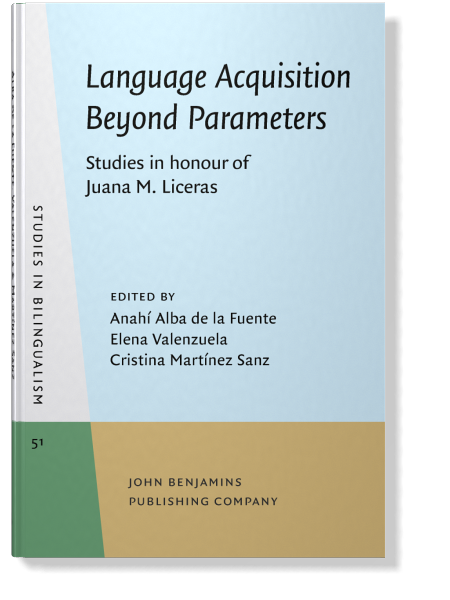
In:Language Acquisition Beyond Parameters: Studies in honour of Juana M. Liceras
Edited by Anahí Alba de la Fuente, Elena Valenzuela and Cristina Martínez Sanz
[Studies in Bilingualism 51] 2016
► pp. 125–145
Not just algunos, but indeed unos L2ers can acquire scalar implicatures in L2 Spanish
Published online: 16 December 2016
https://doi.org/10.1075/sibil.51.06mil
https://doi.org/10.1075/sibil.51.06mil
Abstract
This study examines interpretation of scalar implicatures (SI) in the L2 Spanish of native English advanced learners. Spanish is especially interesting since, unlike English, it has two indefinite determiners, unos and algunos, which ostensibly map to English some. However, each does not allow an implicature like English some. The complexity of the Spanish system is predicted to make Spanish particularly challenging. We present data from a Video Acceptability Judgment experiment where the subset – whole set distinction is applied to algunos/unos. The videos contain sets of 4 participants, in which 0, 3 or all 4 engage in an action. Test sentences are presented after the video clips in four target conditions: (a) algunos with 4 out of 4 (4/4) video, (b) algunos with 3 out of 4 (3/4) video, (c) unos with 4/4 video and (d) unos with 3/4 video. Judgments on the 4/4 video conditions, especially the algunos condition, indicate whether implicatures are projected or not. If participants are sensitive to the idiosyncratic restrictions on algunos for implicatures, one expects to find a distinction between algunos and unos in the 4/4 condition, and between 4/4 versus 3/4 conditions with algunos. Both participant groups (native speakers and advanced L2ers) perform the experiment similarly. Both groups make the two relevant distinctions to the same degree.
Keywords: scalar, implicature,
algunos
,
unos
Article outline
- 1.Introduction
- 2.(Scalar) implicatures
- 2.1Spanish plural indefinites with contrasting properties: Algunos and unos
-
3.Acquisition of scalar implicatures
- 3.1Child monolinguals
- 3.2Adult L2 Acquisition
-
4.The present study
- 4.1Research questions and hypotheses
- 4.2Methodology
- 4.2.1Participants
- 4.2.2Materials
- 4.2.2.1Language background questionnaire
- 4.2.2.2Truth-value video acceptability experiment
- 5.Results
- 5.1Statistical models
- 6.Discussion
- 7.Conclusion
Notes References

References (40)
Barr, D. J., Levy, R., Scheepers, C., & Tily, H. J. (2013). Random effects structure for confirmatory hypothesis testing: Keep it maximal. Journal of Memory and Language, 68(3), 255–278.
Belletti, A., Bennati, E., & Sorace, A. (2007). Theoretical and developmental issues in the syntax of subjects: Evidence from near-native Italian. Natural Language and Linguistic Theory, 4, 657–689.
Breheny, R., Katsos, N., & Williams, J. (2006). Are generalised scalar implicatures generated by default? An on-line investigation into the role of context in generating pragmatic inferences. Cognition, 100(3), 434–463.
Bruhn de Garavito, J., & Valenzuela, E. (2008). Eventive and stative passives in L2 acquisition: A matter of aspect. Bilingualism: Language and Cognition, 11(3), 323–336.
Carston, R. (1998). Informativeness, relevance and scalar implicature. In R. Carston & S. Uchida (Eds.), Relevance Theory: Applications and Implications (pp. 179–236). Amsterdam: John Benjamins.
Chierchia, G., & McConnell-Ginet, S. (2000). Meaning and Grammar: An Introduction to Semantics. Cambridge, MA: MIT.
Chierchia, G. (2004). Scalar implicatures, polarity phenomena and the syntax/pragmatics interface. In A. Belletti (Ed.), Structures and Beyond (pp. 39–103). Oxford: Oxford University Press.
Dekydtspotter, L., & Hathorn, J., (2005). Quelque chose… de remarquable in English–French acquisition: Mandatory, informationally encapsulated computations in second language interpretation. Second Language Research, 21, 291–323.
Donaldson, B. (2012). Syntax and discourse in near-native French: Clefts and focus. Language Learning, 62, 902–930.
Grice, H. P. (1975). Logic and conversation. In P. Cole & J. L. Morgan (Eds.), Syntax and Semantics, Vol. 3 (pp. 41–58). New York, NY: Seminar Press.
Guasti, T. M., Chierchia, G., Crain, S., Foppolo, F., Gaulmini, A., & Meroni, L. (2005). Why children and adults sometimes (but not always) compute implicatures. Language and Cognitive Processes, 20 (5), 667–696.
Gürel, A., (2006). L2 acquisition of pragmatic and syntactic constraints in the use of overt and null subject pronouns. In Slabakova, R., Montrul, S., & Prévost, P. (Eds.), Inquiries in Linguistic Development (pp. 259–282). Amsterdam: John Benjamins.
Gutiérrez-Rexach, J. (2001). The semantics of Spanish plural existential determiners. Probus, 13, 113–154.
Hopp, H., & Schmid, M. S. (2013). Perceived foreign accent in first language attrition and second language acquisition: The impact of age of acquisition and bilingualism. Applied Psycholinguistics, 34(2), 361–394.
Horn, L. (1972). On the Semantic Properties of the Logical Operators in English (Unpublished PhD dissertation). UCLA.
Iverson, M., Kempchinsky, P., & Rothman, J. (2008). Interface vulnerability and knowledge of the subjunctive/indicative distinction with negated epistemic predicates in L2 Spanish. EUROSLA Yearbook, 8, 135–163.
Laca, B., & Tasmowski, L. (1996). Indéfini et quantification. Recherches Linguistiques de Vincennes, 25, 107–128.
Lardiere, D. (2011). Who is the Interface Hypothesis about? Linguistic Approaches to Bilingualism, 1(1), 48–53.
Lieberman, M. (2009). L2 acquisition of scalar implicatures: Interpretation at the syntax-pragmatics interface. Paper presented at Generative Approaches to Second Language Acquisition (GASLA) 2009. University of Illinois, Urbana-Champaign.
López Palma, E. (2007). Plural indefinite descriptions with unos and the interpretation of number. Probus, 19, 235–266.
Noveck, I. A. (2001). When children are more logical than adults: Experimental investigations of scalar implicature. Cognition, 78, 165–188.
Noveck, I., & Sperber, D. (2007). The why and how of experimental pragmatics: the case of ‘scalar inferences’. In N. Burton-Roberts (Ed.), Advances in Pragmatics (pp. 184–212). Houndmills: Palgrave.
Papafragou, A., & Musolino, J. (2003). Scalar implicatures: Experiments at the semantics–pragmatics interface. Cognition, 86(3), 253–282.
Rothman, J. (2009). Pragmatic deficits with syntactic consequences?: L2 pronominal subjects and the syntax-pragmatics interface. Journal of Pragmatics, 41, 951–973.
Rothman, J., & Iverson, M. (2010). Independent normative assessments for bi/multilingualism, where art thou. In M. Cruz-Ferreira (Ed.), Multilingual Norms (pp. 33–51.) Bern: Peter Lang.
Rothman, J., & Slabakova, R. (2011). The mind-context divide: On acquisition at the linguistic interfaces. Lingua, 121(4), 568–576.
Slabakova, R., & Montrul, S. (2003). Genericity and aspect in L2 acquisition. Language Acquisition, 11(3), 165–196.
Slabakova, R., Kempchinsky, P., & Rothman, J. (2012). Clitic-doubled left dislocation and focus fronting in L2 Spanish: A case of successful acquisition at the syntax-discourse interface. Second Language Research, 28(3), 319–343.
Sorace, A. (2011). Pinning down the concept of “interface” in bilingualism. Linguistic Approaches to Bilingualism, 1(1), 1–35.
Sorace, A., & Filiaci, F. (2006). Anaphora resolution in near-native speakers of Italian. Second Language Research, 22(3), 339–368.
Su, Y. E. (2013). Scalar implicatures and downward entailment in child Mandarin. Journal of East Asian Linguistics, 22(2), 167–187.
Syrett, K., Austin, J., Sanchez, L., Germak, C., Lingwall, A., Perez-Cortes, S., Arias-Amaya, A., & Baker, H. (2016). The influence of conversational context and the developing lexicon on the calculation of scalar implicatures. Linguistic Approaches to Bilingualism. issn 1879–9264
Vargas-Tokuda, M., Grinstead, J., & Gutiérrez-Rexach, J. (2009). Context and the Scalar Implicatures of Indefinites in Child Spanish. In J. Grinstead (Ed.), Hispanic Child Languages (pp. 93–114). Amsterdam: John Benjamins.
White, L. (2011). The interface hypothesis: How far does it extend? Linguistic Approaches to Bilingualism, 1(1), 108–110.
Cited by (15)
Cited by 15 other publications
Destruel, Emilie & Glenn Starr
2025. Scalar diversity in L2 French speakers. Linguistic Approaches to Bilingualism 15:6 ► pp. 843 ff.
Feng, Shuo & Kailun Zhang
王, 佳怡
Liu, Yi & Kook-Hee Gil
2024. Second language acquisition of English plurals by Chinese learners. In Current Perspectives on Generative SLA – Processing, Influence, and Interfaces [Language Acquisition and Language Disorders, 70], ► pp. 88 ff.
Destruel, Emilie
Zhang, Jun & Yan Wu
Cho, Jacee
2022. Crosslinguistic influence on L2 implicature computation for determiners. Journal of Second Language Studies 5:1 ► pp. 86 ff.
Feng, Shuo
Feng, Shuo
2024. L2 tolerance of pragmatic violations of informativeness. Linguistic Approaches to Bilingualism 14:2 ► pp. 147 ff.
Syrett, Kristen, Jennifer Austin & Liliana Sanchez
Miller, David & Jason Rothman
Feng, Shuo & Jacee Cho
Snape, Neal & Hironobu Hosoi
Syrett, Kristen, Jennifer Austin, Liliana Sanchez, Christina Germak, Anne Lingwall, Silvia Perez-Cortes, Anthony Arias-Amaya & Hannah Baker
2017. The influence of conversational context and the developing lexicon on the calculation of scalar implicatures. Linguistic Approaches to Bilingualism 7:2 ► pp. 230 ff.
This list is based on CrossRef data as of 1 december 2025. Please note that it may not be complete. Sources presented here have been supplied by the respective publishers. Any errors therein should be reported to them.