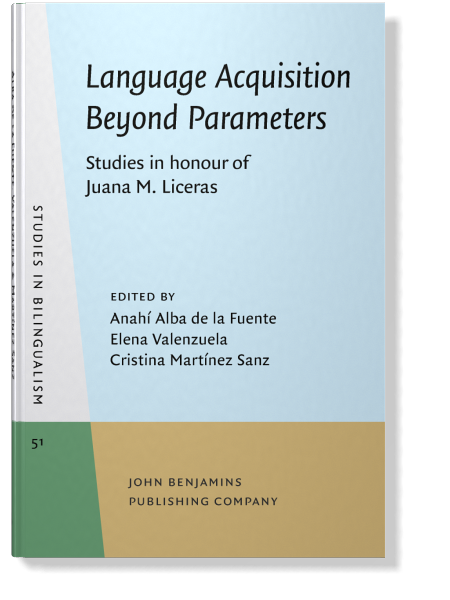
In:Language Acquisition Beyond Parameters: Studies in honour of Juana M. Liceras
Edited by Anahí Alba de la Fuente, Elena Valenzuela and Cristina Martínez Sanz
[Studies in Bilingualism 51] 2016
► pp. 99–124
L2 knowledge of gender and number agreement in Spanish noun ellipsis
Published online: 16 December 2016
https://doi.org/10.1075/sibil.51.05bru
https://doi.org/10.1075/sibil.51.05bru
Abstract
This study focuses on second language knowledge of number and gender in Spanish using ellipsis as a point of departure. Eleven adult learners of Spanish as a second language (L2), and 9 native Spanish speakers were tested on a written elicited production task and a grammaticality judgment task. Results provided evidence that L2 speakers are able to access features not present in their L1, such as gender and number, and that they are then able to compare the relevant features to antecedents. It is argued that problems in the production of gender are not due to any underlying deficit.
Keywords: nominal ellipsis, gender, number, L2 acquisition, Spanish
Article outline
- 1.Introduction
- 2.Background: The acquisition of gender and functional features
- 3.Noun ellipsis in Spanish
-
4.Methodology
- 4.1Participants
- 4.2Tasks
- 4.2.1Production task
- 4.2.2Grammaticality judgment task
- 5.Results
- 5.1Production task
- 5.2Grammaticality judgment task
- 5.3Individual Results
- 6.Discussion and conclusions
Notes References

References (44)
Aelbrecht, L. (2010). The Syntactic Licensing of Ellipsis. Amsterdam: John Benjamins.
Belletti, A., Bennati, E., & Sorace, A. (2007). Theoretical and developmental issues in the syntax of subjects: Evidence from near-native Italian. Natural Language and Linguistic Theory, 25, 657–689.
Bernstein, J. (1991). DPs in French and Walloon: Evidence for parametric variation in nominal head movement. Probus, 3, 1–26.
Borgonovo, C., Bruhn de Garavito, J., & Prévost, P. (2015). Interfaces in acquisition: The case of relative clauses. Studies in Second Language Acquisition, 37(1), 33–69
Brucart, J., & Gràcia, L. (1986). I sintagme nominali senza testa. Rivista di Grammatica Generativa, 11, 3–32.
Bruhn de Garavito, J., & Montoya, L. (2015, May-June). Information structure and nominal ellipsis in L2 Spanish. Paper presented at the Canadian Linguistics Association Annual Meeting, University of Ottawa, Ottawa.
Bruhn de Garavito, J. & White, L. (2002). L2 acquisition of Spanish DPs: The status of grammatical features. In A. T. Pérez-Leroux & J. Liceras (Eds.), The Acquisition of Spanish Morphosyntax:The L1/L2 Connection (pp. 151–176). Dordrecht: Kluwer.
Duffield, N., Matsuo, A., & Roberts, L. (2009). Factoring out the parallelism effect in VP-ellipsis: English vs. Dutch contrasts. Second Language Research, 25(4), 427–467.
Franceschina, F. (2001). Morphological or syntactic deficits in near-native speakers? An assessment of some current proposals. Second Language Research, 17(3), 213–247.
(2005). Fossilized Second Language Grammars: The Acquisition of Grammatical Gender. Amsterdam: John Benjamins.
Grüter, T., Lew-William, C., & Fernald, A. (2012). Grammatical gender in L2: A production or a real-time processing problem? Second Language Research, 28(2), 191–215.
Hawkins, R., & Chan, Y.-h. C. (1997). The partial availability of Universal Grammar in second language acquisition: The ‘failed functional features hypothesis’. Second Language Research, 13(2), 187–226.
Hawkins, R., & Franceschina, F. (2004). Explaining the acquisition and nonacquisition of determiner-noun gender concord in French and Spanish. In J. Paradis & P. Prévost (Eds.), The Acquisition of French in Different Contexts (pp. 175–205). Amsterdam: John Benjamins.
Hawkins, R., & Hattori, H. (2006). Interpretation of English multiple wh-questions by Japanese speakers: A missing uninterpretable feature account. Second Language Research, 22(3), 269–301.
Hopp, H. (2013). Grammatical gender in adult L2 acquisition: Relations between lexical and syntactic variability. Second Language Research, 29(1), 33–56.
Hualde, J. I., Olarrea, A., Escobar, A. M., & Travis, C. E. (2009). Introducción a la lingüística hispánica. Cambridge: Cambridge University Press.
Lardiere, D. (1998). Dissociating syntax from morphology in a divergent end-state grammar. Second Language Research, 14, 359–375.
(2000). Mapping features to forms in second language acquisition. In J. Archibald (Ed.), Second Language Acquisition and Linguistic Theory (pp. 102–129). Oxford: Blackwell.
Lasnik, H. (1995). A note on pseudogapping. In R. Pensalfini & U. Hiroyuki (Eds.), Papers on Minimalist Syntax, MIT Working Papers in Linguistics, 27, 143–163.
Liceras, J., Díaz, L., & Mongeon, C. (2000). N-Drop and determiners in native and non-native Spanish: More on the role of morphology in the acquisition of syntactic knowledge. In R. P. Leow & C. Sanz (Eds.), Spanish Applied Linguistics at the Turn of the Millenium: Papers from the 1999 Conference on the L1 and L2 Acquisition of Spanish and Portuguese (pp. 67–96). Somerville, MA: Cascadilla Press.
Marrero, V., & Aguirre, C. (2003). Plural acquisition and development in Spanish. In S. Montrul & F. Ordóñez (Eds.), Linguistic Theory and Language Development in Hispanic Languages (pp. 275–296). Somerville, MA: Cascadilla Press.
Masullo, P. J., & Depiante, M. A. (2004). Variable vs. intrinsec features in Spanish nominal elipsis. Unpublished ms., University of Pittsburgh and Universidad de Comahue.
McCarthy, C. (2008). Morphological variability in the comprehension of agreement: An argument for representation over computation. Second Language Research, 24, 459–486.
Merchant, J. (2001). The Syntax of Silence: Sluicing, Islands, and the Theory of Ellipsis. Oxford: Oxford University Press.
Paradis, M. (2004). A Neurolinguistic Theory of Bilingualism. Amsterdam: John Benjamins.
Prévost, P., & White, L. (2000). Missing surface inflection or impairment in second language acquisition? Evidence from tense and agreement. Second Language Research, 16(2), 103–133.
Rothman, J., Judy, T., Guijarro-Fuentes, P. & Pires, A. (2010). On the (un)-ambiguity of adjectival modification in Spanish determiner phrases. Informing debates on the mentas representations of L2 syntax. Studies in Second Language Acquisition, 32, 47–77.
Sagarra, N., & Herschensohn, J. (2010). The role of proficiency and working memory in gender and number agreement processing in L1 and L2 Spanish. Lingua, 120, 2022–2039.
(2011). Proficiency and animacy effects on L2 gender agreement processes during comprehension. Language Learning, 61(1), 31–79.
Socarrás, G. M. (2011). First Language Acquisition in Spanish. A Minimalist Approach to Nominal Agreement. London: Continuum.
Sorace, A. (2004). Native language attrition and developmental instability at the syntax-discourse interface: Data, interpretations and methods. Bilingualism: Language and Cognition, 7(2), 143–145.
(2011). Pinning down the concept of “interface” in bilingualism. Linguistic Approaches to Bilingualism, 1(1), 1–33.
Ticio, M. E. (2003). On the Structure of DPs (Unpublished PhD dissertation). University of Connecticut.
Tsimpli, I. M., & Dimitrakopoulou, M. (2007). The Interpretability Hypothesis: Evidence from wh-interrogatives in second language acquisition. Second Language Research, 23(2), 215–242.
Valenzuela, E. (2005). L2 ultimate attainment and the syntax-discourse interface: The acquisition of topic constructions in non-native Spanish and English (Unpublished PhD dissertation). McGill University, Montreal.
Cited by (3)
Cited by three other publications
Bruhn de Garavito, Joyce
2024. Complements and adjuncts of one
in L2 English noun drop. In Current Perspectives on Generative SLA – Processing, Influence, and Interfaces [Language Acquisition and Language Disorders, 70], ► pp. 63 ff.
KULSHA, Dzmitry & Filiz CELE
This list is based on CrossRef data as of 1 december 2025. Please note that it may not be complete. Sources presented here have been supplied by the respective publishers. Any errors therein should be reported to them.