In:Sign Bilingualism: Language development, interaction, and maintenance in sign language contact situations
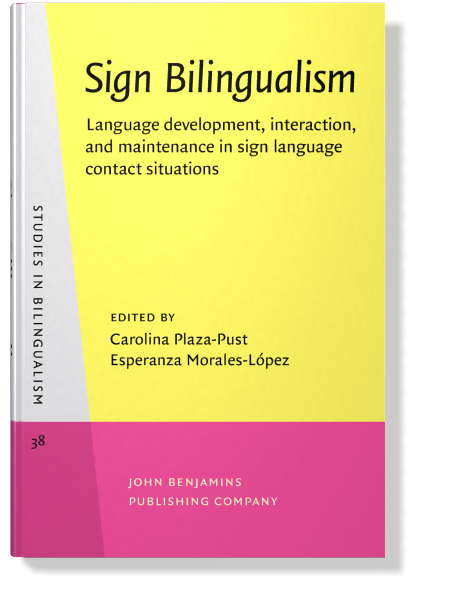
Edited by Carolina Plaza-Pust and Esperanza Morales-López
[Studies in Bilingualism 38] 2008
► pp. 165–193
Can signed language be planned? Implications for interpretation in Spain
Published online: 26 September 2008
https://doi.org/10.1075/sibil.38.09gra
https://doi.org/10.1075/sibil.38.09gra
Signed language in Spain as a language planning target has recently become a subject for debate. The increasing number of second language (hearing) learners, as well as functional expansion (in education and media) has led to a conscious awareness of the language. Also, the recent approval of the law on the recognition of Spanish Signed Language seems to predict the institutionalization of the language planning process. In this chapter, we discuss the role of signed language interpreters in this process as a whole. We show the direction that language planning activities have taken so far, and provide an insight into a suitable future direction.
Keywords: deaf education, interpreting, Sign Language planning, standardization

Cited by (2)
Cited by two other publications
McKee, Rachel & Anna-Lena Nilsson
2022. Interpreters as agents of language planning. Translation and Interpreting Studies 17:3 ► pp. 429 ff.
This list is based on CrossRef data as of 1 december 2025. Please note that it may not be complete. Sources presented here have been supplied by the respective publishers. Any errors therein should be reported to them.