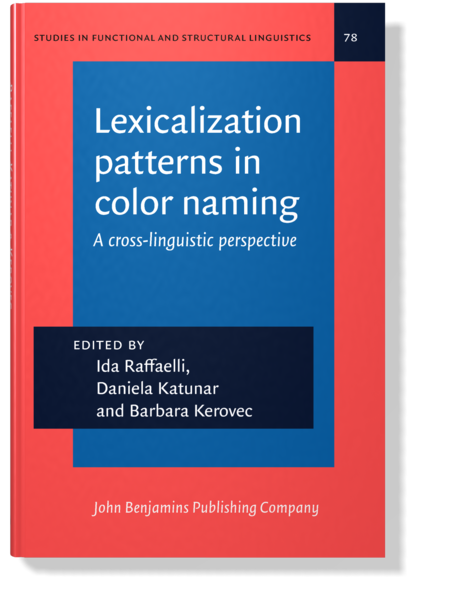
In:Lexicalization patterns in color naming: A cross-linguistic perspective
Edited by Ida Raffaelli, Daniela Katunar and Barbara Kerovec
[Studies in Functional and Structural Linguistics 78] 2019
► pp. 379–400
From object to color and back
Seeing the world in color in Croatian, Turkish, and Arabic
Published online: 9 October 2019
https://doi.org/10.1075/sfsl.78.16kat
https://doi.org/10.1075/sfsl.78.16kat
This chapter deals with lexicalization patterns of color
terms and lexical units derived from color terms in Croatian,
Turkish, and Arabic, three typologically and socioculturally
different languages. The focus of the analysis is the relationship
between object and color in: (a) the way the languages exploit the
object for color conceptualization strategy in order to name colors
and (b) the way languages use the color for object conceptualization
strategy in order to lexicalize different phenomena of experience.
In addition, one of the main aims of the analysis is to see which
lexicalization patterns in the three languages are used productively
in both types of conceptualization strategies.
Article outline
- 1.Introduction
- 2.Lexicalization patterns of color term formation in Croatian,
Turkish, and Arabic
- 2.1object for color lexicalization patterns
- 2.1.1Basic color terms in Croatian, Turkish, and
Arabic – simplex forms and suffixation
- 2.1.1.1Croatian
- 2.1.1.2Arabic
- 2.1.1.3Turkish
- 2.1.2The genitive/possessive construction in Croatian, Turkish, and Arabic
- 2.1.3Differing sociocultural tendencies in the object for color lexicalization patterns
- 2.1.1Basic color terms in Croatian, Turkish, and
Arabic – simplex forms and suffixation
- 2.2Compounding and hue overlap
- 2.3Brightness and intensity modification
- 2.1object for color lexicalization patterns
- 3.From object to color and back
- 3.1Data collection and analysis
- 3.2Domains lexicalized by color terms
- 4.Concluding remarks and future work
Notes References Dictionaries Online dictionaries and corpora

References (42)
Al-Rasheed, A. S., Al-Sharif, H. H., Thabit, M. J., Al-Mohimeed, N. S., & Davies, I. R. L. (2011). Basic colour terms of Arabic. In C. P. Biggam, C. A. Hough, Ch. J. Kay & D. R. Simmons (Eds.), New directions in colour studies (pp. 53–58). Amsterdam / Philadelphia: John Benjamins Publishing Company.
Bayraktar, N. (2004). Kara ve Siyah renk adlarının Türkçedeki kavram ve
anlam boyutu üzerine. TÖMER Dil Dergisi, 126, 56–77.
(2005). Kavram ve anlam boyutunda al, kırmızı ve
kızıl. International Journal of Central Asian Studies Mustafa
Canpolat Armağanı, 10 (1), 145–165.
(2006). Kavram ve anlam boyutunda Türkçede ak ve
beyaz. In C. Yıldız, & L. Beyreli (Eds.), Dilbilim, Dil Öğretimi ve Çeviribilim Yazıları
I-II (pp. 35–50). Ankara: Pegem-A Yayıncılık.
Berlin, B., & Kay, P. (1969). Basic color terms: Their universality and
evolution. Berkeley: California University Press.
Hasan, A. A., Al-Sammerai, N. S. M., & Kadir, F. A. B. A. (2011). How Colours Are Semantically Construed in the
Arabic and English Culture: A Comparative
Study. English language teaching, 4 (3), 206–213.
Hrnjak, A. (2009). Secondary colours in Croatian and Russian
phraseology. In E. E. Stefanskij (Ed.), Kartina mira v slavjanskih i romano-germanskih
jazykah (pp. 82–86). Samarskaja gosudarstvennaja akademija.
Kay, P., & Regier, T. (2003). Resolving the question of color naming
universals. Proceedings of the National Academy of Sciences, 100 (15), 9085–9089.
Küçük, S. (2010). Türkiye Türkçesinde renk andları ve özellikleri.
Uluslararası Sosyal Arastırmalar Dergisi / The Journal of International Social Research, 3 (10), 420-427. [URL]
Özgen, E., & Davies, I. R. L. (1998). Turkish color terms: tests of Berlin and Kay's theory of color universals and linguistic relativity. Linguistics, 36 (5), 919-956.
Raffaelli, I. (2017). Conventionalized patterns of colour naming in
Croatian. In K. Cergol Kovačević & S. L. Udier (Eds.), Proceedings of the XXIX. CALS conference (pp. 171–186). Peter Lang: Frankfurt a/M.
(2013). The model of morphosemantic patterns in the
description of lexical architecture. Lingue e linguaggio, 1, 47–72.
Raffaelli, I., & Kerovec, B. (2008). Morphosemantic fields in the analysis of Croatian
vocabulary. Jezikoslovlje 9 (1–2), 141–169.
Ronga, I., & Bazzanella, C. (2015). The emergence of color categories: Variance and
invariance. Proceedings of the EuroAsianPacific Joint Conference on
Cognitive Science, 222–227.
Ryding, K. C. (2005). A Reference Grammar of Modern Standard Arabic. Cambridge: Cambridge University Press.
Sandford, J. L. (2014). Her blue eyes are red: An idealized cognitive model of
conceptual color metonymy in English. In W. Anderson, C. P. Biggam, C. Hough & Ch. Kay (Eds.), Color studies: A broad spectrum (pp. 109–125). Amsterdam / Philadelphia: John Benjamins.
Topçu, N. (2001). Fransızca ve Türkçe renk isimleri içeren
deyimlerin karşılaştırmalı incelenmesi. Hacettepe Üniversitesi Eğitim Fakültesi Dergisi, 20, 131–140.
Ullmann, S. (1966). Semantic universals. In J. H. Greenberg (Ed.), Universals of language (pp. 217–262). Cambridge, MA: MIT Press.
Wehr, H., & Cowan, J. M. (1979). A dictionary of modern written Arabic
(Arab.-Engl.). Wiesbaden: Otto Harrassowitz Verlag.
Baalbaki, R. (Ed.). (1995). Al-Mawrid: A Modern Arabic-English Dictionary. Beirut: Dar El-ilm Lilmalayin.
Clauson, G. (1972). An Etymological Dictionary of Pre-Thirteenth-Century
Turkish. Oxford: Oxford University Press.
http://www.nisanyansozluk.com/
Hrvatski jezični portal, [URL]
http://nlp.ffzg.hr/resources/corpora/hrwac/
http://www.tdk.gov.tr/index.php?option=com_gts&view=gts