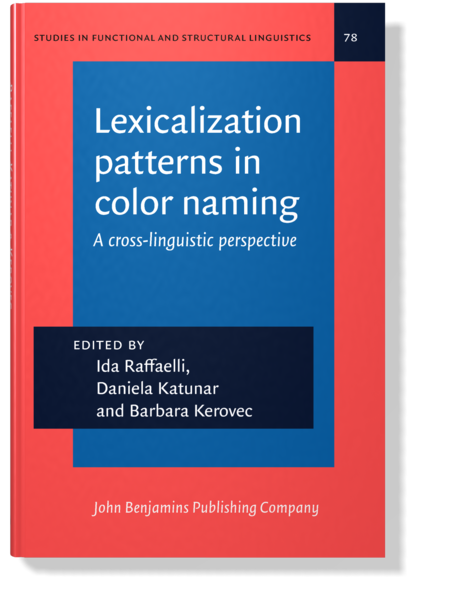
In:Lexicalization patterns in color naming: A cross-linguistic perspective
Edited by Ida Raffaelli, Daniela Katunar and Barbara Kerovec
[Studies in Functional and Structural Linguistics 78] 2019
► pp. 45–60
Lexicalization patterns in Slovak color naming
Published online: 9 October 2019
https://doi.org/10.1075/sfsl.78.03dud
https://doi.org/10.1075/sfsl.78.03dud
This chapter deals with lexicalization patterns in Slovak
color naming on the basis of empirical data from the EoSS project
(Evolution of Semantic Systems, 2011–2014, Max Planck Institute for
Psycholinguistics, Nijmegen). Due to the developmental
particularities of the Slovak color naming system, we can find
word-formation, and other grammatical (e.g., syntactic) and semantic
(e.g., metonymy) patterns featured in the creation of Slovak color
terms in the structure of the contemporary Slovak language. For all
these patterns, we use the term lexicalization pattern, which is
involved in creating different semantic categories. Not all
lexicalization patterns are equally productive in the division of
the color spectrum. Therefore, we focus on their productivity, as
well as on the dominant and peripheral types of meanings that have
cultural roots.
Article outline
- 1.Introduction
- 2.The cultural and historical aspects of color naming
- 2.1Influence of culture on color spectrum differentiation
- 2.2Developmental particularities of the Slovak color naming system
- 3.Lexicalization patterns in color naming
- 3.1Basic meanings expressed by derivation and composition
- 3.2Productivity of lexicalization patterns and meaning categories
- 3.3The semantic pattern ‘N-like’ in color naming
- 4.Conclusion
Notes References

References (24)
Berlin, B., & Kay, P. (1969). Basic Color Terms: Their Universality and
Evolution. Berkeley, CA: University of California Press.
Dorn, A., Willalva, A., Giouli, V., Wiebke, B., Kovalenko, K., & Wandl-Vogt, E. (2016). Displaying Language Diversity on the European
Dictionary Portal – COST ENeL – Case Study on Colours and
Emotions and their Cultural References. In T. Margalitatze, & G. Meladze (Eds.), Proceedings of the 17th EURALEX International
Congress (pp. 237–243). Tbilisi: Ivane Javakhishvili Tbilisi University Press.
Hergenhahn, B. R. (2009). An introduction to the history of psychology (6th ed.). Australia: Wadsworth Cengage Learning.
Jameson, K., & D´Anadrade, R. (1997). It´s not really red, green, yellow, blue: an
inquiry into perceptual color space. In C. L. Hardin, & L. Maffi (Eds.), Color Categories in Thought and Language (pp. 295–319). Cambridge: Cambridge University Press.
Lucy, J. A. (1997). The linguistics of “color”. In C. L. Hardin, & L. Maffi (Eds.), Color Categories in Thought and Language (pp. 320–346). Cambridge: Cambridge University Press.
Malt, B., & Majid, A. (2013). How thought is mapped into words. WIREs Cognitive Science,
4
(6), 583–597.
Majid, A., & Levinson, S. C. (2007). The language of vision I: colour. In A. Majid (Ed.), Field Manual Volume 10 (pp. 22-25). Nijmegen: Max Planck Institute for Psycholinguistics.
Raffaelli, I., & Kerovec, B. (2017). The concept of 'taste' in formation of Croatian
and Turkish lexicon: A contrastive analysis. Suvremena lingvistika,
83
(43), 21-48.
Roberson, D., Davies, I., & Davidoff, J. (2000). Color categories are not universal: replications
and new evidence from a stone-age culture. Journal of Experimental Psychology: General,
129
(3), 369–398.
Regier, T., Káy, P., & Khetarpal, N. (2007). Color naming reflects optimal partitions of color
space. Proceedings of the National Academy of Sciences of the
United States of America,
104
(4), 1436–1441.
Talmy, L. (1985). Lexicalization patterns: semantic structures in
lexical forms. In: T. Shopen (Eds.), Language Typology and Syntactic Description III:
Grammatical Categories and the Lexicon (pp. 57-149). Cambridge: Cambridge University Press.
Tokarski, R. (1995). Sematyka barw we współczesnej polszczyźnie. Lublin: Wydawnictwo Uniwersytetu Marii Curie-Skłodowskiej.
Vaňková, I. (2003). Kolory w czeskim językowym obrazie świata: barwa
„žlutá“. In R. Grzegorczykowa, & K. Waszakowa (Eds.), Studia z semantyki porównawczej. Nazwy barw. Nazwy
wymiarów. Predykaty mentalne. Cz. II. (pp. 69–99). Warszawa: Wydawnictwo Uniwersystetu Warszawskiego.
Vaňková, I., Nebeská, I., Saicová-Římalová, L., & Šlédrová, J. (2005). Co na srdci, to na jazyku. Praha: Univerzita Karlova v Praze. Nakladatelství Karolinum.
Waszakowa, K. (2001). Struktura znaczeniowa podstawowych nazw barw.
Założenia opisu porównawczego. In R. Grzegorczykowa, & K. Waszakowa (Eds.), Studia z semantyki porównawczej. Nazwy barw. Nazwy
wymiarów. Predykaty mentalne. Cz. I. (pp. 59–72). Warszawa: Wydawnictwo Uniwersystetu Warszawskiego.