In:Usage-Based Approaches to Language Change
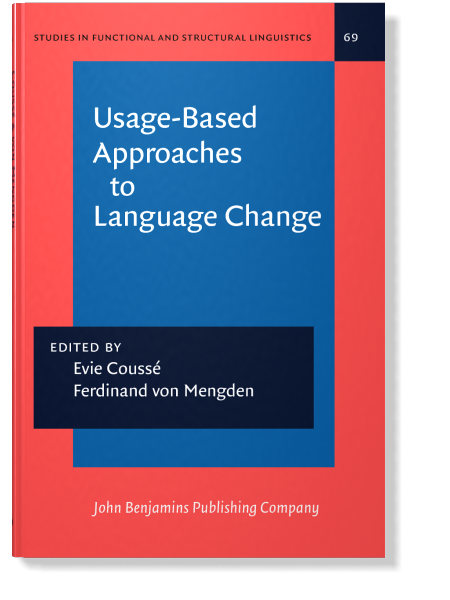
Edited by Evie Coussé and Ferdinand von Mengden
[Studies in Functional and Structural Linguistics 69] 2014
► pp. 243–270
Filling empty distinctions of expression with content
Usage-motivated assignment of grammatical meaning
Published online: 10 July 2014
https://doi.org/10.1075/sfsl.69.09nor
https://doi.org/10.1075/sfsl.69.09nor
This article opens with a brief discussion of the fundamental issues of usage, structure, grammaticalization and reanalysis and then introduces the key concept of an empty distinction, which is defined as a conventionalized distinction of expression that has lost its former motivation (semantic or non-semantic, in particular phonological) as the result of a change. Three change scenarios involving a stage with an empty distinction are considered. The first case study is concerned with the reinterpretation of Old High German umlauted vs. non-umlauted vowel as a marker of number, thus exemplifying an empty distinction originating in a change of the sound system. The second case study considers the complicated development of the inflectional morphemes for the nominative plural of Polish masculine nouns, and it is shown that this change scenario involves a stage with an empty distinction originating in a degrammation. Finally, the third case study discusses the alternation between the accusative and the genitive in the A2 (argument 2) slot in the history of Russian and suggests an analysis involving an empty distinction resulting from domain narrowing of another distinction. In the conclusion the results of the analyses are interpreted in terms of a speakers’ strategy.

References (45)
Nasonov, A.N. (ed.) 1950.
Novgorodskaja pervaja letopis‘ staršego i mladšego izvodov
. Moscow 1950: Izdatel’stvo Akademii Nauk SSSR.
References
. (2001). Markedness and the theory of linguistic change. In H. Andersen (Ed.),
Actualization. Linguistic change in progress
(pp. 21–57). Amsterdam: John Benjamins.
. (2006a). Grammation, regrammation and degrammation: Tense loss in Russian.
Diachronica
, 23, 231–258.
. (2006b). Synchrony, diachrony, and evolution. In O. Nedergaard Thomsen (Ed.),
Competing models of linguistic change. Evolution and beyond
(pp. 59–90). Amsterdam: John Benjamins.
. (2008). Grammaticalization in a speaker-oriented theory of change. In T. Eythórsson (Ed.),
Grammatical Change and Linguistic Theory. The Rosendal Papers
(pp. 11–44). Amsterdam: John Benjamins.
Bräuer, H. (1969).
Slavische Sprachwissenschaft II. Formenlehre 1. Teil
. Berlin: Walter de Gruyter.
Bybee, J. (2003). Mechanisms of change in grammaticalization: The role of frequency. In B.D. Joseph & R.D. Janda (Eds.),
The Handbook of Historical Linguistics
(pp. 602-23). Oxford: Blackwell.
. (2011). Usage-based theory and grammaticalization. In H. Narrog & B. Heine (Eds.),
The Oxford handbook of grammaticalization
(pp. 69–78). Oxford: Oxford University Press.
Bybee, J., Perkins R. & Pagliuca W. (1994).
The Evolution of Grammar
.
Tense, Aspect and Modality in the Languages of the World
. Chicago: The University of Chicago Press.
Fischer, O., Norde M. & Perridon H. (Eds.) (2004).
Up and down the cline – the nature of grammaticalization
. Amsterdam: John Benjamins.
Givón, T. (1971). Historical syntax and synchronic morphology.
Papers from the seventh regional meeting. Chicago Linguistic Society
, 394–415.
Grzegorzykowa, R., Laskowski R. & Wróbel H. (Eds) (1984).
Gramatyka wspólczesnego języka polskiego. Morfologia
. Warszawa: Państwowe Wydawnictwa Naukowe.
Harder, P. (2010).
Meaning in mind and society. A functional contribution to the social turn in linguistics
. Berlin: De Gruyter Mouton.
Harris, A.C. & Campbell L. (1995).
Historical syntax in cross-linguistic perspective
. Cambridge: Cambridge University Press.
Heine, B. & Kuteva T. (2002).
World lexicon of grammaticalization
. Cambridge: Cambridge University Press.
Heltoft, L. (this volume). Constructional change, paradigmatic structure and the orientation of usage processes.
Joseph, B.D. (2003). Morphologization from syntax. In B.D. Joseph & R.D. Janda (Eds.),
The Handbook of Historical Linguistics
(pp. 472–92). Oxford: Blackwell.
Joseph, B.D. & Janda R.D. (1988). The how and why of diachronic morphologization and demorphologization. In M. Hammond & M. Noonan (Eds.),
Theoretical morphology: approaches in modern linguistics
(pp. 193–210). San Diego: Academic Press.
Kemmer, S. & Barlow M. (2000). Introduction: a usage-based conception of language. In M. Barlow & S. Kemmer (Eds.),
Usage-based models of language
(pp. vii-xxviii). Stanford, California: CSLI Publications.
Kragh, K.J. & Schøsler L. (this volume). Reanalysis and gramma (ticaliza)tion of constructions: The case of the deictic relative construction with perception verbs in French.
Langacker, R.W. (1977). Syntactic reanalysis. In C.N. Li (Ed.),
Mechanisms of syntactic change
(pp. 57–139). Austin: University of Texas Press.
Lass, R. (1990). How to do things with junk: exaptation in language evolution.
Journal of Linguistics
, 26, 79–102.
Lehmann, C. (1985). Grammaticalization: Synchronic Variation and Diachronic Change.
Lingua e Stile
, 20, 303–18.
Nørgård-Sørensen, J. (2011a).
Russian nominal semantics and morphology
. Bloomington, Indiana: Slavica Publishers.
. (2011b). Patterns of connecting grammaticalisation in Russian: Syntax, animacy and aspect. In J. Nørgård-Sørensen, L. Heltoft & L. Schøsler (pp. 115–170).
Nørgård-Sørensen, J., Heltoft L. & Schøsler L. (2011).
Connecting grammaticalization
. Amsterdam: John Benjamins.
Rothstein, R.A. (1993). Polish. In B. Comrie & G.G. Corbett (Eds.),
The Slavonic languages
(pp. 686–758). London: Routledge.
. (this volume). Does innovation need reanalysis?
Szober, S. (1963).
Gramatyka języka polskiego
.
Wydanie szóste
. Warszawa: Państwowe Wydawnictwa Naukowe.
Cited by (3)
Cited by three other publications
GÜZEL, Hasan
Kragh, Kirsten Jeppesen & Lene Schøsler
2014. Reanalysis and gramma(ticaliza)tion of constructions. In Usage-Based Approaches to Language Change [Studies in Functional and Structural Linguistics, 69], ► pp. 169 ff.
This list is based on CrossRef data as of 1 december 2025. Please note that it may not be complete. Sources presented here have been supplied by the respective publishers. Any errors therein should be reported to them.