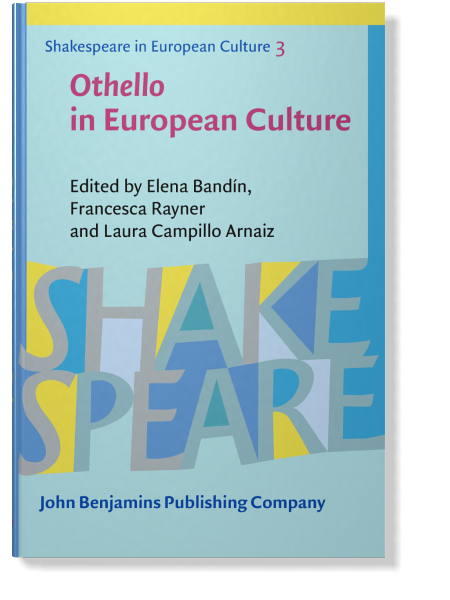
In:Othello in European Culture
Edited by Elena Bandín Fuertes, Francesca Rayner and Laura Campillo Arnaiz
[Shakespeare in European Culture 3] 2022
► pp. 99–112
Chapter 5Othello’s race and slavery
Shakespeare, Ducis and Barbaz
Published online: 25 May 2022
https://doi.org/10.1075/sec.3.05fra
https://doi.org/10.1075/sec.3.05fra
Abstract
Shakespeare’s Othello is usually regarded as a play about race. According to Douglas Lanier, however, continental European cinema often foregrounds the hero’s class instead of his race. I trace this continental phenomenon to post-revolutionary France. In Jean-François Ducis’s Othello adaptation (1792), race is subsumed under class. As John Golder has argued, Ducis’s Othello responds to the revolutionary French movement towards the emancipation of slaves and coloured people. When Britain abolished the slave trade, however, the dangers to economic prosperity became clear. In that context, a racist parody of Ducis’s Othello adaptation by the Dutchman Abraham Barbaz (1815) reinstated race as its anti-hero’s defining characteristic. Whether Othello’s race is seen as his defining characteristic depends on the political and economic context.
Keywords: Shakespeare, Ducis, Duval, Barbaz, Othello, race, class, French Revolution, slavery, abolition
Article outline
- Ducis and Duval
- Barbaz
- Slavery and slave trade
- Conclusion
Acknowledgements Note References

References (16)
Anon. 1802. [Review of] Othello, of de Moor van Venetien. Vaderlandsche Letteroefeningen [Dutch literary journal, 1761–1876]. In Digitale Bibliotheek voor de Nederlandse Letteren. [URL]
Barbaz, Abraham Louis. 1815 [1814?]. Othello, of de jaloersche zwart, hekelspel. In Tooneel-Parodiën of Hekelspelen, 1–56 [continued numbering 33–88]. Amsterdam: P.E. Briët.
. 1818. De Negerhandel Afgeschaft, Dichtstuk. In Dichterlyke Bloemhof, 180–208. Amsterdam: J. C. van Kesteren.
Boulukos, George E. 2006. “The Politics of Silence: Mansfield Park and the Amelioration of Slavery.” Novel 39 (3): 361–383.
Ducis, Jean-François. 1839. Othello, ou le More de Venise. In Œuvres de J.F. Ducis suivies des œuvres de M.J. de Chénier, 155–182. Paris: Ledentu.
Duval, Alexandre. 1824–1825. Shakespeare amoureux; ou, la pièce à l’étude. In Œuvres Complètes d’Alexandre Duval, vol. 8, 305–348. Bruxelles: Hayez.
Franssen, Paul. 2016. Shakespeare’s Literary Lives: The Author as Character in Fiction and Film. Cambridge: Cambridge University Press.
Golder, John. 1992. Shakespeare for the Age of Reason: The Earliest Stage Adaptations of Jean-François Ducis, 1769–1792. Oxford: Voltaire Foundation.
Lanier, Douglas. 2013. “Othello without Race in European Film.” Unpublished conference paper. Montpellier, ESRA conference Shakespeare and Myth.
Leek, Robert-Henri. 1972. Shakespeare in the Netherlands: A Study of Dutch Translations and Dutch Performances of William Shakespeare’s Plays. PhD diss. University of Auckland, NZ. [URL]
Oostindie, Gert. 2014. “Dutch Atlantic Decline during ‘The Age of Revolutions.’” In Dutch Atlantic Connections, 1680–1800: Linking Empires, Bridging Borders, edited by Gert Oostindie and Jessica V. Roitman, 309–335. Leiden: Brill.
Parker, Reeve. 2011. Romantic Tragedies: The Dark Employments of Wordsworth, Coleridge, and Shelley. Cambridge: Cambridge University Press.
[Uylenbroek], P. J.. 1802. Othello, of de moor van Venetiën; Treurspel. Het Fransche van Ducis vry gevolgd. Amsterdam: Abraham Mars.