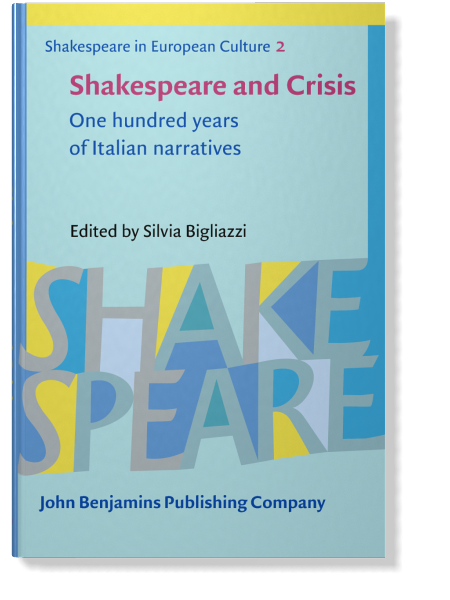
In:Shakespeare and Crisis: One hundred years of Italian narratives
Edited by Silvia Bigliazzi
[Shakespeare in European Culture 2] 2020
► pp. 95–145
Chapter 3Fascist crises
Shakespeare, ‘thou art mighty yet!’
Published online: 22 June 2020
https://doi.org/10.1075/sec.2.03big
https://doi.org/10.1075/sec.2.03big
Abstract
Shakespeare’s Julius Caesar was a play that Italian Fascism accurately exploited during various
transitions in the history of its regime. Although in many respects a difficult play, full of thorny ambiguities for Fascist ideology,
it offered good possibilities for propaganda, if appositely manipulated, at least until the Ethiopian Empire was proclaimed. This
chapter contends that Shakespeare’s fortune with Fascism coincides with some of the most critical phases in the transformation and
establishment of Fascist power between 1924–1925 and 1939. It also argues that although after the 1935 Maxentius production, and the
1936 Genoa performance of Malipiero’s opera drawn from Julius Caesar, its fortune suddenly dropped, the play
continued to haunt the Italian stages. It became the ‘Stone Guest’ of other subsequent Italian Caesar plays which sought to erase its
memory in order to contribute to new propaganda trends. By also exploring practices of manipulation and censorial excision, the essay
discusses how Shakespeare offered at the time the litmus test of critical moments in the history of the Fascist regime.
Keywords: Fascism, Shakespeare, Julius Caesar, censorship
Article outline
- Rising and falling in Fascist Italy
- The fad begins: The 1924 crisis
- Fascistising Shakespeare: 1928 law and order
- Mussolini, Caesar, Shakespeare: An interlude (1932)
- ‘Propaganda Shakespeare’: The 1935 crisis
- Towards power consolidation and self-censure: 1936
- Post-empire transitions: Forgetting Shakespeare’s Caesar
- 1939: Shakespeare, “thou are mighty yet!”
- Silence
Notes References

References (73)
Angeli, Diego. 1935. “Alla
Basilica Massenzio. Giulio Cesare e Bruto nella tragedia shakespeariana.” La
Stampa 2 August: 4.
Appian. 1578. An Avncient Historie and
exquisite Chronicle of the Romanes warres, both Ciuile and
Foren. London: Rause Newbery and Henrie Bynniman.
Bassi, Shaul. 2009. “Guglielmo
e Benito: Shakespeare e la razza in epoca fascista.” In Postcolonial
Shakespeare. Studi in onore di Viola Papetti, edited by M. D’Amico and S. Corso, 19–32. Roma: Edizioni di Storia e Letteratura. (English version Bassi 2011.)
. 2011. “Guglielmo
and Benito: Shakespeare, Nation and Ethnicity in Fascist Italy.” In The
Shakespearean International Yearbook (11), edited by Graham Bradshaw, Tom Bishop, Alexander Huang, and Jonathan Harris, 199–216. Aldershot: Ashgate.
Bigliazzi, Silvia, ed. 2019. Julius
Caesar 1935. Shakespeare and Censorship in Fascist
Italy. Verona: Skenè.
Berghaus, Günter. 1996. Fascism
and Theatre. Comparative Studies on the Aesthetics and Politics of Performance in Europe,
1925–1945. New York: Berghahn Books.
Bertolini, Alberto. 1948. “Il
presidente Einaudi a Verona per la prima di ‘Romeo e Giulietta’.” Il
Gazzettino (Venezia) 27 July. Accessed September 1, 2018. [URL]
Boatti, Giorgio. 2010. Preferirei
di no. Le storie dei dodici professori che si opposero a
Mussolini. Torino: Einaudi.
Calvani, Alessandra. 2012. Traduzioni
e Traduttori. Limena (Padova): Libreriauniversitaria.it Edizioni.
Campodonico, Marcello, ed.
and trans. 1925. Giulio Cesare di Guglielmo
Shakespeare. Milano: Carlo Signorelli.
Canfora, Luciano. 2009. “Caesar
for Communists and Fascists.” In A Companion to Julius
Caesar, edited by Miriam Griffin, 431–440. Oxford: Wiley-Blackwell.
Cavallo, Pietro. 1990. Immaginario
e rappresentazione. Il teatro fascista di
propaganda. Roma, Bonacci Editore.
. 1996. “Theatre
Politics of the Mussolini Régime and Their Influence on Fascist
Drama.” In Fascism and Theatre. Comparative Studies on the Aesthetics and
Politics of Performance in Europe, 1925–1945, edited by Günter Berghaus, 111–132. New York: Berghahn Books.
Cerpelloni, Emma. 1998. “Simoni
e Strehler due nemici in
scena.” L’Arena 2 July. Accessed September 1, 2018. [URL]
De Benedictis, Michele. 2014. “Crossing
the Rubicon in Fascist Italy. Mussolini and Theatrical Casesarism from Shakespeare’s Julius
Caesar”. In Shakespeare and Tyranny: Regimes of Reading in
Europe and Beyond, edited by Keith Gregor, 127–144. Newcastle upon Tyne: Cambridge Scholars Publishing.
De Biasio, Elisabetta. 2006. Alfredo
Frassati un conservatore illuminato: aspetti biografici editi e
inediti. Milano: Franco Angeli.
. 1924. “Prefazione.” In Roma
nelle tragedie di Shakespeare: Giulio Cesare, Coriolano. Translation by Ada Salvatore, v–xxviii. Napoli: G. Casella.
Dunnett, Jane. 2006. “The
Rhetoric of Romanità: Representations of Caesar in Fascist
Theatre’.” In Julius Caesar in Western
Culture, edited by Maria Wyke, 244–268. Oxford: Blackwell.
Folena, Gianfranco. 1977. “La
voce e la scrittura di Malipiero.” In Omaggio a
Malipiero, edited by Mario Messinis, 95–114. Firenze: Olsckhi.
Forzano, Giovacchino. 1954. Mussolini
autore drammatico: Campo di Maggio; Villafranca; Giulio
Cesare. Firenze: G. Barbera.
Frassati, Luciana. 1979. Un
uomo un giornale. Alfredo
Frassati. Vol. 2, part 2. Roma: Edizioni di Storia e Letteratura.
Frese Witt, Mary Ann. 2001. The Search for Modern Tragedy. Aesthetic
Fascism in Italy and France. Ithaca, NY: Cornell University Press.
Fried, Ilona. 2010. “Bontempelli
e i ‘teatri di masse’.” Bollettino ’900. Electronic Journal of ’900 Italian
Literature (1–2). Accessed September 1, 2018. [URL]
Gentile, Emilio. 1996. “The
Theatre of Politics in Fascist Italy.” In Fascism and Theatre.
Comparative Studies on the Aesthetics and Politics of Performance in Europe, 1925–1945, edited
by G. Berghaus, 72–93. New York: Berghahn Books.
Giardina, Andrea. 2000. “Ritorno
al futuro: la Romanità Fascista”. In Il mito di Roma: da Carlo Magno a
Mussolini, by Andrea Giardina, and André Vauchez, 212–296. Bari: Laterza.
Gramsci, Antonio. 1979. Letteratura
e vita nazionale. Nuova edizione riveduta e
integrata. Roma: Editori Riuniti.
Griffiths, Clive. 2006. “Theatre
under Fascism.” In A History of Italian
Theatre, edited by Joseph Farrell and Paolo Puppa, 339–348. Cambridge: Cambridge University Press.
Isenberg, Nancy. 2012. “‘Caesar’s
Word against the World’: Caesarism and the Discourses of
Empire.” In Shakespeare and the Second World
War, edited by Irena R. Makaryk and Marissa McHugh, 83–105. Toronto: Toronto University Press.
Ludwig, Emil. 1933. Talks
with Mussolini. Translated from the German by Eden and Cedar Paul. Boston: Little, Brown & Co.
Malipiero, Gian Francesco. 1938. “Memorie utili. Ovvero: come
nasce nei musicisti il desiderio di scrivere per il
teatro.” Scenario 7 (3): 107–110.
. 1992a. L’armonioso labirinto. Teatro da
musica 1913–1970, edited by Marzio Pieri. Venezia: Marsilio.
. 1992b. “Esalazioni
epurative.” Il Sole 24
ore 25 October, n.p. Accessed September 1, 2018. [URL]
Marjanović, Alexandra. 2005. “Introduzione
alla vita e alle carte di Raffaello Piccoli: un
racconto.” Cartevive 16 (1) (37): 26–84.
Muccioli, Alessandro. 1924. “Introduction.” In Guglielmo
Shakespeare. Giulio Cesare, edited and translated by Alessandro Muccioli, 5–20. Firenze: Battistelli.
Mussolini, Benito. 1934. Scritti
e discorsi. Vol. 2: La rivoluzione
fascista (23 marzo 1919 – 28 ottobre 1922). Milano: Hoepli.
. 1934. Poesia
e vita spirituale saggi sulla letteratura e la civiltà inglese e americana e sui loro rapporti con
l’Italia. Bari: Laterza.
Plutarch. (1576) 1899. Plutarch’s Lives
Englished by Sir Thomas North in Ten Volumes, vols 7 and
9. London: J.M. Dent and Sons.
Rebora, Roberto. 1953. “La
tragedia di un
intellettuale.” Sipario 18, 1 December. Accessed September 10, 2018. [URL]
Ricci, Aldo, ed. 1921. W.
Shakespeare, Giulio Cesare. Tragedia, con introduzione e note ad uso
scolastico. Firenze: G.C. Sansoni Editore.
Ripamonti, Icilio. 1953. “Successo
al ‘Piccolo’ del ‘Giulio
Cesare’.” Avanti! 21 November. Accessed September 10, 2018. [URL]
Santi, Piero. 1977. “La
concezione teatrale.” In Omaggio a
Malipiero, edited by Mario Messinis, 153–163. Firenze: Olsckhi.
Scarpellini, Emanuela. 1989. Organizzazione
teatrale e politica del teatro nell’Italia
fascista. Firenze: La Nuova Italia.
Shakespeare, William. 1862. Œuvres
complètes. Tome x. La Société. Translated by François-Victor Hugo. Paris: Pagnerre Librairie – Éditeur.
Simini, Ezio Maria. 1993. “Vita e morte di Domenico
Piccoli deputato socialista vicentino (1854–1921).” VENETICA, Annuario di storia delle Venezie in
età contemporanea, nuova serie
n. 2: 131–168.
Sterpos, Marco. 2015. Scrivere
teatro nel regime. Giovacchino Forzano e la collaborazione con
Mussolini. Modena: Mucchi Editore.
Testa, Pietro. s.d. Rapporto
sul campo 83. Dal Comando Italiano, 22 giugno 1945. Storia dei militari che rifiutarono il
nazismo. Premessa di Mario Beiletti, Introduzione e note di Franco Di
Giorgi.
Treves, Piero. 1993. “Interpretazioni
di Giulio Cesare” (1934). Quaderni di
Storia 19 (37): 115–126.
Turba, Alessandro. 2016. Il
mito di Giulio Cesare e il culto della romanità nel teatro musicale dell’Era Fascista: i casi di Gian Francesco e Riccardo
Malipiero. PhD diss. Università di Milano. Accessed September 1,
2018. [URL]
Verdone, Mario. 1996. “Mussolini’s
‘Theatre of the Masses’.” In Fascism and Theatre. Comparative Studies on
the Aesthetics and Politics of Performance in Europe, 1925–1945, edited by Günter Berghaus, 133–139. New York: Berghahn Books.
Waterhouse, C. G. John. 2013. Gian Francesco Malipiero. The Life,
Times and Music of a Wayward Genius 1882–1973. New York: Routledge.
. 2016. “Malipiero, Gian
Francesco.” Grove Music Online. Oxford Music
Online. Oxford: Oxford Unversity Press. Accessed September 10,
2018. [URL]
Wyke, Maria. 1999. “Sawdust
Caesar: Mussolini, Julius Caesar, and Drama of Dictatorship.” In The Uses
and Abuses of Antiquity, edited by Michael Biddiss and Maria Wyke, 167–186. Bern: Peter Lang.