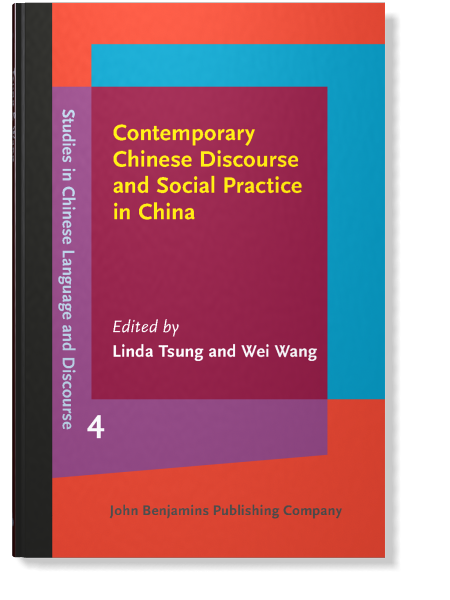
In:Contemporary Chinese Discourse and Social Practice in China
Edited by Linda Tsung and Wei Wang
[Studies in Chinese Language and Discourse 4] 2015
► pp. 59–80
Nation-State Building in a Rising China
PRC Discourses on the Chinese Language since the Turn of the 21st Century
Published online: 9 October 2015
https://doi.org/10.1075/scld.4.05zho
https://doi.org/10.1075/scld.4.05zho
This chapter studies how nation-state is built through discourse evolution in
contemporary China. I consider discourse as an ensemble of concepts of an
ideology bespoken by a collection of defining terms, words and expressions,
in relevant texts. Adopting both constructive and deconstructive approaches
to discourse, I will focus on the analysis of the occurrence and use of two new
terms, the national common language (guojia tongyong yuyan) and global
promotion of Chinese (hanyu guoji tuiguang), in China since 2000. I will argue,
since these key terms play a core role as indicators of power relations in the
production of a new ideology (Laclau and Mouffe 1985; van Dijk 1997, 17–34),
that these changes in Chinese official and public discourses redefine China as a
new nation-state and prepare a rising China for the battle for its linguistic and
cultural hegemony both domestically and globally (see Stambach 2015).

References (51)
Brubaker, Rogers. 1992. Citizenship and Nationhood in France and Germany. Cambridge, MA: Harvard University Press.
China. 2012. Guojia zhongchangqi yuyan wenzi shiye gaige he fazhan guihua gangyao (2010–2020) (Outline of the PRC’s 2010–2020 language and script reform and development plan). [URL]. Retrieved on April 25, 2013.
. 2001. Zhonghua renmin gongheguo guojia tongyong yuyan wenzi fa: xuexi duben [The Law of the national common language of the People’s Republic of China: A reader]. Beijing: Yuwen Press.
. 1996. Guojia yuyan wenzi zhengce fagui huibian (1949–1995) [Collection of state language and script policies and regulations: 1949–1995]. Beijing: Language Press.
. 1991. Shaoshu minzu jiaoyu gongzuo wenjian xuanbian 1949–1988 [Selected documents of the Central Government on minority education: 1949–1988]. Hohhot: Inner Mongolian Education Press.
Confucius. 1938. The Analects of Confucius (Arthur Waley, trans. and annot.). New York: Vintage Book.
Cooper, Robert L. 1988. Planning language acquisition. In Language Spread and Language Policy: Issues, Implications, and Case Studies, ed. by Peter H. Lowenberg, 140–151. Washington, DC: Georgetown University Press.
Dai, Qingxia, Teng Xing, Guan Xinqiu, and Dong Yan. 1997. Zhongguo Shaoshu minzu shuangyu jiaoyu gailun [Introduction to bilingual education for China’s ethnic minorities]. Shenyang: Liaoning Minzu Press.
Derrida, Jacques. 1967. Of Grammatology. (G.C. Spivak, trans.) Baltimore: Johns Hopkins University Press.
Ding, Sheng. 2008. The Dragon’s Hidden Wings: How China Rises with its Soft Power. Lanham, MD: Lexington Books.
Eley, Geoff, and Jan Palmowski (eds.). 2008. Citizenship and National Identity in Twentieth-Century Germany. Stanford, CA: Stanford University Press.
Fairclough, Norman. 2003. Analyzing Discourse: Textual Analysis for Social Research. New York: Routledge.
Fei, Xiaotong (ed.) 1999. The Pattern of Diversity in Unity of the Chinese Nation [Zhonghua minzu duoyuan yiti geju]. Revised Edition. Beijing: Zhongyang Minzu Daxue Press.
(ed.) 1991. New Perspectives on Studies of the Chinese Nation [Zhonghua minzu yanjiu xintansuo]. Beijing: Shehui Kexue Press.
Foucault, Michel. 1980. Power/Knowledge: Selected Interviews and Other Writings, 1972–1977, ed. Colin Gordon. New York: Pantheon Books.
Hartig, Falk. 2014. The globalization of Chinese soft power: Confucius Institutes in Africa. CPD Perspectives on Public Diplomacy, Paper 3: 47–66. Los Angeles, CA: Figueroa Press.
. 2012. Confucius Institutes and the rise of China. Journal of Chinese Political Science, 17: 53–76.
Howarth, David R., and Jacob Torfing. 2005. Discourse Theory in European Politics: Identity, Polity and Governance. New York: Palgrave.
Hu, Yaobang. 1979. Opening speech at the conference on theoretical work (Lilun gongzuo wuxu hui yinyan). Retrieved on April 13, 2014 from [URL].
Hubbert, Jennifer. 2014. Authenticating the nation: Confucius Institutes and soft power. CPD Perspectives on Public Diplomacy, Paper 3: 33–46. Los Angeles, CA: Figueroa Press.
Li, Hua-Yu. 2010. Instilling Stalinism in Chinese Communist Party members: Absorbing Stalin’s Short Course in the 1950s. In China Learns from the Soviet Union, 1949–present, ed. by Thomas P. Bernstein and Hua-Yu Li, 477–503. Lanham, MD: Lexington Books.
Li, Wei and Zhu, Hua. 2014. Geopolitics and the changing hierarchies of the Chinese language. Modern Language Journal, 98 (1): 326–339.
Liu, Xiaotian. 2012. Tisheng yuyan ruanshili tuidong hanyu guoji chuanbo [Increase language soft power and promote international spread of Chinese]. Haiwai Huawen Jiaoyu [Oversea Chinese Education], 3: 115–116.
Lo Bianco, Joseph. 2007. Emergent China and Chinese: Language planning categories. Language Policy, 6: 3–26.
Ma, Rong. 2013. An investigation and analysis of the implementation of one-to-one projects in Xinjiang (Xinjiang duikou zhiyuan xiangmu shishi qingkuang de diaocha fenxi). Sociology of Ethnicity 147: 1–12.
. 2008. Xinjiang minzu jiaoyu de fazhan yu shuangyu jiaoyu shijian [The development of minority education and the practice of bilingual education in Xinjiang]. Peking University Education Review, 6 (2): 2–41.
Pool, Jonathan. 1979. Language planning and identity planning. International Journal of the Sociology of Language 20, 5–21.
Ren, Qing. 2007. Dali tuijin minhan hexiao, jijidi yingzao hexie de shuangyu jiaoxue huanjing (Strive to promote the integration of minority language medium schools and Chinese language-medium schools and actively create a harmonious environment for bilingual education). Jichu Jiaoyu Gaige Dongtai (Newsletter of Reform in Elementary Education), vol. 261 (9): 29–33.
. 2013. China U. The Nation, November 18, 2013: [URL]. Retrieved on March 28, 2015.
Spolsky, Bernard and Elana Shohamy. 1999. The languages of Israel: Policy, Ideology and Practice. Clevedon: Multilingual Matters.
Stambach, Amy. 2015. Confucius Institute programming in the United States: Language ideology, hegemony, and the making of Chinese culture in university classes. Anthropology & Education Quarterly, 46(1): 55–70.
Star, Don. 2009. Chinese language education in Europe: The Confucius Institutes. European Journal of Education, 44(1): 65–82.
Sutherland, Claire. 2005. Nation building through discourse theory. Nations and Nationalism, 11(2): 185–202.
Tilly, Charles. 1996. Citizenship, Identity, and Social History. Cambridge: Cambridge University Press.
an Dijk, Teun A. 1997. Discourse as interaction in society. In Discourse as Social Interaction, ed. by Teun A. Van Dijk, 1–34. London: Sage.
Vogel, Ezra. 2011. Deng Xiaoping and the Transformation of China. Cambridge, MA: Harvard University Press.
Xinjiang. 2012. Xinjiang weiwuer zizhiqu shaoshu minzu xueqian he zhongxiaoxue shuangyu jiaoyu fazhan guihua (2010–2020) (2010–2020 plan for the development of bilingual education for pre-schools and elementary and secondary schools in Xinjiang Uyghur Autonomous Region). [URL]. Retrieved on April 25, 2013.
Yang, Alan H. and Hsiao Michael. 2012. Confucius Institutes as Trojan horses for Chinese hegemony. Help AsianNews, July 18, 2012.
Zaharna, R.S. 2014. China’s Confucius Institutes: Understanding the relational structure and relational dynamics of network collaboration. CPD Perspectives on Public Diplomacy, Paper 3: 9–32. Los Angeles, CA: Figueroa Press.
Zhou, Minglang. 2011a. “A global Putonghua? Globalization of Chinese and the PRC’s global promotion of Chinese.” Paper presented at the 16th World Congress on Applied Linguistics, Beijing, August 23–28.
. 2011b. Historical Review of the PRC’s Minority/Indigenous Language Policy and Practice: Nation-State Building and Identity Construction. In China’s Integrationist Language Policy: Impact on Ethnic Harmony, ed. by Gulbahar H. Beckett and Gerard A. Postiglione, 18–30. New York: Routledge.
. 2010a. The fate of the Soviet model of multinational-state building in China. In China Learns from the Soviet Union, 1949–present, ed. by Thomas P. Bernstein and Hua-Yu Li, 477–503. Lanham, MD: Lexington Books.
. 2010b. China: The Mainland, Hong Kong and Taiwan. In Handbook of Language and Ethnic Identity: Disciplinary and Regional Perspectives, ed. by Joshua A. Fishman and Ofelia García, vol. 1, 470–484. Oxford: Oxford University Press.
. 2009. Shijie huayu datong? Hanyu guoji tuiguang yu kuajing yuyan guihua de lilun sikao [A global Chinese? Theoretical considerations of global Chinese promotion and cross-border language planning]. Paper presented At the Second Global Chinese Forum, Jinan University in Guangzhou, China, November 15–17, 2009.
. 2008. “Models of nation-state building and the meaning of being Chinese in contemporary China.” Paper presented at the Critical Han Studies conference, Stanford University, April 24–27.
Cited by (10)
Cited by ten other publications
Zhou, Minglang
Zhou, Minglang
Zhou, Minglang
Zhou, Minglang
Zhou, Minglang
Ji, Fengyuan
This list is based on CrossRef data as of 1 december 2025. Please note that it may not be complete. Sources presented here have been supplied by the respective publishers. Any errors therein should be reported to them.