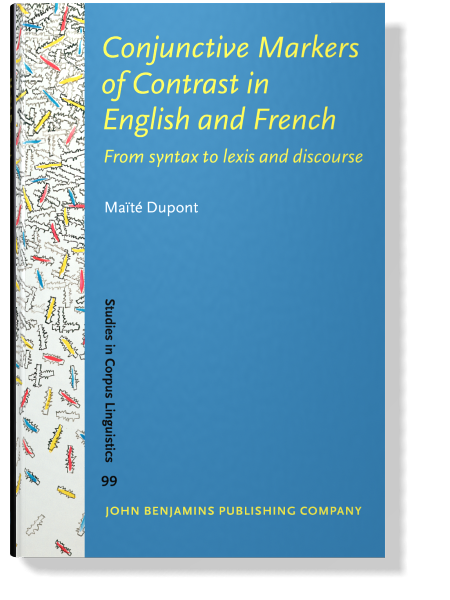
In:Conjunctive Markers of Contrast in English and French: From syntax to lexis and discourse
Maïté Dupont
[Studies in Corpus Linguistics 99] 2021
► pp. v–x
Get fulltext
This article is available free of charge.
Published online: 9 June 2021
https://doi.org/10.1075/scl.99.toc
https://doi.org/10.1075/scl.99.toc
Table of contents
List of tables
List of figures
List of abbreviations
Acknowledgements
Chapter 1.Introduction
1.1Background
1.2Objectives of the study
1.3Framework of the study
1.4Outline of the book
Chapter 2.Defining the key constructs
2.1Issues of comparability for contrastive analysis
2.1.1Equivalence and tertium comparationis
2.1.2Various types of equivalence
2.1.3Issues of circularity in contrastive linguistics: Chesterman’s Contrastive Functional Analysis
2.2Conjunctive markers
2.2.1Cohesion and coherence
2.2.2A focus on conjunctive cohesion
2.2.3Different views on conjunction: Broad and narrow approaches
2.2.3.1Taxis in Systemic Functional Linguistics
2.2.3.2Arguments in favour of the narrow and the broad approaches to conjunction
2.2.3.3Other approaches to conjunction
2.2.4Towards a broad definition of conjunction
2.2.5Some core features of conjunctive markers
2.2.5.1Optionality
2.2.5.2Specific features of the three types of conjunctive markers
2.3Contrast
2.3.1Overview of the literature on contrast
2.3.1.1Number and types of relations of contrast
2.3.1.2Categorisation of relations of contrast
2.3.2Contrast in the present book
2.3.2.1Towards a tripartite view of contrast
2.3.2.2Features of the relations of contrast
2.4Conclusion
Chapter 3.Corpus-based contrastive approaches to conjunctive markers
3.1Corpus-based contrastive linguistics
3.1.1The benefits of a corpus approach to comparing languages
3.1.2Types of corpora in contrastive linguistics
3.1.3Register-sensitive contrastive linguistics: An emerging trend in contrastive linguistics
3.2Corpus-based contrastive research on conjunctive markers
3.2.1Cross-linguistic equivalences between conjunctive markers
3.2.2Onomasiological approaches to conjunctive markers
3.3Conjunctive markers in English and French
3.3.1Frequency of conjunctive markers in English and French
3.3.2Preferred types of conjunctive markers in English and French
3.4Conclusion
Chapter 4.Systemic Functional Linguistics, corpus linguistics and the textual metafunction
4.1Systemic Functional Linguistics and corpus linguistics: A promising synergy
4.1.1Systemic Functional Linguistics and corpus linguistics: A ‘natural affinity’
4.1.2SFL and CL: Areas of divergence
4.1.3Corpus-based Systemic Functional Linguistics: Where do we stand?
4.2Zooming in on the textual metafunction
4.2.1The textual metafunction and thematic structure: Theme and Rheme in Systemic Functional Linguistics
4.2.1.1Theme and Rheme in Systemic Functional Linguistics
4.2.1.2Several types of Theme
4.2.1.3The Rheme: The parent pauvre of thematic structure
4.2.1.4Controversy over thematic structure: Theme/Rheme boundary and cross-linguistic validity
4.2.2Thematic structure and conjunctive markers
4.3Conclusion
Chapter 5.Data and methodology
5.1Data
5.1.1Comparable or translation data?
5.1.2Description of the corpus data
5.2Methodology
5.2.1Four main methodological steps
5.2.1.1Compilation of a list of English and French conjunctive markers of contrast
5.2.1.2Automatic extraction of the conjunctive markers from the corpus
5.2.2Statistical methods
5.2.2.1Frequency comparisons: The chi-square test of independence
5.2.2.2Classification and Regression Trees (CART)
5.3Conclusion
Chapter 6.Beyond automatic extraction: Semantic disambiguation and syntactic segmentation
6.1Semantic disambiguation
6.1.1The polyfunctionality of conjunctive markers
6.1.2Contrast and other meaning relations: Some areas of overlap
6.1.3Dealing with ambiguity: The use of double tags
6.2Syntactic segmentation
6.2.1What do conjunctive markers link?
6.2.2Clauses in English and French
6.2.3Distinguishing between phrasal and clausal segments
6.2.4Coding the syntactic features of the host clause
6.3Conclusion
Chapter 7.Frequency and patterns of use of English and French conjunctive markers of contrast
7.1Introduction
7.2Frequencies of conjunctive markers of contrast in English and French editorials
7.2.1Overall frequency of conjunctive markers of contrast
7.2.2Preferred types of conjunctive markers in English and French
7.2.3Lexical breakdown of the corpus results
7.2.3.1Lexical variety of conjunctive markers in English and French
7.2.3.2Frequency features of individual conjunctive markers of contrast
7.3Syntactic patterning of conjunctive markers of contrast
7.3.1Syntactic patterning of English and French conjunctive markers of contrast
7.3.1.1Syntactic patterns of English and French conjunctive adjuncts of contrast
7.3.1.2Syntactic patterns of English and French coordinators of contrast
7.3.1.3Syntactic patterns of English and French subordinators of contrast
7.3.2The syntax-discourse interface
7.3.2.1Syntactic fragmentation as an emphatic device
7.3.2.2Syntactic compression of contrastive linking in English and French editorials
7.3.3The syntax-lexis interface
7.4Conjunctive adjuncts of contrast in English and French: A cross-register comparison
7.4.1Frequency of conjunctive adjuncts of contrast in English and French: A comparison of newspaper editorials and academic writing
7.4.1.1Overall frequencies of English and French conjunctive markers in LOCRA and Mult-Ed
7.4.1.2Lexical breakdown of the corpus results
7.4.2Syntactic patterns of English and French conjunctive markers of contrast in editorials and academic writing: A focus on sentence-initial coordinators
7.5Conclusion
Chapter 8.Placement patterns of English and French conjunctive adjuncts of contrast
8.1Introduction
8.2A Systemic Functional approach to conjunctive adjunct placement
8.3Conjunctive adjunct placement across languages and registers: A general overview
8.3.1Conjunctive adjunct placement in English and French: Intralingual cross-register comparisons
8.3.2Cross-linguistic comparison of English and French conjunctive adjunct placement: A register-sensitive account
8.3.3Respective weight of language and register on conjunctive adjunct placement
8.4Conjunctive adjunct placement at the syntax-discourse interface
8.4.1Conjunctive adjunct placement in English and French: A range of discourse functions
8.4.1.1Thematic 1 conjunctive adjuncts as ‘pure’ markers of conjunction
8.4.1.2Rhematic 1 conjunctive adjuncts
8.4.1.3Rhematic 2 conjunctive adjuncts
8.4.1.4A short word on thematic 2 and rhematic 3 conjunctive adjuncts
8.4.2Discourse effects of CA placement and cross-register differences
8.5Conjunctive adjunct placement at the syntax-lexis interface
8.5.1Individual placement patterns of English and French conjunctive adjuncts of contrast
8.5.1.1English
8.5.1.2French
8.5.2The combined influence of lexis and register on conjunctive adjunct placement
8.5.2.1English
8.5.2.2French
8.5.2.3Respective influence of lexis and register on English and French conjunctive adjunct placement
8.6Conclusion
Chapter 9.General conclusion
9.1Summary of the main findings
9.1.1Frequency and patterns of use of English and French conjunctive markers of contrast
9.1.2Placement patterns of English and French conjunctive adjuncts of contrast
9.2Main contributions of the study
9.2.1Contribution to (contrastive) discourse analysis
9.2.2Systemic Functional Linguistics and corpus linguistics
9.2.3Quantitative vs qualitative/macro vs micro linguistic research
9.3Promising avenues for future research
References
Appendices
Index
