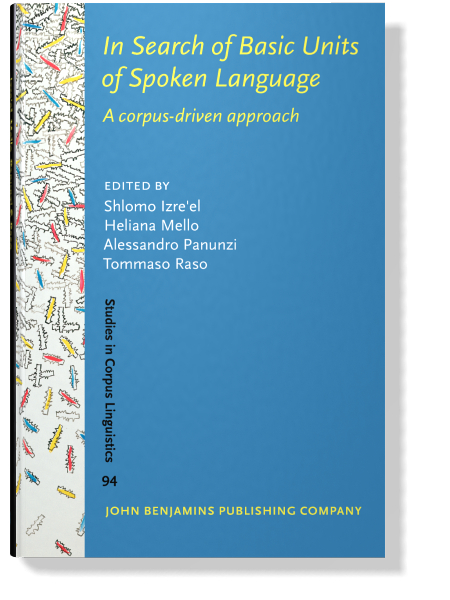
In:In Search of Basic Units of Spoken Language: A corpus-driven approach
Edited by Shlomo Izre'el, Heliana Mello, Alessandro Panunzi and Tommaso Raso
[Studies in Corpus Linguistics 94] 2020
► pp. vii–x
Get fulltext
This article is available free of charge.
Published online: 18 June 2020
https://doi.org/10.1075/scl.94.toc
https://doi.org/10.1075/scl.94.toc
Table of contents
Supplementary materials
The comparative work among all the segmentations is stored in the SLAC (Spoken Language Annotation Comparison) database, through which the reader can find all the segmentations compared and analyzed, freely accessible online at <>.
AcknowledgmentsXI
Introduction.In search of a basic unit of spoken language: Segmenting speech1
Shlomo Izre’el
Heliana Mello
Alessandro Panunzi
Tommaso Raso
Part I
Chapter 1.Russian spoken discourse: Local structure and prosody35
Andrej A. Kibrik
Nikolay A. Korotaev
Vera I. Podlesskaya
Chapter 2.The basic unit of spoken language and the interfaces between prosody, discourse and
syntax: A view from spontaneous spoken Hebrew77
Shlomo Izre’el
Chapter 3.Prosody and the organization of information in Central Pomo, a California indigenous
language107
Marianne Mithun
Chapter 4.Syntactic and prosodic segmentation in spoken French127
Jeanne-Marie Debaisieux
Philippe Martin
Chapter 5.Design and annotation of two-level utterance units in Japanese155
Takehiko Maruyama
Yasuharu Den
Hanae Koiso
Chapter 6.The pragmatic analysis of speech and its illocutionary classification according to the
Language into Act Theory181
Emanuela Cresti
Chapter 7.Illocution as a unit of reference for spontaneous speech: An account of insubordinated
adverbial clauses in Brazilian Portuguese221
Giulia Bossaglia
Heliana Mello
Tommaso Raso
Chapter 8.Narrative discourse segmentation in clinical linguistics257
Mira B. Bergelson
Mariya V. Khudyakova
Chapter 9.Cross-linguistic comparison of automatic detection of speech breaks in read and narrated
speech in four languages285
Plínio Barbosa
Part II
Introduction.Same texts, different approaches to segmentation: An introduction to the second part of
the volume303
Shlomo Izre’el
Heliana Mello
Alessandro Panunzi
Tommaso Raso
Chapter 1.Segmentation and analysis of the two English excerpts: The Brazilian team
proposal309
Tommaso Raso
Plínio Barbosa
Frederico Cavalcante
Maryualê Mittmann
Chapter 2.Analysis of two English spontaneous speech examples with the dependency incremental
prosodic structure model327
Philippe Martin
Chapter 3.Applying criteria of spontaneous hebrew speech segmentation to English337
Shlomo Izre’el
Chapter 4.Basic units of speech segmentation349
Marianne Mithun
Chapter 5.Segmentation of the English texts Navy and Hearts with
SUU and LUU359
Takehiko Maruyama
Chapter 6.The Moscow approach to local discourse structure: An application to English367
Andrej A. Kibrik
Nikolay A. Korotaev
Vera I. Podlesskaya
Chapter 7.Some notes on the Hearts and Navy excerpts according
to the Language into Act Theory383
Emanuela Cresti
Massimo Moneglia
Chapter 8.Comparing annotations for the prosodic segmentation of spontaneous speech: Focus on
reference units403
Alessandro Panunzi
Lorenzo Gregori
Bruno Rocha
Index433
