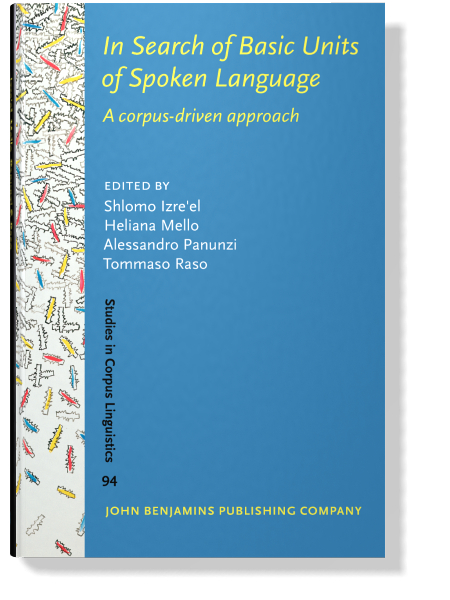
In:In Search of Basic Units of Spoken Language: A corpus-driven approach
Edited by Shlomo Izre'el, Heliana Mello, Alessandro Panunzi and Tommaso Raso
[Studies in Corpus Linguistics 94] 2020
► pp. 77–106
Chapter 2The basic unit of spoken language and the interfaces between prosody, discourse and
syntax
A View from spontaneous spoken Hebrew
Published online: 18 June 2020
https://doi.org/10.1075/scl.94.02izr
https://doi.org/10.1075/scl.94.02izr
Abstract
Looking at spoken language as an integrative whole, where prosody,
syntax and discourse features interplay as to conveying information, I will try to figure out
the best methodology for its research by advocating that the best candidate to be regarded
as the basic unit of spoken discourse is the utterance. Arguments brought
will be mainly phonetic, phonological (prosodic), informational, and syntactic. In addition,
arguments from pragmatics and conversation analysis will be mentioned.
Keywords: prosodic units, utterance, segmentation, syntax, clause, predicate, spoken language, Hebrew
Article outline
- 1.Introduction
- 2.Units of spoken language: Definitions and terminology
- 2.1Prosodic and information (discourse) units
- 2.1.1Prosodic module (PM), segmental module (SM) and information module (IM)
- 2.1.2Prosodic set (PS) and utterance (Utt) or information set
- 2.2Syntax: The clause
- 2.1Prosodic and information (discourse) units
- 3.In search of the basic unit of spoken language
- 3.1The interface between prosodic, information (discourse), and syntactic units
- 3.2Hypotheses
- 3.3One single utterance consists of a single clause
- 3.4Utterances with no syntactic contents
- 3.5Expanded configurations
- 3.5.1Clause+
- 3.5.2Clause clusters
- 3.6Interim conclusions
- 3.7Utterances ending in minor boundaries and Utts continuing after major
boundaries
- 3.7.1Utterances ending in minor boundaries
- 3.7.1.1Isotony
- 3.7.1.2Backchannels
- 3.7.1.3Greetings and courtesy phrases
- 3.7.1.4Suspended utterances
- 3.7.2Major boundaries in mid-utterance position
- 3.7.2.1Inserts
- 3.7.2.2Split utterances
- 3.7.1Utterances ending in minor boundaries
- 4.Conclusion
Acknowledgements Notes References

References (59)
Amir, N., Silber-Varod, V., & Izre’el, S. (2004). Characteristics
of intonation unit boundaries in spontaneous spoken Hebrew: Perception and acoustic
correlates. In B. Bel, & I. Marlien (Eds.), Speech
prosody
2004 (pp. 677–680). Nara, Japan: ISCA.
Bolinger, D. (1972
[1964]). Around the edge of language:
Intonation. In D. Bolinger (Ed.), Intonation:
Selected readings (pp. 19–29). Harmondsworth: Penguin Books.
Bossaglia, G., Mello, H., & Raso, T. (this
volume). Illocution as a unit of reference for spontaneous
speech: An account for insubordinated adverbial clauses in Brazilian
Portuguese. In S. Izre’el, H. Mello, A. Panunzi, & T. Raso (Eds.), In
search of basic units of spoken language: A corpus-driven
approach. Amsterdam: John Benjamins.
Chafe, W. (1993). Prosodic
and functional units of
language. In J. Edwards & M. D. Lampert (Eds.), Talking
data: Transcription and coding in discourse
research (pp. 33–43). Hillsdale, NJ: Lawrence Erlbaum Associates.
(1994). Discourse,
consciousness, and time: The flow and displacement of conscious experience in speaking and
writing. Chicago, IL: The University of Chicago Press.
CoSIH. (2012). The
corpus of spoken Israeli Hebrew (CoSIH). Retrieved
from <[URL]>
(2007). Intonation
units and grammatical structure in Wardaman and
English. Australian Journal of
Linguistics, 27, 1–39.
Debaisieux, J-M. (Ed.). (2013). Analyses
linguistiques sur corpus: Subordination et insubordination en
français. Cachan: Hermès & Lavoisier.
Debaisieux, J-M., & Martin, P. (this
volume). Syntactic and prosodic segmentation in spoken
French. In S. Izre’el, H. Mello, A. Panunzi, & T. Raso (Eds.), In
search of basic units of spoken language: A corpus-driven
approach. Amsterdam: John Benjamins.
Den, Y., Koiso, H., Takehiko, M., Maekawa, K., Takanashi, K., Enomoto, M., & Yoshida, N. (2010). Two-level
annotation of utterance-unit in Japanese dialogs: An empirically emerged
scheme. Proceedings of LREC
2010, 2103–2110.
Du Bois, J. W. (2006). Representing
discourse. Retrieved from <[URL]>
Du Bois, J. W., Cumming, S., Schuetze-Coburn, S., & Paolino, D. (1992). Discourse
transcription. Santa Barbara, CA: Department of Linguistics, University of California.
(1993). Outline
of discourse
transcription. In J. A. Edwards & M. D. Lampert (Eds.), Talking
data: Transcription and coding in discourse
research (pp. 45–89). Hillsdale, NJ: Lawrence Erlbaum Associates.
Evans, N. (2007). Insubordination
and its uses. In I. Nikolaeva (Ed.), Finiteness:
Theoretical and empirical
foundations (pp. 366–431). New York, NY: Oxford University Press.
Ford, C. E., & Thompson, S. A. (1996). Interactional
units in conversation: Syntactic, intonational, and pragmatic resources for the management
of turns. In E. Ochs, E. A. Schegloff, & S. A. Thompson (Eds.), Interaction
and
grammar (pp. 134–184). Cambrige: Cambridge University Press.
Halliday, M. A. K. (2014). Halliday’s Introduction to Functional Grammar. Fourth edition revised by Christian M. I. M. Matthiessen. London and New York: Routledge.
Hirst, D., & Di Cristo, A. (Eds.). (1998). Intonation
systems: A survey of twenty
languages. Cambridge: Cambridge University Press.
Inbar, A. (2016). Is
subordination viable? The case of Hebrew ʃɛ
‘that’. CHIMERA: Romance Corpora And Linguistic
Studies, 3(2), 287–310.
Iwasaki, S. (1993). The
structure of intonation units in
Japanese. In S. Choi (Ed.), Japanese/Korean
linguistics (Vol. 3, pp. 39–53). Stanford CA: CSLI.
Iwasaki, S., & Tao, H. (1993). A
comparative study of the structure of the intonation unit in English, Japanese, and
Mandarin Chinese. Paper presented at
the Annual Meeting of the Linguistics Society of
America, Los Angeles,
CA. Retrieved from <[URL]>
(2005). Intonation
units and the structure of spontaneous spoken language: A view from
Hebrew. In C. Auran, R. Bertrand, C. Chanet, A. Colas, A. Di Cristo, C. Portes, A. Reynier, & M. Vion (Eds.), Proceedings
of the IDP05 international symposium on discourse-prosody
interfaces. Retrieved from <[URL]>
(2012). Basic
sentence structures: A view from spoken Israeli
Hebrew. In S. Caddéo, M.-N. Roubaud, M. Rouquier, & F. Sabio (Eds.), Penser
les langues avec Claire
Blanche-Benveniste (pp. 215–227). Aix-en-Provence: Presses Universitaires de Provence.
(2018a). Unipartite
clauses: A view from spoken Israeli
Hebrew. In M. Tosco (Ed.), Afroasiatic:
Data and
perspectives (pp. 235–259). Amsterdam: John Benjamins.
(2018b). Syntax,
prosody, discourse and information structure: The case for unipartite clauses. A view from
spoken Israeli Hebrew. Revista de Estudos da
Linguagem, 26(4), 1675–1726. Retrieved
from <[URL]>
Izre’el, S., & Mettouchi, A. (2015). Representation
of speech in CorpAfroAs: Transcriptional strategies and prosodic
units. In A. Mettouchi, M. Vanhove, & D. Caubet (Eds.), Corpus-based
studies of lesser-described languages: The CorpAfroAs corpus of spoken AfroAsiatic
languages (pp. 13–41). Amsterdam: John Benjamins.
Kibrik, A. A., Korotaev, N. A., & Podlesskaya, V. I. (this
volume). Russian spoken discourse: Local structure and
prosody. In S. Izre’el, H. Mello, A. Panunzi, & T. Raso (Eds.), In
search of basic units of spoken language: A corpus-driven
approach. Amsterdam: John Benjamins.
Kibrik, A. A., & Podlesskaya, V. I. (2006). Problema segmentacii ustnogo diskursa i kognitivnaja sistema
govorjashchego [Segmentation of spoken
discourse and the speaker’s cognitive
system]. In V. D. Solovyev, (Ed.), Kognitivnye
issledovanija (Vol. 1, pp. 138–158). Moscow: Institut psixologii RAN.
(2008). Is
sentence viable? In The third
international conference on cognitive science. June 20–25, 2008, Moscow, Russia.
Abstracts (Vol. 1, pp. 84–85). Moscow: IP RAN.
(Eds.). (2009). Rasskazy o snovidenijax: korpusnoe issledovanie ustnogo russkogo diskursa [Night dream stories: A corpus study
of spoken Russian
discourse]. Moskva: Iazyki Slavjanskyx Kultur.
Lieberman, P., & Blumstein, S. E. (1988). Speech
physiology, speech perception, and
acoustic. Cambridge: Cambridge University Press.
Martin, P. (2015). The
structure of spoken language: Intonation in
romance. Cambridge: Cambridge University Press.
Matsumoto, K. (2003). Intonation
units in Japanese conversation: Syntactic, informational and functional
structures. Amsterdam: John Benjamins.
Raso, T., & Moneglia, M. (2014). Notes
on Language into Act Theory
(L-AcT). In T. Raso & H. Mello (Eds.), Spoken
corpora and linguistic
studies (pp. 468–495). Amsterdam: John Benjamins.
Sacks, H., Schegloff, E. A., & Jefferson, G. L. (1974). A
simplest systematics for the organization of turn-taking for
conversation. Language, 50, 696–735.
Selkirk, E. (2001). The
syntax-phonology
interface. In N. J. Smelser & P. B. Baltes (Eds.), International
encyclopedia of the social and behavioral sciences (2nd
ed., Vol. 23, pp. 895–899). Amsterdam: Elsevier.
Shor, L. (2016). Cognitive
and interactional motivations for prosodic phrasing: A corpus-based analysis of the clause
in spoken Israeli Hebrew. CHIMERA: Romance Corpora and
Linguistic
Studies, 3(2), 325–343.
Silber-Varod, V. (2011). The
SpeeCHain perspective: Prosodic-syntactic interface in spontaneous spoken
Hebrew (Unpublished doctoral
dissertation), Tel-Aviv University, Israel. Retrieved
from <[URL]>
Sornicola, R. (2006). Topic
and comment. In K. Brown (Ed.), Encyclopedia
of language and linguistics (2nd
ed., pp. 766–773). Oxford: Elsevier.
Szczepek Reed, B. (2011). Analysing
conversation: An introduction to
prosody. Houndmills: Palgrave Macmillan.
Tao, H. (1996). Units
in Mandarin conversation: Prosody, discourse, and
grammar. Amsterdam: John Benjamins.
Warren, P. (2016). Uptalk:
The phenomenon of rising
intonation. Cambridge: Cambridge University Press.
Wichmann, A. (2000). Intonation
in text and discourse: Beginnings, middles and
ends. Harlow: Pearson Education.
Wouk, F. (2008). The
syntax of intonation units in Sasak. Studies in
Language, 32, 137–162.
Cited by (12)
Cited by 12 other publications
Majhenič, Simona, Mitja Beras & Janez Križaj
Raso, Tommaso, Saulo Mendes Santos, Albert Rilliard & João A. Moraes
Ozerov, Pavel
Izre'el, Shlomo
Izre'el, Shlomo
Izre'el, Shlomo
Bossaglia, Giulia, Heliana Mello & Tommaso Raso
2020. Illocution as a unit of reference for spontaneous speech. In In search of basic units of spoken language [Studies in Corpus Linguistics, 94], ► pp. 221 ff.
Izre’el, Shlomo
2020. Applying criteria of spontaneous Hebrew speech segmentation to English. In In search of basic units of spoken language [Studies in Corpus Linguistics, 94], ► pp. 337 ff.
Izre’el, Shlomo, Heliana Mello, Alessandro Panunzi & Tommaso Raso
2020. In search of a basic unit of spoken language. In In search of basic units of spoken language [Studies in Corpus Linguistics, 94], ► pp. 1 ff.
Kibrik, Andrej A., Nikolay A. Korotaev & Vera I. Podlesskaya
2020. Russian spoken discourse. In In search of basic units of spoken language [Studies in Corpus Linguistics, 94], ► pp. 35 ff.
Shor, Leon
This list is based on CrossRef data as of 1 december 2025. Please note that it may not be complete. Sources presented here have been supplied by the respective publishers. Any errors therein should be reported to them.