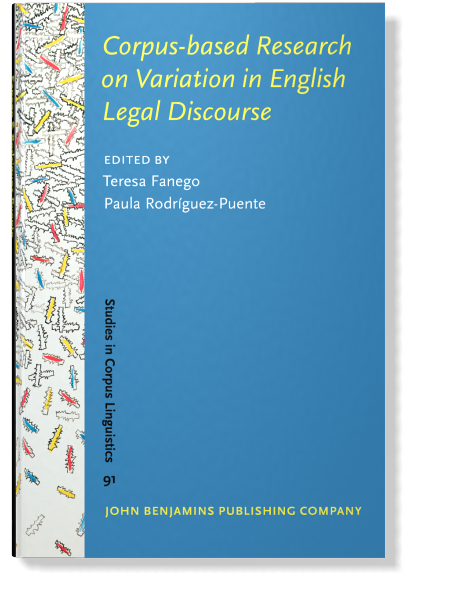
In:Corpus-based Research on Variation in English Legal Discourse
Edited by Teresa Fanego and Paula Rodríguez-Puente
[Studies in Corpus Linguistics 91] 2019
► pp. 171–200
Chapter 8Interpersonality in legal written discourse
A diachronic analysis of personal pronouns in law reports, 1535 to present
Published online: 6 February 2019
https://doi.org/10.1075/scl.91.08rod
https://doi.org/10.1075/scl.91.08rod
This chapter offers a diachronic analysis of the use of personal pronouns in English law reports. Results show that law reports are narrative texts with high frequencies of third person pronouns. However, markers of subjectivity, involvement and interpersonality, such as first and second person pronouns, are also amply represented–a feature which distinguishes law reports from other formal, specialized text types, as well as from other legal documents. In addition, law reports seem to have developed over time, becoming more involved, subjective and interpersonal, a tendency that coincides with a major change in the history of law reporting in English.
Keywords: law reports, interpersonality, pronouns
Article outline
- 1.Introduction
- 2.Sources and methodology
- 3.Results
- 3.1Pronouns in law reports and other legal written documents
- 3.2Diachronic variation in the use of pronouns in law reports
- 4.Conclusion
Acknowledgements Notes References

References (102)
Ariel, Mira. 1999. The development of person agreement markers: From pronouns to higher accessibility markers. In Usage-based Models of Language, Michael Barlow & Suzanne Kemmer (eds), 197–260. Stanford CA: CSLI.
Atkinson, Dwight. 1996. The Philosophical Transactions of the Royal Society of London, 1675–1975: A sociohistorical discourse analysis. Language in Society 2(3): 333–371.
Atkinson, Dwight. 1999. Scientific Discourse in Sociohistorical Context. The Philosophical Transactions of the Royal Society of London, 1675–1975. Mahwah NJ: Lawrence Erlbaum Associates.
Badger, Richard. 2003. Legal and general: Towards a genre analysis of newspaper law reports. English for Specific Purposes 22: 249–263.
Benveniste, Émile. 1971. Problems in General Linguistics. Coral Gables FL: University of Miami Press.
Bhatia, Vijay K. 1993. Analysing Genre. Language Use in Professional Settings. Harlow: Pearson Education.
Biber, Douglas & Finegan, Edward. 1997. Diachronic relations among speech-based and written registers in English. In To Explain the Present: Studies in the Changing English Language in Honour of Matti Rissanen, Terttu Nevalainen & Leena Kahlas-Tarkka (eds), 253–275. Helsinki: Société Néophilologique.
Biber, Douglas & Clark, Victoria. 2002. Historical shifts in modification patterns with complex noun phrase structures: How long can you go without a verb? In English Historical Syntax and Morphology: Selected Papers from 11 ICEHL, Santiago de Compostela, 7–11 September 2000, Vol. 1 [Current Issues in Linguistic Theory 223], Teresa Fanego, María José López-Couso & Javier Pérez-Guerra (eds), 43–66. Amsterdam: John Benjamins.
Biber, Douglas, Johansson, Stig, Leech, Geoffrey, Conrad, Susan & Finegan, Edward. 1999. Longman Grammar of Spoken and Written English. Harlow: Pearson Education.
Breeze, Ruth. 2010. They say, we do: Writer’s strategic positioning in the discourse of political communication research. In Lorés-Sanz, Mur-Dueñas & Lafuente-Millán (eds), 163–179.
Breeze, Ruth. 2014. The discursive construction of professional relationships through the legal letter of advice. In Breeze, Gotti & Sancho-Guinda (eds), 281–302.
Breeze, Ruth, Gotti, Maurizio & Sancho-Guinda, Carmen (eds). 2014. Interpersonality in Legal Genres. Bern: Peter Lang.
Breivega, Kjersti, Dahl, Trine & Fløttum, Kjersti. 2002. Traces of self and others in research articles. A comparative pilot study of English, French and Norwegian research articles in medicine, economics and linguistics. International Journal of Applied Linguistics 12(2): 218–239.
Claridge, Claudia. 2012. Linguistic levels: Styles, registers, genres, text types. In English Historical Linguistics. An International Handbook, Vol. 1, Alexander Bergs & Laurel J. Brinton (eds), 237–253. Berlin: Mouton de Gruyter.
Cornish, William, Anderson, J. Stuart, Cocks, Ray, Lobban, Michael, Polden, Patrick & Smith, Keith. 2010. The Oxford History of the Laws of England, Vol. XI: 1820–1914. Oxford: OUP.
Craig, Hugh. 1999. Authorial attribution and computational stylistics: If you can tell authors apart, have you learned anything about them? Literary and Linguistic Computing 14(1): 103–113.
Culpeper, Jonathan & Kytö, Merja. 2000. Data in historical pragmatics: Spoken interaction (re)cast as writing. Journal of Historical Pragmatics 1(2): 175–199.
Culpeper, Jonathan & Kytö, Merja. 2010. Early Modern English Dialogues. Spoken Interaction as Writing. Cambridge: CUP.
Encyclopædia Britannica Online. <[URL]>
Fanego, Teresa, Rodríguez-Puente, Paula, López-Couso, María José, Méndez-Naya, Belén, Núñez-Pertejo, Paloma, Blanco-García, Cristina & Tamaredo, Iván. 2017. The Corpus of Historical English Law Reports 1535–1999 (CHELAR): A resource for analysing the development of English legal discourse. ICAME Journal 41: 53–82.
Gea-Valor, María-Lluisa. 2010. The emergence of the author’s voice in book reviewing: A contrastive study of academic vs. non-academic discourse. In Lorés-Sanz, Mur-Dueñas & Lafuente-Millán (eds), 117–135.
Gotti, Maurizio. 2010. Identity traits in written academic discourse across languages and cultures. In Lorés-Sanz, Mur-Dueñas & Lafuente-Millán (eds), 41–59.
Goźdź-Roszkowski, Stanisƚaw. 2011. Patterns of Linguistic Variation in American Legal English. A Corpus-based Study. Frankfurt: Peter Lang.
Greenberg, Daniel. 2008. The techniques of gender-neutral drafting. In Drafting Legislation. A Modern Approach, Constantin Stefanou & Helen Xanthaki (eds), 63–76. London: Routledge.
Grund, Peter. 2007. From tongue to text: The transmission of the Salem witchcraft examination records. American Speech 82(2): 119–150.
Hafner, Christoph A. 2014. Stance in a professional legal genre. The barrister’s opinion. In Breeze, Gotti & Sancho-Guinda (eds), 137–160.
Harwood, Nigel. 2005.‘We do not seem to have a theory … The theory I present here attempts to fill this gap’: Inclusive and exclusive pronouns in academic writing. Applied Linguistics 26(3): 343–375.
Herrando-Rodrigo, Isabel. 2010. “If you suffer from… check the Internet”: The role of engagement and self-mention devices in medical research articles and electronic popularizations. In Lorés-Sanz, Mur-Dueñas & Lafuente-Millán (eds), 255–274.
Hiltunen, Risto. 1990. Chapters on Legal English. Aspects Past and Present of the Language of the Law. Helsinki: Suomalainen Tiedeakatemia.
Huber, Magnus. 2007. The Old Bailey Proceedings, 1764–1834. Evaluating and annotating a corpus of 18th- and 19th-century spoken English. In Annotating Variation and Change [Studies in Variation, Contacts and Change in English 1], Anneli Meurman-Solin & Arja Nurmi (eds). Helsinki: University of Helsinki <[URL]>
Huber, Magnus, Nissel, Magnus, Maiwald, Patrick & Widlitzki, Bianca. 2012. The Old Bailey Corpus. Spoken English in the 18th and 19th centuries. <[URL]>
Huddleston, Rodney & Pullum, Geoffrey K. 2002. The Cambridge Grammar of the English Language. Cambridge: CUP.
Hyland, Ken. 2001. Humble servants of the discipline? Self mention in research articles. English for Specific Purposes 20(3): 207–226.
Hyland, Ken. 2002. Authority and invisibility: Authorial identity in academic writing. Journal of Pragmatics 34: 1091–1112.
Hyland, Ken 2005. Stance and engagement: A model of interaction in academic discourse. Discourse Studies 7(2): 173–192.
Ivanič, Roz. 1998. Writing and Identity: The Discoursal Construction of Identity in Academic Writing [Studies in Written Language and Literacy 5]. Amsterdam: John Benjamins.
Ivanič, Roz & Camps, David. 2001. I am how I sound. Voice as self-representation in L2 writing. Journal of Second Language Writing 10: 3–33.
Jaffe, Alexandra 2009. Introduction: The sociolinguistics of stance. In Stance: Sociolinguistic Perspectives, Alexandra Jaffe (ed), 1–28. Oxford: OUP.
Kilgarriff, Adam. 2001. Comparing corpora. International Journal of Corpus Linguistics 6(1): 97–133.
Kuo, Chih-Hua. 1999. The use of personal pronouns: Role relationships in scientific journal articles. English for Specific Purposes 18(2): 121–138.
Kytö, Merja. 1996. Manual to the Diachronic Part of The Helsinki Corpus of English Texts. Coding Conventions and Lists of Source Texts, 3rd edn. Helsinki: Department of English, University of Helsinki.
Kytö, Merja & Walker, Terry. 2003. The linguistic study of Early Modern English speech-related texts: How ‘bad’ can ‘bad’ data be? Journal of English Linguistics 31: 221–148.
Kytö, Merja & Culpeper, Jonathan. 2006. A Corpus of English Dialogues, 1560–1760. <[URL]>
Lafuente-Millán, Enrique, Mur-Dueñas, Pilar, Lorés-Sanz, Rosa & Vázquez-Orta Ignacio. 2010. Interpersonality in written academic discourse. In Lorés-Sanz, Mur-Dueñas & Lafuente-Millán (eds), 13–39.
Lass, Roger. 1999. Phonology and morphology. In The Cambridge History of the English Language, Vol. III: 1476–1776, Roger Lass (ed), 56–186. Cambridge: CUP.
Lehto, Anu. 2013. Complexity and genre conventions. Text structure and coordination in Early Modern English proclamations. In Meaning in the History of English. Words and Texts in Context [Studies in Language Companion Series, 148], Andreas H. Jucker, Daniela Landert, Annina Seiler & Nicole Studer-Joho (eds), 233–256. Amsterdam: John Benjamins.
Lehto, Anu. 2017. Binomials and multinomials in Early Modern English Parliamentary Acts. In Binomials in the History of English, Joanna Kopaczyk & Hans Sauer (eds), 261–278. Cambridge: CUP.
Lehto, Anu. 2018. Lexical bundles in Early Modern and Present-day English Acts of Parliament. In Applications of Pattern-driven Methods in Corpus Linguistics [Studies in Corpus Linguistics 82], Joanna Kopaczyk & Jukka Tyrkkö (eds), 159–186. Amsterdam: John Benjamins.
Lijffijt, Jefrey, Nevalainen, Terttu, Säily, Tanja, Papapetrou, Panagiotis, Puolamäki, Kai & Mannila, Heikki. 2016. Significance testing of word frequencies in corpora. Digital Scholarship in the Humanities 31(2): 374–397.
Lorés-Sanz, Rosa, Mur-Dueñas, Pilar & Lafuente-Millán Enrique (eds). 2010. Constructing Interpersonality: Multiple Perspectives on Written Academic Genres. Newcastle upon Tyne: Cambridge Scholars.
Lyons, John. 1982. Deixis and subjectivity: Loquor, ergo sum? In Speech, Place, and Action: Studies in Deixis and Related Topics, Robert J. Jarvella & Wolfgang Klein (eds), 101–124. New York NY: John Wiley & Sons.
Maci, Stefania. 2006. An emerging medical genre: The research letter. Paper presented at the conference on Identity and Culture in English Domain-Specific Discourse: Methodological Issues and Preliminary Studies. October 19–20, Naples, Italy.
Magrath, Paul (ed). 2015b. The Law Reports 1865–2015. Anniversary Edition. London: The Incorporated Council of Law Reporting for England and Wales.
Marín Pérez, María José & Rea Rizzo, Camino. 2012. Structure and design of the British Law Report Corpus (BLRC): A legal corpus of judicial decisions from the UK. Journal of English Studies 10: 131–145.
Mazzi, Davide. 2014. “The words are plain and clear …”: On interpersonal positioning in the discourse of judicial interpretation. In Breeze, Gotti & Sancho-Guinda (eds), 39–62.
Mur-Dueñas, Pilar. 2007. “I/we focus on…”: A cross-cultural analysis of self-mentions in business management research articles. Journal of English for Academic Purposes 7: 15–26.
John A. SimpsonOED = Oxford English Dictionary. Third edition in progress: OED Online, March 2000–, John A. Simpson (ed). <[URL]>
Quirk, Randolph, Greenbaum, Sidney, Leech, Geoffrey & Svartvik, Jan. 1985. A Comprehensive Grammar of the English Language. London: Longman.
R version 3.3.1. 2016. A Language and Environment for Statistical Computing. R Core Team. R Foundation for Statistical Computing. Vienna, Austria. <[URL]>
Rahimivand, Masumeh & Kuhi, Davud. 2014. An exploration of discoursal construction of identity in academic writing. Procedia: Social and Behavioral Sciences 98: 1492–1501.
Ratia, Maura. 2005. Personal pronouns in argumentation: An early tobacco controversy. In Opening Windows on Texts and Discourses of the Past [Pragmatics & Beyond New Series 134], Janne Skaffari, Matti Peikola, Ruth Carroll, Risto Hiltunen & Brita Wårvik (eds), 123–141. Amsterdam: John Benjamins.
Ratia, Maura & Suhr, Carla. 2011. Medical pamphlets: Controversy and advertising. In Medical Writing in Early Modern English, Irma Taavitsainen & Päivi Pahta (eds), 180–203. Cambridge: CUP.
Rissanen, Matti, Kytö, Merja, Kahlas-Tarka, Leena, Kilpiö, Matti, Nevanlinna, Saara, Taavitsainen, Irma, Nevalainen, Terttu & Raumolin-Brunberg, Helena. 1991. The Helsinki Corpus of English Texts. <[URL]>
Rodríguez-Puente, Paula. 2011. Introducing the Corpus of Historical English Law Reports: Structure and compilation techniques. Revista de Lenguas para Fines Específicos 17: 99–120.
Rodríguez-Puente, Paula, Fanego, Teresa, López-Couso, María José, Méndez-Naya, Belén & Núñez-Pertejo, Paloma. 2016. Corpus of Historical English Law Reports 1535–1999 (CHELAR). <[URL]>
Sancho-Guinda, Carmen, Gotti, Maurizio & Breeze, Ruth. 2014. Framing interpersonality in law contexts. In Breeze, Gotti & Sancho-Guinda (eds), 9–35.
Scheibman, Joanne. 2002. Point of View and Grammar: Structural Patterns of Subjectivity in American English Conversation [Studies in Discourse and Grammar 11] Amsterdam: John Benjamins.
Scotto di Carlo, Giuseppina. 2015. Diachronic and Synchronic Aspects of Legal English: Past, Present, and Possible Future of Legal English. Newcastle upon Tyne: Cambridge Scholars.
Shoemaker, Robert B. 2008. The Old Bailey Proceedings and the representation of crime and criminal justice in eighteenth-century London. Journal of British Studies 47(3): 559–180.
Taavitsainen, Irma & Pahta, Päivi. 2010. Scientific discourse. In Historical Pragmatics, Irma Taavitsainen & Andreas H. Jucker (eds), 549–586. Berlin: Mouton de Gruyter.
Tang, Ramona & Suganthi, John. 1999. The ‘I’ in identity: Exploring writer identity in student academic writing through the first person pronoun. English for Specific Purposes 18: 23–39.
Tessuto, Girolamo 2006. Opinions of counsel: An exploratory survey of generic features. In Explorations in Specialized Genres, Vijay K. Bhatia & Maurizio Gotti (eds), 291–308. Bern: Peter Lang
van Gelderen, Elly. 2006. A History of the English Language. Amsterdam: John Benjamins.
Vassileva, Irena. 1998. Who am I/Who are we in academic writing? International Journal of Applied Linguistics 8(2): 163–190.
Vázquez Rozas, Victoria & García-Miguel, José M. 2006. Transitividad, subjetividad y frecuencia de uso. Actes del VII Congrés de Lingüística General. Barcelona, 18–21 April 2006. Barcelona: Universitat de Barcelona.
Walker, Terry. 2007.
Thou and You in Early Modern English Dialogues [Benjamins Translation Library 84]. Amsterdam: John Benjamins.
Widlitzki, Bianca & Huber, Magnus. 2016. Taboo language and swearing in 18th century and 19th century English. A diachronic study based on the Old Bailey Corpus
. In Corpus Linguistics on the Move: Exploring and Understanding English Through Corpora, María José López-Couso, Belén Méndez-Naya, Paloma Núñez-Pertejo & Ignacio M. Palacios-Martínez (eds), 313–336. Leiden: Brill.
Williams, Christopher. 2007[2005]. Tradition and Change in Legal English. Verbal Constructions in Prescriptive Texts, 2nd edn. Bern: Peter Lang.
Williams, Christopher. 2008. The end of the ‘masculine rule’? Gender-neutral legislative drafting in the United Kingdom and Ireland. Statute Law Review 3(1): 139–153.
Cited by (4)
Cited by four other publications
Rodríguez-Puente, Paula & David Hernández-Coalla
Wood, Margaret
Rodríguez-Puente, Paula
2021. Nominalizations in Early Modern English. In Corpus-based approaches to register variation [Studies in Corpus Linguistics, 103], ► pp. 259 ff.
Rodríguez-Puente, Paula
2024. Is legal discourse really “outside the ravages of time”?. In Unlocking the History of English [Current Issues in Linguistic Theory, 364], ► pp. 101 ff.
This list is based on CrossRef data as of 1 december 2025. Please note that it may not be complete. Sources presented here have been supplied by the respective publishers. Any errors therein should be reported to them.