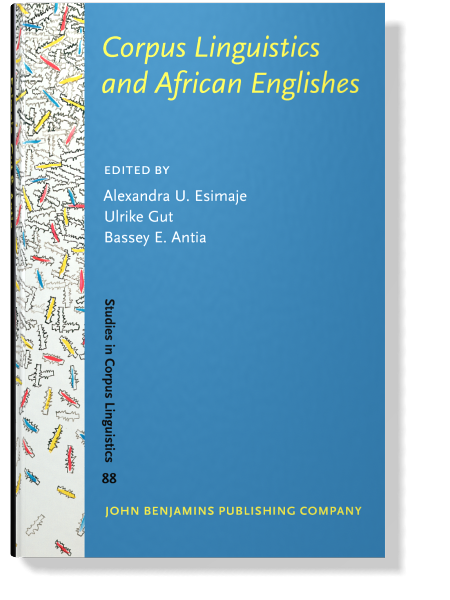
In:Corpus Linguistics and African Englishes
Edited by Alexandra U. Esimaje, Ulrike Gut and Bassey E. Antia
[Studies in Corpus Linguistics 88] 2019
► pp. 293–328
Chapter 2.5Capturing the lexicon of Ugandan English
ICE-Uganda, its limitations, and effective complements
Published online: 13 February 2019
https://doi.org/10.1075/scl.88.13isi
https://doi.org/10.1075/scl.88.13isi
Abstract
This paper discusses corpus linguistics as one method to investigate the lexicon of Ugandan English, which is characterised by borrowing, calquing, semantic extension, narrowing, and shift. It documents how analysing a well-balanced corpus, such as the Uganda component of the International Corpus of English, allows for a contextualisation of observations made from current uses of English and for an assessment of the textual genres in which such innovations occur. At the same time, it critically discusses the limitations and biases associated with a comparatively small corpus and argues for a multi-method approach that involves using larger, though less well controlled, corpora as well as supplementing corpus analyses with experimental data, which tap into the spread of lexical innovations.
Article outline
- 1.Introduction
- 1.1English in Uganda
- 2.Ugandan English and its lexicon
- 2.1Ugandan English
- 2.2The lexicon of Ugandan English
- 2.2.1Introduction
- 2.2.2Borrowing
- 2.2.3Calques
- 2.2.4Semantic change
- 2.2.5Morphological and phraseological innovations
- 2.2.6Conclusion
- 3.The lexicon in ICE Uganda
- 3.1ICE-UG compilation and issues
- 3.2Lexical properties of ICE-UG
- 3.2.1Borrowings in ICE-UG
- 3.2.2English word stock in ICE-UG
- 4.Limitations of ICE-UG and suggested supplements
- 4.1Ugandan English on the Internet: Web-UG
- 4.2Familiarity and attitudes: Results from acceptability ratings
- 4.3Factual knowledge: Results of the production test
- 5.Conclusion
Notes References Appendix

References (65)
Algeo, John. 2010. The Origin and Development of the English Language, 6th edn. Boston MA: Wadsworth.
Batibo, Herman M. 2005. Language Decline and Death in Africa: Causes, Consequences and Challenges. Clevedon: Multilingual Matters.
Biber, Douglas, Johansson, Stig, Leech, Geoffrey, Conrad, Susan & Finegan, Edward. 1999. Longman Grammar of Spoken and Written English. London: Longman.
Bible Hub. <[URL]> (16 July 2017).
Bokamba, Eyamba G. 2012. A polylectal grammar of Lingála and its theoretical implications. In Selected Proceedings of the 42nd Annual Conference on African Linguistics: African Languages in Context, Michael R. Marlo, Nikki B. Adams, Christopher R. Green, Michelle Morrison & Tristian M. Purvis (eds), 291–307. Somerville, MA: Cascadilla Proceedings Project.
Buregeya, Alfred. 2007. Aspects of the vocabulary of Kenyan English: An overview. University of Nairobi Occasional Papers in Language and Linguistics 3: 1–31.
Byabazaire, Deogratias M. 1979. The Contribution of the Christian Churches to the Development of Western Uganda, 1894–1974. Frankfurt: Peter Lang.
Collins Dictionary. <[URL]> (30 July 2017).
Corpus of Global Web-Based English (GLoWbE). <[URL]> (16 July 2016).
Davies, Mark. 2010. More than a peephole: Using large and diverse online corpora. International Journal of Computer Linguistics 15: 405–411.
Davies, Mark & Fuchs, Robert. 2015. Expanding horizons in the study of World Englishes with the 1.9 billion word Global Web-based English Corpus (GloWbE). English World-Wide 36(1): 1–28.
Haspelmath, Martin. 2009. Lexical borrowing: Concepts and issues. In Loanwords in the World’s Languages: A Comparative Handbook, Martin Haspelmath, & Uri Tadmor (eds), 35–54. Berlin: Mouton de Gruyter.
Hussein, Ashatu. 2009. The use of triangulation in social sciences research: Can qualitative and quantitative methods be combined? Journal of Comparative Social Work 1: 1–12.
Isingoma, Bebwa. 2016. Borrowings and calques in Ugandan English. In Meierkord, Isingoma & Namyalo (eds), 149–172.
Isingoma, Bebwa & Meierkord, Christiane. 2016. Introduction: Ugandan English – Challenges to, and food for, current theories. In Meierkord, Isingoma & Namyalo (eds), 1–15.
Kabananukye, Kaban & Kwagala, Dorothy. 2007. Culture, minorities and linguistic rights in Uganda: The case of the Batwa and the IK. Working Paper 11. Kampala: Human Rights and Peace Centre (HURIPEC).
Karlson, Monica. 2013. Quantitative and qualitative aspects of L1 (Swedish) and L2 (English) idiom comprehension. Studies in Second Language Learning and Teaching 3(2): 293–319.
Kilgarriff, Adam, Baisa, Vít, Bušta, Jan, Jakubíček, Miloš, Kovvář, Vojtěch, Michelfeit, Jan, Rychlý, Pavel & Suchomel, Vít. 2014. The Sketch Engine: Ten years on. Lexicography 1: 7–36.
Lewis, Paul M., Simons, Gary F. & Fennig, Charles D. (eds). 2015. Ethnologue: Languages of the World, 18th edn. Dallas TX: SIL International.
Loewen, Shawn & Reinders, Hayo. 2011. Key Concepts in Second Language Acquisition. Houndmills: Palgrave Macmillan.
Mackey, Alison & Gass, Susan M. 2016. Second Language Research. Methodology and Design, 2nd edn. New York NY: Routledge.
Mair, Christian. 2007. Change and variation in present-day English: Integrating the analysis of closed corpora and web-based monitoring. In Corpus Linguistics and the Web, Marianne Hundt, Nadja Nesselhauf & Carolin Biewer (eds), 233–247. Amsterdam: Rodopi.
Meierkord, Christiane. 2016a. A social history of English in Uganda. In Meierkord, Isingoma & Namyalo (eds), 51–71.
. 2016b. Diphthongs in Ugandan English: Evidence for and against variety status and Interactions across Englishes. In Meierkord, Isingoma & Namyalo (eds), 121–148.
Meierkord, Christiane, Isingoma, Bebwa & Namyalo, Saudah (eds). 2016. Ugandan English: Its Sociolinguistics, Structure and Uses in a Globalizing Post-protectorate [Varieties of English Around the World 59]. Amsterdam: John Benjamins.
Mesthrie, Rajend. & Bhatt, Rakesh M. 2008. World Englishes: The Study of New Linguistic Varieties. Cambridge: CUP.
Michieka, Martha M. 2009. Expanding Circles within the Outer Circle: The rural Kisii in Kenya. World Englishes 28(3): 352–364.
Monitor. <[URL].> (30 July 2016).
Nakayiza, Judith. 2016. The sociolinguistic situation of English in Uganda: A case of language attitudes and beliefs. In Meierkord, Isingoma & Namyalo (eds), 75–94.
Namyalo, Saudah, Bebwa Isingoma & Christiane Meierkord. 2016. Towards assessing the space of English in Uganda’s linguistic ecology: Facts and issues. In Meierkord, Isingoma & Namyalo (eds), 19–49.
Nassenstein, Nico. 2016. A preliminary description of Ugandan English. World Englishes 35.3: 396–420.
Nelson, Gerald. 1996. The design of the corpus. In Comparing English Worldwide. The International Corpus of English, Sydney Greenbaum (ed.), 27–35. Oxford: Clarendon Press.
New Vision. <[URL]> (August 2017).
Observer. <[URL].> (30 July 2017).
Oxford Dictionary Online. 2017. <[URL]> (2 July 2017).
Okazaki, Sumie, E. J. R. David & Nancy Abelmann. 2008. Colonialism and psychology of culture. Social & Personality Psychology Compass 2(1): 90–106.
Rosenbach, Anette. 2013. Combining elicitation data with corpus data. In Research Methods in Language Variation and Change, Manfred Krug & Julia Schlüter (eds), 278–294. Cambridge: CUP.
Scanlon, David. 1964. Education in Uganda. U.S. Department of Health, Education, and Welfare. Office of Education. Bulletin 1964, No. 32. Washington DC: US Department of Health, Education, and Welfare (now Health and Human Services).
Schmied, Josef. 2012. Standards of English in East Africa. In Standards of English. Codified Varieties Around the World, Raymond Hickey (ed.), 229–255. Cambridge: CUP.
Schneider, Edgar. 2007. Postcolonial English. Varieties of English Around the World. Cambridge: CUP.
Silva, Penny et al. 1996. A Dictionary of South African English on Historical Principles. Oxford: OUP.
Simons, Gary F. & Fennig, Charles D. (eds). 2017. Ethnologue: Languages of the World, 20th edn. Dallas TX: SIL International. <[URL]>/ (16 July 2017).
Ssempuuma, Jude, Isingoma, Bebwa & Meierkord, Christiane. 2016. The use of the progressive in Ugandan English. In Meierkord, Isingoma & Namyalo (eds), 173–199.
Ssentanda, Medadi E. 2016. Tensions between English medium and mother tongue education in rural Ugandan primary schools: An ethnographic investigation. In Meierkord, Isingoma & Namyalo (eds), 95–117.
Suruma, Ezra S. 2014. Advancing the Ugandan Economy: A Personal Account. Washington DC: Brookings Institution Press.
Taguchi, Naoko. 2013. Prompted Responses. In The Encyclopedia of Applied Linguistics: Quantitative and Mixed Methods, Carol Chapelle (ed.), Malden MA: Wiley-Blackwell.
Trudgill, Peter & Hannah, Jean. 2017. International English. A Guide to Varieties of English Around the World, 6th edn. London: Routledge.
Uganda Bureau of Statistics. 2010. Uganda National Household Survey Report 2009/10. Kampala: Uganda Bureau of Statistics. <[URL]> (5 July 2017).
. 2016. National population and housing census 2014. <[URL]> (30 June 2017).
Cited by (11)
Cited by 11 other publications
Collins, Peter & Adam Smith
van Rooy, Bertus
Collins, Peter
Yikiru, Peace & Bebwa Isingoma
Deborah Mirembe, Dorica & Bebwa Isingoma
Isingoma, Bebwa & Christiane Meierkord
Meierkord, Christiane
Meierkord, Christiane & Bebwa Isingoma
2022. Between first language influence, exonormative orientation and migration. English World-Wide. A Journal of Varieties of English 43:2 ► pp. 220 ff.
Amarorwot, Sarah & Bebwa Isingoma
Isingoma, Bebwa
This list is based on CrossRef data as of 1 december 2025. Please note that it may not be complete. Sources presented here have been supplied by the respective publishers. Any errors therein should be reported to them.