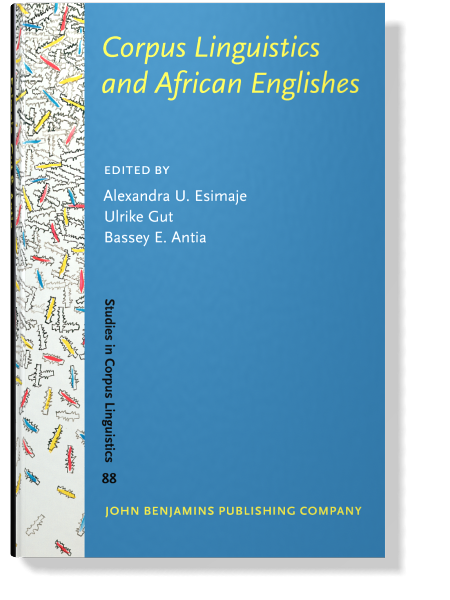
In:Corpus Linguistics and African Englishes
Edited by Alexandra U. Esimaje, Ulrike Gut and Bassey E. Antia
[Studies in Corpus Linguistics 88] 2019
► pp. 205–230
Chapter 2.2The use of stance markers in West African Englishes
Published online: 13 February 2019
https://doi.org/10.1075/scl.88.10gut
https://doi.org/10.1075/scl.88.10gut
Abstract
This chapter investigates the extent of similarity in the use of stance markers in two national varieties of West African English, Nigerian English and Ghanaian English, and compares them to British English. The frequency and stylistic variability of four semantic groups of stance markers were examined in ICE-Nigeria and ICE-Ghana and compared with ICE-Great Britain. The results are mixed: the two West African varieties show an overall lower frequency of stance markers compared to British English but the speakers of the two West African English varieties do not demonstrate lower stylistic variability in the use of stance markers across different text types. Notwithstanding, there are systematic differences in stance marker usage between the two West African English varieties.
Article outline
- 1.Introduction
- 2.Stance markers within a variational pragmatic framework
- 3.Data and method
- 4.Results
- Use of stance markers in different text types
- 5.Summary and discussion
- 6.Conclusion
Acknowledgements Note References Appendix

References (55)
Adegbite, Adewale, Udofot, Inyang & Ayoola, Kehinde. 2014. A Dictionary of Nigerian English. Ile-Ife: Obafemi Awolowo University.
Aijmer, Karin. 2013. Understanding Pragmatic Markers: A Variational Pragmatic Approach. Edinburgh: EUP.
Akindele, Femi & Adegbite, Wale. 1999. The Sociology and Politics of English in Nigeria: An Introduction. Ile-Ife: Obafemi Awolowo University Press.
Aull, Laura L. & Lancaster, Zak. 2014. Linguistic markers of stance in early and advanced academic writings: A corpus-based comparison. Written Communication 32(2):151–183.
Barron, Anne. 2014. Variational pragmatics. In The Encyclopedia of Applied Linguistics, Carol A. Chapelle (ed.), 1–7. Malden MA: Blackwell.
Barron, Anne, Pandarova, Irina & Muderack, Karoline. 2015. Tag questions across Irish English and British English: A corpus analysis of form and function. Multilingua 34(4): 495–525.
Barron, Anne & Schneider, Klaus P.. 2009. Variational pragmatics: Studying the impact of social factors on language use in interaction. Intercultural Pragmatics 6: 425–442.
Baumgarten, Nicole & House, Juliane. 2010. ‘I think’ and ‘I don’t know’ in English as lingua franca and native English discourse. Journal of Pragmatics 42(5): 1184–1200.
Biber, Douglas. 2006. Stance in spoken and written university registers. Journal of English for Academic Purposes 5: 97–116.
Biber, Douglas, Johansson, Stig, Leech, Geoffrey, Conrad, Susan, Finegan, Edward & Quirk, Randolph. 1999. Longman Grammar of Spoken and Written English. Cambridge MA: The MIT Press.
Biber, Douglas & Staples, Shelley. 2014. Variation in the realisation of stance adverbials. In Spoken Corpora and Linguistic Studies [Studies in Corpus Linguistics 61], Tommaso Raso & Heliana Mello (eds), 271–294. Amsterdam: John Benjamins.
Brato, Thorsten & Huber, Magnus. 2012. English in Africa. In Areal Features of the Anglophone World, Raymond Hickey (ed.), 161–185. Berlin: Mouton de Gruyter.
Bucholtz, Mary & Hall, Kira. 2005. Identity and interaction: A sociocultural linguistic approach. Discourse Studies 7(4–5): 585–614.
Bygate, Martin. 2009. Teaching and testing speaking. In The Handbook of Language Teaching, Michael H. Long & Catherine J. Doughty (eds), 412–440. Chichester: Wiley-Blackwell.
Chiluwa, Innocent. 2013. West African English in digital discourse. Covenant Journal of Language Studies 1(1): 42–61.
Conrad, Susan & Biber, Douglas. 2000. Adverbial marking of stance in speech and writing. In Evaluation in Text: Authorial stance and the Construction of Discourse, Susan Hunston & Geoffrey Thompson (eds), 56–73. Oxford: OUP.
Conteh-Morgan, Miriam. 1997. English in Sierra Leone: A description of the language as used in this West African Country and a consideration of its status there. English Today 13: 52–56.
Danescu-Niculescu-Mizil, Cristian, Sudhof, Moritz, Jurafsky, Dan, Leskovec, Jure & Potts, Christopher. 2013. A Computational Approach to Politeness with Application to Social Factors. <[URL]> (16 October 2017).
Dolphyne, Florence 1995. A note on the English language in Ghana. In New Englishes: A West African Perspective, Ayo Bamgbose, Ayo Banjo & Andrew Thomas (eds), 27–33. Ibadan: Mosuro.
Englebretson, Robert. 2007. Stancetaking in Discourse: Subjectivity, Evaluation, Interaction [Pragmatics & Beyond New Series 164]. Amsterdam: John Benjamins.
Gablasova, Dana & Brezina, Vaclav. 2015. Does speaker role affect the choice of epistemic adverbials in L2 speech? Evidence from the Trinity Lancaster Corpus. In Yearbook of Corpus Linguistics and Pragmatics, Jesús Romero-Trillo (ed.), 117–136. Dordrecht: Springer.
Gablasova, Dana, Brezina, Vaclav, McEnery, Tony & Boyd, Elaine. 2015. Epistemic stance in spoken L2 English: The effect of task and speaker style. Applied Linguistics: 1–26. .
Gray, Bethany & Biber, Douglas. 2015. Stance markers. In Corpus Pragmatics: A Handbook, Karin Aijmer & Christoph Rühlemann (eds), 219–248. Cambridge: CUP.
Gut, Ulrike. 2012. Standards of English in West Africa. In Standards of English: Codified Varieties around the World, Raymond Hickey (ed.), 213–228. Cambridge: CUP.
. 2017. English in West Africa. In The Oxford Handbook of World Englishes, Markku Filppula, Juhani Klemola & Devyani Sharma (eds), 491–507. Oxford: OUP.
Hunston, Susan & Sinclair, John. 2000. A local grammar of evaluation. In Evaluation in Text: Authorial stance and the Construction of Discourse, Susan Hunston & Geoffrey Thompson (eds), 74–101. Oxford: OUP.
Hunston, Susan & Thompson, Geoffrey. 2000. Evaluation in Text: Authorial Stance and the Construction of Discourse. Oxford: OUP.
Hyland, Ken & Milton, John. 1997. Qualification and certainty in L1 and L2 students’ writing. Journal of Second Language Writing 6(2): 183–205.
Jaffe, Alexandra. 2009. Introduction: The sociolinguistics of stance. In Stance: Sociolinguistic Perspectives, Alexandra Jaffe (ed.), 3–28. Oxford: OUP.
Johnstone, Barbara. 2009. Stance, style and the linguistic individual. In Stance: Sociolinguistic Perspectives, Alexandra Jaffe (ed.), 29–53. Oxford: OUP.
Kärkkäinen, Elise. 1992. Modality as a strategy in interaction: Epistemic modality in the language of native and non-native speakers of English. Pragmatics and Language Learning 3: 197–216.
. 2003. Epistemic Stance in English Conversation: A Description of its Interactional Functions, with a Focus on I Think [Pragmatics & Beyond New Series 115]. Amsterdam: John Benjamins.
. 2006. Stance taking in conversation: From subjectivity to intersubjectivity. Text & Talk 26(6): 699–731.
. 2010. Position and scope of epistemic phrases in planned and unplanned American speech. In New Approaches to Hedging, Gunther Kaltenböck, Wiltrud Mihatsch & Stefan Schneider (eds), 203–236. Bingley: Emerald.
Keteku, Nancy W., Adebayo, Folashade & Meyers, James P. 2008. Anglophone West Africa: Education, Credentials, Recruitment & Resources. Paper presented at NAFSA Conference, Washington DC. <[URL]> (8 January 2017).
Martin, James R. & White, Peter R. R. 2005. The Language of Evaluation: Appraisal in English. New York NY: Palgrave Macmillan.
McEnery, Tony & Kifle, Nazareth A. 2002. Epistemic modality in argumentative essays of second-language writers. In Academic Discourse, John Flowerdew (ed.), 182–195. Harlow: Longman.
Omoniyi, Tope. 2008. West African Englishes. In Handbook of World Englishes, Braj Kachru, Yumuna Kachru & Cecil Nelson (eds), 172–187. London: Wiley.
Pichler, Heike. 2016. Introduction: Discourse-pragmatic variation and change. In Discourse-Pragmatic Variation and Change: Insights from English, Heike Pichler (ed.), 1–18. Cambridge: CUP.
Romero-Trillo, Jesus. 2008. Introduction: Pragmatics and corpus linguistics. A mutualistic entente. In Pragmatics and Corpus Linguistics. A Mutualistic Entente, Jesus Romero-Trillo (ed.), 1–10. Berlin: Mouton de Gruyter.
Rühlemann, Christoph. 2010. What can a corpus tell us about pragmatics? In Routledge Handbook of Corpus Linguistics, Anne O’Keeffe & Michael McCarthy (eds), 288–301. London: Routledge.
Rühlemann, Christoph & Aijmer, Karin. 2015. Corpus pragmatics: Laying the foundations. In Corpus Pragmatics: A Handbook, Karin Aijmer & Christoph Rühlemann (eds), 1–28. Cambridge: CUP.
Rühlemann, Christoph & O’Donnell, Brook. 2012. Introducing a corpus of conversational stories: Construction and annotation of the Narrative Corpus. Corpus Linguistics and Linguistic Theory 8(2): 313–350.
Schilling-Estes, Natalie. 2006. Dialect variation. In An Introduction to Language and Linguistics, Ralph W. Fasold & Jeff Connor-Linton (eds), 311–342. Cambridge: CUP.
Schneider, Klaus P. 2012. Appropriate behaviour across varieties of English. Journal of Pragmatics 44(9): 1022–1037.
Udofot, Inyang. 2003. Stress and rhythm in the Nigerian accent of English. English World Wide 24: 201–220.
Weisser, Martin. 2015. Speech act annotation. In Corpus Pragmatics: A Handbook, Karin Aijmer & Christoph Rühlemann (eds), 84–116. Cambridge: CUP.
White, Peter R. R. 2011. Appraisal. In Discursive Pragmatics [Handbook of Pragmatics Highlights 8], Jan Zienkowski, Jan-Ola Östman & Jeff Verschueren (eds), 14–36. Amsterdam: John Benjamins.
Wolf, Hans-Georg & Igboanusi, Herbert. 2003. A preliminary comparison of some lexical items in Nigerian English and Cameroon English. In Studies in African Varieties of English, Peter Lucko, Lothar Peter and Hans-Georg Wolf (eds), 69–81. Bern: Peter Lang.
Cited by (9)
Cited by nine other publications
Olayinka Unuabonah, Foluke & Folajimi Oyebola
2023. “He’s a lawyer you know and all of that”. English World-Wide. A Journal of Varieties of English 44:1 ► pp. 61 ff.
Unuabonah, Foluke Olayinka & Jemima Asabea Anderson
Gut, Ulrike & Foluke O. Unuabonah
Oladipupo, Rotimi O. & Foluke O. Unuabonah
Unuabonah, Foluke O. & Rotimi O. Oladipupo
Unuabonah, Foluke Olayinka, Folajimi Oyebola & Ulrike Gut
2021. “Abeg na! we write so our comments can be posted!”. Pragmatics. Quarterly Publication of the International Pragmatics Association (IPrA) 31:3 ► pp. 455 ff.
Unuabonah, Foluke Olayinka
Unuabonah, Foluke Olayinka
This list is based on CrossRef data as of 1 december 2025. Please note that it may not be complete. Sources presented here have been supplied by the respective publishers. Any errors therein should be reported to them.