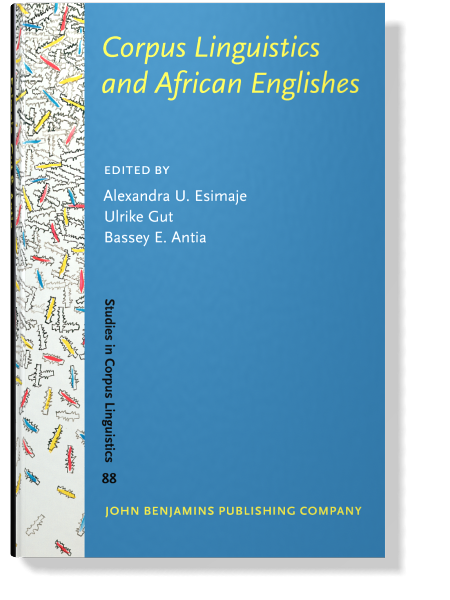
In:Corpus Linguistics and African Englishes
Edited by Alexandra U. Esimaje, Ulrike Gut and Bassey E. Antia
[Studies in Corpus Linguistics 88] 2019
► pp. 165–182
Chapter 1.7Practical corpus linguistics
Designing and exploiting a written corpus for research with special reference to Cameroon English
Published online: 13 February 2019
https://doi.org/10.1075/scl.88.08nke
https://doi.org/10.1075/scl.88.08nke
Abstract
One major contribution of the corpus-based approach to language study is the facility with which linguists can access large amounts of data and search for regularities across text types and varieties of English on the basis of observed frequencies. Such regularities of features, if based on well-designed and/or specialised corpora, can be useful for classroom activities and material design. This chapter describes the basic steps involved in corpus design and corpus exploitation. Section 1 defines the corpus and briefly states the relevance of investigating English second language (ESL) varieties via a corpus. Section 2 describes key steps involved in simple corpus compilation and how students can compile their own corpora for research. Section 3 presents results of two studies on the frequency and use of modals in the corpus of Cameroonian English. These results are intended to illustrate the point that the corpus approach is indispensable if certain types of linguistic information are investigated in a particular variety.
Article outline
- 1.Introduction
- 1.1Aim
- 1.2Why is corpus linguistics relevant for ESL varieties?
- 2.Compilation of the CCE
- 2.1Initial considerations
- 2.2Design parameters
- 3.Some findings on the use of modals in CamE
- 3.1‘Must’, ‘should’, ‘ought’ and ‘need’ in CamE
- ‘must’
- Root
- Epistemic
- ‘should’
- 3.2Frequencies and common senses of the modals
- 3.1‘Must’, ‘should’, ‘ought’ and ‘need’ in CamE
- 4.Discussion and conclusions
Acknowledgements Notes References

References (35)
Akere, Funso. 1996. The Nigerian Corpus of English Project: A survey of Nigerian English usage. In English in Ghana: Proceedings of the Inaugural Meeting of Ghana English Association, held at the University College of Education, Winneba, June 13–15, Mary Esther Kropp Dakubu (ed.), 115–125.
Biber, Douglas, Johansson, Stig, Leech, Geoffrey, Conrad, Susan & Finegan, Edward. 1999. The Longman Grammar of Spoken and Written English. London: Longman.
Coates, Jennifer & Leech, Geoffrey. 1980. The meanings of the modals in modern British and American English. York Papers in Linguistics 8: 23–24.
Collins, Peter. 1988. The semantics of some modals in contemporary Australian English. Australian Journal of Linguistics 8: 237–58.
. 1991. The modals of obligation and necessity in Australian English. In English Corpus Linguistics, Karin Aijmer & Bengt Altenberg (eds), 145–165. London: Longman.
De Klerk, Vivian. 2002. Toward a corpus of Black South African English. South African Journal of Linguistics and Applied Language Studies 20(1): 25–35.
Esimaje, Alexandra. 2016. A corpus-based study of tense use by advanced learners of English in Nigeria. In Academic Writing Across Disciplines in Africa: From Students to Experts, Josef Schmied & Daniel A. Nkemleke (eds), 33–146. Göttingen: Cuvillier Verlag.
. 2017. Comparing spelling usage by advanced learners in Nigeria and Cameroon: A Conacell-based study. Review Syllabus Vol. 7(1): 161–183.
Greenbaum, Sydney. 1988. A proposal for an international computerized corpus of English. World Englishes 7: 315.
Haliday, Michael A. K. 1970. Functional diversity in language as seen from a consideration of modality and mood in English. Foundation of Language 6: 322–361.
Kachru, Braj B. 1990. The Alchemy of English: The Spread, Functions, and Models of Non-native Englishes. Oxford: Pergamon Press.
Katikar, Pratibha B. 1994. The Meaning of the Modals in Indian English. PhD dissertation, Shivaji University, Kolhapur.
. 1980. The meaning of the modals in modern British and American English. York Papers in Linguistics 8: 23–34.
Nkemleke, Daniel. 2003. A Corpus-based Study of the Modal Verbs in Cameroonian English. PhD dissertation, University of Yaoundé 1.
. 2008. Manual of Information to Accompany the Corpus of Cameroon English. Chemnitz: Chemnitz University of Technology, Department of English.
Renouf, Antoinette. 1987. Corpus development at Birmingham University. In Looking Up: An Account of the COBUILD PROJECT in Lexical Computing, John M. Sinclair (ed.), 1–40. Glasgow: Collins.
Schmied, Josef. 1989. Conference report: Compiling a corpus of East African English. ICAME Journal 13: 75–77.
. 1999. Applying contrastive corpora in modern contrastive grammars: The Chemnitz Internet Grammar of English. In Out of Corpora: Studies in Honour of Stig Johansson, Hilde Hasselgard & Signe Oksefjell (eds), 21–30. Amsterdam: Rodopi.
Sinclair, John. 1982. Reflection on computer corpora in English language research. In Computer in English Language Research, Stig Johansson (ed.), 243–252. Bergen: Norwegian Computing Centre for the Humanities.
Svartvik, J. & Wright, D. 1977. The use of ought in Teenage English. In Acceptability in Language, Sidney Greenbaum (ed.), 179–201. The Hague: Mouton.
Trudgill, Peter & Hannah, Jean. 1982. International English: A Guide to Varieties of Standard English. New York NY: Routledge Chapman and Hall.
Cited by (2)
Cited by two other publications
van Rooy, Bertus
Schmied, Josef
2019. African corpora for standards in African academic English. In Corpus Linguistics and African Englishes [Studies in Corpus Linguistics, 88], ► pp. 355 ff.
This list is based on CrossRef data as of 1 december 2025. Please note that it may not be complete. Sources presented here have been supplied by the respective publishers. Any errors therein should be reported to them.