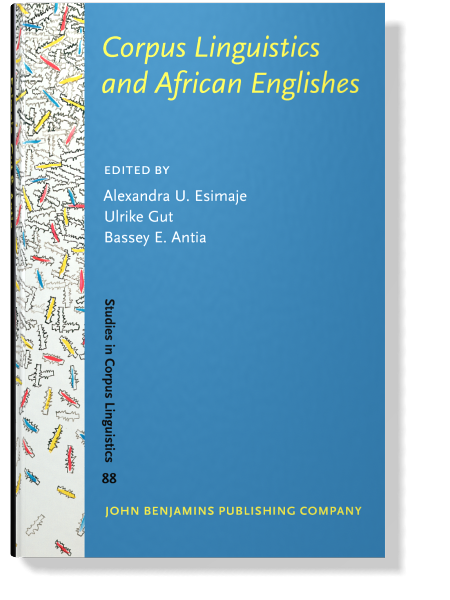
In:Corpus Linguistics and African Englishes
Edited by Alexandra U. Esimaje, Ulrike Gut and Bassey E. Antia
[Studies in Corpus Linguistics 88] 2019
► pp. 119–142
Chapter 1.5The historical corpus of English in Ghana (HiCE Ghana)
Motivation, compilation, opportunities
Published online: 13 February 2019
https://doi.org/10.1075/scl.88.06bra
https://doi.org/10.1075/scl.88.06bra
Abstract
This chapter discusses various aspects relevant to the compilation of the Historical Corpus of English in Ghana (HiCE Ghana), a 600,000-word corpus of written Ghanaian English (GhE) from the period 1966 to 1975. The corpus captures written GhE in the early years of its nativization phase and by comparison to the relevant sections of the Ghanaian component of ICE makes it possible to trace structural nativization in real time. The paper addresses the motivation for such a corpus and shows how methodological and theoretical concerns and challenges have affected the final corpus design. The paper is rounded off with contemporary examples of GhE.
Article outline
- 1.Introduction
- 2.English in Ghana
- 3.Motivation for compiling a historical corpus of GhE
- 4.The compilation of HiCE Ghana
- 5.Digitisation and annotation
- 6.Opportunities
- 7.Conclusion and outlook
Notes References

References (60)
Anderson, Jemima Asabea. 2006. Request forms in English in Ghana. Legon Journal of the Humanities 17: 75–103.
. 2009. Codifying Ghanaian English: Problems and prospects. In World Englishes – Problems, Properties and Prospects: Selected Papers from the 13th IAWE Conference [Varieties of English around the World G40], Thomas Hoffmann & Lucia Siebers (eds), 19–36. Amsterdam: John Benjamins.
Bartels, Charles. 1972. Ghana Who’s Who, 1972–73: A Fully-Comprehensive Annual Biographical Dictionary of Prominent Men and Women in the Country, Includ. an Encyclopaedia of Useful Information. Accra: Bartels Publishing.
Biewer, Carolin, Bernaisch, Tobias, Berger, Mike & Heller, Benedikt. 2014. Compiling the diachronic corpus of Hong Kong English (DC-HKE): Motivation, progress and challenges. ICAME Journal 35. Nottingham, April 30.
Biewer, Carolin, Hundt, Marianne & Zipp, Lena. 2010. ‘How’ a Fiji Corpus? Challenges in the Compilation of an ESL ICE Component. ICAME Journal 34: 5–23.
Blench, Roger. 2006. A Dictionary of Ghanaian English. <[URL]> (13 July 2016).
Bolt, Philip. 1994. The International Corpus of English project: The Hong Kong experience. In Creating and Using English Language Corpora: 14th International Conference on English Language Research on Computerized Corpora: Selected Papers, Udo Fries, Gunnel Tottie & Peter Schneider (eds), 15–24. Amsterdam: Rodopi.
Borlongan, Ariane Macalinga & Dita, Shirley N. 2015. Taking a look at expanded predicates in Philippine English across time. Asian Englishes 17(3): 240–47.
Brato, Thorsten. In preparation. Extra- and intraterritorial forces in the development of Ghanaian English. In Modelling Current Linguistic Realities of English World-Wide: The Extra- and Intra-Territorial Forces Model Put to the Test, Sarah Buschfeld & Alexander Kautzsch (eds).
Brato, Thorsten & Huber, Magnus. 2008. The emergence of social varieties in Ghanaian English. Accents 2008: II International Conference on Native and Non-native Accents of English, Łodz, December 12.
. 2012. English in Africa. In Areal Features of the Anglophone World, Raymond Hickey (ed.), 161–85. Berlin: Mouton de Gruyter.
Buschfeld, Sarah & Kautzsch, Alexander. 2017. Towards an integrated approach to postcolonial and non-postcolonial Englishes. World Englishes 36(1): 104–26.
Collins, Peter C. 2015. Recent diachronic change in the progressive in Philippine English. In Grammatical change in English world-wide, edited by Peter C. Collins, 271–96. Studies in corpus linguistics 67. Amsterdam: John Benjamins.
Collins, Peter C., Borlongan, Ariane Macalinga & Yao, Xinyue. 2014. Modality in Philippine English: A diachronic study. Journal of English Linguistics 42(1): 68–88.
Dako, Kari. 2001. Ghanaianisms: Towards a semantic and formal classification. English World-Wide 22(1): 23–53.
Davies, Mark. 2016. NOW Corpus (News on the Web). <[URL]> (22 June 2016).
Davies, Mark & Fuchs, Robert. 2015. Expanding horizons in the study of World Englishes with the 1.9 billion word global web-based English corpus (GloWbE). English World-Wide 36(1): 1–28.
Foster, Philip. 1965. Education and Social Change in Ghana. Chicago IL: The University of Chicago Press.
Francis, W. Nelson & Kučera, Henry. 1964. A Standard Corpus of Present-Day Edited American English, for Use with Digital Computers (Brown). Providence RD: Brown University.
Fuchs, Robert & Gut, Ulrike. 2015. An apparent time study of the progressive in Nigerian English. In Collins (ed.), 373–87.
Ghana Statistical Service. 2012. 2010 Population & Housing Census: Summary Report of Final Results. Ms, last modified July 13, 2016. <[URL]>
. 2016. Population Statistics. <[URL]> (9 August 2017).
Hoffmann, Sebastian. 2013. The Corpus of Historical Singapore English: Practical and Methodological Issues. Trier: University of Trier.
Hoffmann, Sebastian, Sand, Andrea & Tan, Peter K. W. 2012. The Corpus of Historical Singapore English: A first pilot study on data from the 1950s and 1960s. Paper presented at ICAME 33, Leuven, 30 May.
Huber, Magnus. 2004. “Ghanaian English: phonology.” In A Handbook of Varieties of English: A Multimedia Reference Tool. 1: Phonology, edited by Edgar W. Schneider, Kate Burridge, Bernd Kortmann, Rajend Mesthrie, and Clive Upton. 3 vols, 842–865. Berlin: Mouton de Gruyter.
. 2014. Stylistic and sociolinguistic variation in Schneider’s nativization phase: The case of Ghanaian English. In The Evolution of Englishes: The Dynamic Model and Beyond [Varieties of English Around the World G49], Sarah Buschfeld, Magnus Huber, Thomas Hoffmann & Alexander Kautzsch (eds), 86–106. Amsterdam: John Benjamins.
. 2017. Early recordings from Ghana: A variationist approach to the phonological history of an outer circle variety. In Listening to the Past: Audio Records of Accents of English, Raymond Hickey (ed.), 444–463. Cambridge: CUP.
Huber, Magnus & Dako, Kari. 2004. Ghanaian English – Morphology and syntax. In A Handbook of Varieties of English: A Multimedia Reference Tool, Edgar W. Schneider, Kate Burridge, Bernd Kortmann, Rajend Mesthrie & Clive Upton (eds), 854–865. Berlin: Mouton de Gruyter.
Kachru, Braj B. 1985. Standards, codification and sociolinguistic realism: The English language in the outer circle. In English in the World: Teaching and Learning the Language and Literatures, Randolph Quirk & Henry G. Widdowson (eds), 11–30. Cambridge: CUP.
Kirby, Jon P. 1998. A North American’s Guide to Ghanaian English. Tamale: Tamale Institute of Cross-Cultural Studies.
Loureiro-Porto, Lucía. 2016. (Semi-)modals of necessity in Hong Kong and Indian Englishes. In World Englishes: New Theoretical and Methodological Considerations [Varieties of English Around the World G57], Elena Seoane & Cristina Suárez Gómez (eds), 143–72. Amsterdam: John Benjamins.
Lu, Xiaofei. 2010. Automatic analysis of syntactic complexity in second language writing. International Journal of Corpus Linguistics 15(4): 474–96.
Mair, Christian. 2011. Corpora and the New Englishes. In A Taste for Corpora [Studies in Corpus Linguistics 45], Fanny Meunier, Sylvie de Cock, Gaëtanelle Gilquin & Magali Paquot (eds) 209–36. Amsterdam: John Benjamins.
. 2013. The world system of Englishes: Accounting for the transnational importance of mobile and mediated vernaculars. English World-Wide 34(3): 253–78.
Mukherjee, Joybrato & Gries, Stefan T. 2009. Collostructional nativisation in New Englishes: Verb-construction associations in the International Corpus of English. English World-Wide 30(1): 27–51.
Nelson, Gerald. 1996. The design of the corpus. In Comparing English Worldwide: The International Corpus of English, Sydney Greenbaum (ed.), 27–35. Oxford: Clarendon Press.
OCLC Online Computer Library Center. 2017. WorldCat. <[URL]> (11 August 2017).
Odamtten, Helen & Larya, E. B. 2009. Steps to Effective Spoken English (SESEN). Accra: Asempa Publishers.
Platt, John Talbot, Weber, Heidi & Ho, Lian-Mian. 1984. The New Englishes. London: Routledge and Kegan Paul.
Schneider, Edgar W. 2003. The dynamics of New Englishes: From identity construction to dialect birth. Language 79(2): 233–281.
Staatsbibliothek zu Berlin – Preußischer Kulturbesitz. 2017. Zeitschriftendatenbank. <[URL]> (10 August 2017).
The Government of the Gold Coast. 1950. The Gold Coast: Census of Population 1948 – Report and Tables.
The ICE Project. 2016. International Corpus of English. <[URL]> (28 July 2017).
The World Bank Group. 2017. Ghana Population, 1960–2016. <[URL]> (16 August 2017).
Tingley, Christopher. 1981. Deviance in the English of Ghanaian newspapers. English World-Wide 2(1): 39–62.
Trudgill, Peter. 2004. New-Dialect Formation: The Inevitability of Colonial Englishes. Edinburgh: EUP.
Universitätsbibliothek J. C. Senckenberg. 2016. Africa South of the Sahara. <[URL]> (10 August 2017).
van Rooy, Bertus & Piotrowska, Caroline. 2015. The development of an extended time period meaning of the progressive in black South African English. In Collins (ed.), 465–83.
Cited by (8)
Cited by eight other publications
Anderson, Jemima Asabea
Neels, Jakob, Sven Leuckert & Arne Lohmann
van Rooy, Bertus
van Rooy, Bertus
Vergaro, Carla
2023. Linguistic and pragmatic ways of committing oneself. Pragmatics & Cognition 30:1 ► pp. 120 ff.
Wilson, Guyanne
2020. Lange, C., & Leuckert, S. (2019).Corpus Linguistics for World Englishes: A Guide for Research. International Journal of Corpus Linguistics 25:4 ► pp. 511 ff.
This list is based on CrossRef data as of 1 december 2025. Please note that it may not be complete. Sources presented here have been supplied by the respective publishers. Any errors therein should be reported to them.