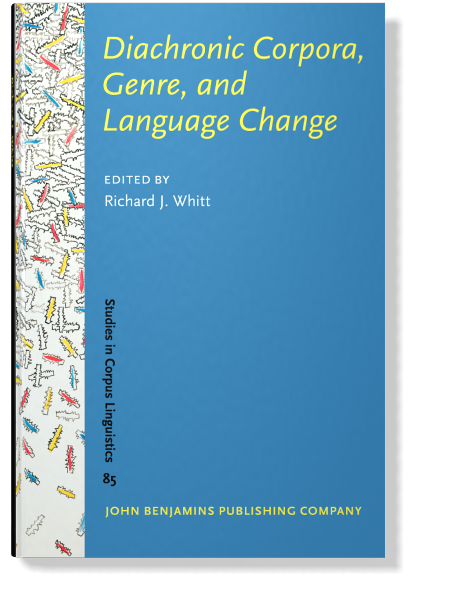
In:Diachronic Corpora, Genre, and Language Change
Edited by Richard J. Whitt
[Studies in Corpus Linguistics 85] 2018
► pp. v–vi
Get fulltext
This article is available free of charge.
Published online: 8 November 2018
https://doi.org/10.1075/scl.85.toc
https://doi.org/10.1075/scl.85.toc
Table of contents
Preface and acknowledgements
vii
Using diachronic corpora to understand the connection between genre and language change
1
Richard J. Whitt
Part I.Methods in diachronic corpus linguistics
“From above”, “from below”, and regionally balanced: Towards a new corpus of nineteenth-century German
19
Konstantin Niehaus
Stephan Elspaß
Diachronic collocations, genre, and DiaCollo
41
Bryan Jurish
Classical and modern Arabic corpora: Genre and language change
65
Eric Atwell
Part II.Genre and diachronic corpora
Scholastic genre scripts in English medical writing 1375–1800
95
Irma Taavitsainen
Academic writing as a locus of grammatical change: The development of phrasal complexity features
117
Bethany Gray
Douglas Biber
Part III.Genre-based analyses of linguistic phenomena
The importance of genre in the Greek diglossia of the 20th century: A diachronic corpus study of recent language
change
149
Georgia Fragaki
Dionysis Goutsos
“You can’t control a thing like that”: Genres and changes in Modern English human impersonal pronouns
171
Florian Haas
Concessive conjunctions in written American English: Diachronic and
genre-related changes in frequency and semantics
195
Ole Schützler
Variation of sentence length across time and genre: Influence on syntactic usage in English
219
Karolina Rudnicka
A comparison of multi-genre and single-genre corpora in the context of contact-induced change
241
Carola Trips
Achim Stein
Some methodological issues in the corpus-based study of morphosyntactic variation: The case of Old Spanish
possessives
261
Andrés Enrique-Arias
The interplay between genre variation and syntax in a historical Low German corpus
281
Melissa Farasyn
George Walkden
Sheila Watts
Anne Breitbarth
Genre influence on word formation (change): A case study of German adjectival derivation
301
Luise Kempf
Index
333
