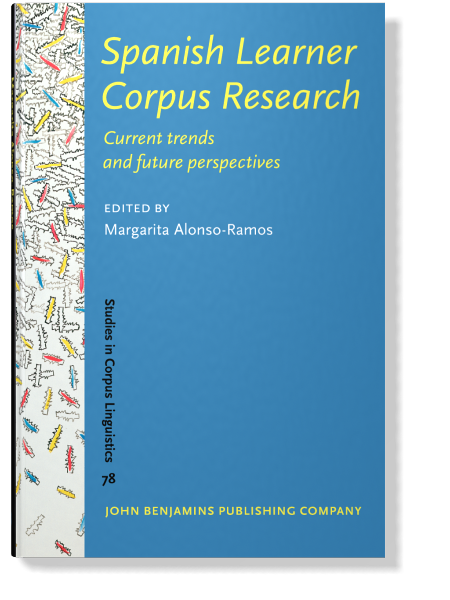
In:Spanish Learner Corpus Research: Current trends and future perspectives
Edited by Margarita Alonso-Ramos
[Studies in Corpus Linguistics 78] 2016
► pp. 299–331
Chapter 11A corpus study of Spanish as a foreign language learners’ collocation production
Published online: 16 December 2016
https://doi.org/10.1075/scl.78.11vin
https://doi.org/10.1075/scl.78.11vin
Abstract
We carried out a learner corpus study with the aim of exploring Spanish as a Foreign Language learners’ collocation production. The study involved the manual annotation of collocations in a portion of the CEDEL2 corpus using a typology specific to learner collocation errors. The quantitative comparison of learners’ and native Spanish speakers’ collocation production showed that although the two groups use a similar number of collocations, learners have a smaller repertoire and they overuse frequent combinations with less variability regarding the choice of the collocate. An analysis of learner errors revealed that most lexical collocation errors affect the collocate, the element whose selection is restricted, and that most errors result from L1 transfer.
Article outline
- 1.Introduction
- 2.Research on language learners’ knowledge and use of collocations
- 2.1Studies investigating quantitative differences between native and non-native speaker collocation use
- 2.2Studies investigating collocation errors
- 3.Research questions
- 4.Methodology
- 4.1The corpus
- 4.2The annotation procedure
- 5.Quantitative differences in the collocation use of SFL learners and native speakers of Spanish
- 5.1Results
- 5.2Discussion
-
6.Exploring collocation errors in SFL learners’ writing
- 6.1Results
- 6.2Discussion
- 7.Conclusions
Acknowledgments Notes References

References (57)
Alonso-Ramos, M., Wanner, L., Vázquez Veiga, N., Vincze, O., Mosqueira Suárez, E. & Prieto González, S. 2010a. Tagging collocations for learners. In Elexicography in the 21st Century: New Challenges, New Applications. Proceedings of eLex 2009 [Cahiers du Cental 7], Sylviane Granger & Magali Paquot (eds), 375–380. Louvain-la Neuve: Presses Universitaires de Louvain.
Alonso-Ramos, M., Wanner, L., Vincze, O., Casamayor, G., Vázquez Veiga, N., Mosqueira Suárez, E. & Prieto González, S. 2010b. Towards a motivated annotation schema of collocation errors in learner corpora. In Proceedings of the Seventh Conference on International Language Resources and Evaluation (LREC’10), 19–21 May 2010, Valletta, Malta, N. Calzolari, K. Choukri, B. Maegaard, J. Mariani, J. Odjik, S. Piperidis, M. Rosner & D. Tapias (eds), 3209–3214. Paris: European Language Resources Association (ELRA).
Altenberg, B. & Granger, S. 2001. The grammatical and lexical patterning of make in native and non-native student writing. Applied Linguistics 22(2): 173–194.
Biber, D. 1993. Representativeness in Corpus Design. Literary and Linguistic Computing 8(4): 243–257.
Biskup, D. 1992. L1 influence on learners’ renderings of English collocations. A Polish/German empirical study. In Vocabulary and Applied Linguistics, P.J.L. Arraud & H. Bejoint (eds), 85–93. London: Macmillan.
Bonk, W.J. 2001. Testing ESL learners’ knowledge of collocations. In A Focus on Language Test Development: Expanding the Language Proficiency Construct across a Variety of Tests, T. Hudson & J.D. Brown (eds), 113–142. Honolulu HI: Second Language Teaching & Curriculum Center, University of Hawaii at Mānoa.
Buckingham, L. 2008. Spanish verb support constructions from a learner perspective. ELIA: Estudios de Lingüística Inglesa Aplicada 8: 151–179.
Durrant, P. 2009. Investigating the viability of a collocation list for students of English for academic purposes. English for Specific Purposes 28(3): 157–169. .
2008. High Frequency Collocations and Second Language Learning. PhD dissertation, University of Nottingham.
Farghal, M. & Obiedat, H. 1995. Collocations: A neglected variable in EFL. International Review of Applied Linguistics 33(4): 315–331.
Ferrando Aramo, V. 2009. Materiales didácticos para la enseñanza-aprendizaje de las colocaciones: Análisis y propuestas. MA thesis, Universidad Rovira i Virgili.
García-Salido, M. 2014. O uso de construcións con verbos soporte en aprendices de español como lingua estranxeira e en falantes nativos. Cadernos de Fraseoloxía Galega 16: 181–198.
2016. Error analysis of support verb constructions in written Spanish learner corpora. The Modern Language Journal 100(1): 362–376
Granger, S. 1998. Prefabricated patterns in advanced EFL writing: Collocations and formulae. In Phraseology: Theory, Analysis and Applications, Cowie, A.P. (ed), 145–160. Oxford: OUP.
Gyllstad, H. 2007. Testing English Collocations: Developing Receptive Tests for Use with Advanced Swedish Learners. PhD dissertation, Lund University.
Hausmann, F.J. 1979. Un dictionnaire des collocations est-il possible? Travaux de Linguistique et de Littérature 17(1): 187–95.
1985. Kollokationen im Deutschen Wörterbuch: Ein Beitrag zur Teorie des Lexicographishen Beispiels. In Lexicographie und Grammatik [Lexicographica. Series Maior 3], Henning Bergenholtz & Joachim Mugdon (eds), 118–29. Tübingen: Niemeyer.
1989. Le dictionnaire de collocations. In Wörterbücher, Dictionaries, Dictionnaires, Vol. 1., F.J. Hausmann, O. Reichmann, H.E. Wiegand & L. Zgusta (eds), 1010–19. Berlin: De Gruyter.
1998. O diccionario de colocacións. Criterio de organización. In Actas do 1 Coloquio Galego de Fraseoloxía, X.F. Ruibal (ed.), 63–81. Vigo: Xunta de Galicia.
Henriksen, B. 2013. Research on L2 learners’ collocational competence and development – A progress report. In L2 Vocabulary Acquisition, Knowledge and Use: New Perspectives on Assessment and Corpus Analysis [Eurosla Monograph Series 2], C. Bardel, C. Lindquist & B. Laufer (eds), 29–56. European Second Language Association.
1998a. The phraseology of learners’ academic writing. In Phraseology, Theory, Analysis and Applications, Cowie, A.P. (ed.), 161–86. Oxford: OUP.
Jensen, B.U. 2013. “A Chi-square showed that …” Or did it really? Presentation delivered at the Learner Corpus Research Conference (LRC 2013), Bergen/Os, Norway, 27–29, 2013. <[URL]>
Kaszubski, P. 2000. Selected Aspects of Lexicon, Phraseology and Style in the Writing of Polish Advanced Learners of English: A Contrastive, Corpus-Based Approach. PhD dissertation, Adam Mickiewicz Univeristy, Poznań.
Koya, T. 2005. The Acquisition of Basic Collocations by Japanese Learners of English. PhD dissertation, Waseda University, Japan.
Laufer, B. & Waldman, T. 2011. Verb-noun collocations in second language writing: A corpus analysis of learners’ English. Language Learning 61(2): 647–672. .
Larson-Hall, J. 2010. A Guide to Doing Statistics in Second Language Research Using SPSS. London: Routledge.
Leech, G. & Fallon, R. 1992. Computer corpora – What do they tell us about culture? ICAME Journal 16:29–50.
Lorenz, G. 1999. Adjective Intensification – Learners versus Native Speakers: A Corpus Study of Argumentative Writing. Amsterdam: Rodopi.
Lozano, C. 2009. CEDEL2: Corpus Escrito del Español L2. In Applied Linguistics Now: Understanding Language and Mind / La lingüística aplicada hoy: Comprendiendo el lenguaje y la mente, C.M. Bretones Callejas, J.F. Fernández Sánchez, J.R. Ibáñez Ibáñez, M.E. García Sánchez, M.E. Cortés de los Ríos, S. Salaberri Ramiro, M.S. Cruz Martínez, N. Perdú Honeyman & B. Cantizano Márquez (eds), 197–212. Almería: Universidad de Almería.
Lozano, C. & Mendikoetxea, A. 2013. Learner corpora and second language acquisition: The design and collection of CEDEL. In Automatic Treatment and Analysis of Learner Corpus Data [Studies in Corpus Linguistics 59], Ana Díaz-Negrillo, Nicolas Ballier & Paul Thompson (eds), 65–100. Amsterdam: John Benjamins.
Martelli, A. 2006. A corpus based description of English lexical collocations used by Italian advanced learners. In Atti Del XII Congresso Internazionale Di Lessicografia, Marello, C., E. Corino & C. Onesti (eds), 1005–1011. Alessandria: Edizioni dell’Orso.
Mel’čuk, I. 1996. Lexical functions: A tool for the description of lexical eelations in the lexicon. In Lexical Functions in Lexicography and Natural Language Processing [Studies in Language Companion Series 31], Leo Wanner (ed.), 37–102. Amsterdam: John Benjamins.
Mel’čuk, Igor. 2012. Phraseology in the language, in the dictionary, and in the computer. Yearbook of Phraseology 3(1): 31–56. .
Mel’čuk, I. 2015. Lexical functions: Description of lexical relations in a lexicon. In Semantics: From Meaning to Text [Studies in Language Companion Series 168], 155–279. Amsterdam: John Benjamins.
Mochizuki, M. 2002. Exploration of two aspects of vocabulary knowledge: Paradigmatic and collocational. Annual Review of English Language Education in Japan 13: 121–29.
Moreno Jaén, M. 2009. Recopilación, desarrollo pedagógico y evaluación de un banco de colocaciones frecuentes de la lengua inglesa a través de la lingüistica de corpus y computacional. PhD dissertation, Universidad de Granada.
Nesselhauf, N. 2003. The use of collocations by advanced learners of English and some implications for teaching. Applied Linguistics 24(2): 223–42. .
2005. Collocations in a Learner Corpus. Amsterdam: John Benjamins.
Nizonkiza, D. 2012. Quantifying controlled productive knowledge of collocations across proficiency and word frequency levels. Studies in Second Language Learning and Teaching 2(1): 67–92.
Oakes, M.P. & Farrow, M. 2007. Use of the chi-squared test to examine vocabulary differences in English language corpora representing seven different countries. Literary and Linguistic Computing 22(1): 85–99.
Pérez Serrano, M. 2014. Análisis de errores colocacionales en un corpus de aprendientes de ELE. Marco ELE: Revista de Didáctica de Español Como Lengua Extranjera, 19. <[URL]>
Real Academia Española. n.d. Corpus de referencia del español actual. <[URL]>
Revier, R.L. 2009. Evaluating a new test of whole English collocations. In Researching Collocations in Another Language, A. Barfield & H. Gyllstad (eds), 125–38. Houndmills: Palgrave Macmillan.
Sinclair, J.M. 1987. Collocation: A progress report. In Language Topics: Essays in Honour of Michael Halliday, Vol. 2, R. Steele & T. Threadgold (eds), 319–331. Amsterdam: John Benjamins.
Siyanova, A. & Schmitt, N. 2008. L2 learner production and processing of collocation: A multi-study perspective. Canadian Modern Language Review/ La Revue Canadienne Des Langues Vivantes 64(3): 429–58. .
University of Wisconsin. 1998. The University of Wisconsin College-Level Placement Test: Spanish (grammar) [Form 96M]. Madison WI: University of Wisconsin Press.
Uriel Domínguez, M. 2014. Las colocaciones en un corpus de aprendices valón y flamenco. MA thesis, Universitat de Barcelona/Universitat Pompeu Fabra.
Vincze, O., Alonso-Ramos, M., Mosqueira Suárez, E. & Prieto González, S. 2011. Exploiting a learner corpus for the development of a CALL environment for learning Spanish collocations. In Electronic Lexicography in the 21st Century: New Applications for New Users. Proceedings of eLex 2011, I. Kosem & K. Kosem (eds), 280–85. Ljubljana: Trojina, Institute for Applied Slovene Studies.
Wanner, L., Alonso-Ramos, M., Vincze, O., Nazar, R., Ferraro, G., Mosqueira, E. & Prieto, S. 2013. Annotation of collocations in a learner corpus for building a learning environment. In Twenty Years of Learner Corpus Research: Looking Back, Moving Ahead, Granger, S., G. Gilquin & F. Meunier (eds), 493–504. Louvain-la-Neuve: Presses Universitaires de Louvain.
Cited by (7)
Cited by seven other publications
Kopotev, Mikhail, Olesya Kisselev & Anton Vakhranev
Díez-Ortega, María & Kristopher Kyle
Gudmestad, Aarnes
Alonso-Ramos, Margarita & Marcos García Salido
Salido, Marcos García, Paula Lorente & Almudena Basanta
Torner, Sergi & Blanca Arias-Badia
This list is based on CrossRef data as of 1 december 2025. Please note that it may not be complete. Sources presented here have been supplied by the respective publishers. Any errors therein should be reported to them.