In:Spanish Learner Corpus Research: Current trends and future perspectives
Edited by Margarita Alonso-Ramos
[Studies in Corpus Linguistics 78] 2016
► pp. 55–87
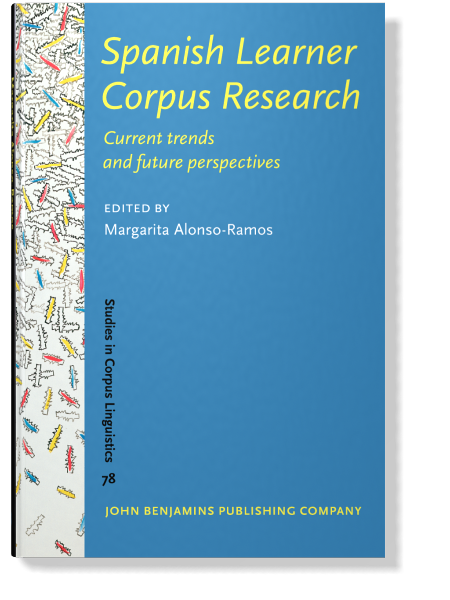
Chapter 3Learner Spanish on computer
The CAES ‘Corpus de Aprendices de Español’ project
Published online: 16 December 2016
https://doi.org/10.1075/scl.78.03roj
https://doi.org/10.1075/scl.78.03roj
Abstract
This chapter aims to provide a general description of the ‘Corpus de Aprendices de Español’ (CAES). It starts by discussing the contributions of Corpus Linguistics to the study of language and it next explains the emergence of learner corpora. The next section is concerned with the origin and development of the CAES corpus from the beginning to its current state and explains in detail the general design, compilation method, text encoding and annotation plus the search tool accompanying the corpus. The last part presents the results of a study on false friends based on data extracted from the corpus. Several conclusions and reflections follow together with some suggestions for further research.
Article outline
- 1.Introduction
- 2.CL, general learner corpora and main Spanish learner corpora
- 2.1Brief overview of the importance of CL, the emergence of learner corpora and their applications
- 2.2General review of the existing learner corpora in Spanish
-
3.The CAES (Corpus de Aprendices de Español) Project
- 3.1Origin and development of the project up to its current state
- 3.2General design and compilation
- 3.3Tasks devised for each of the levels considered and description of the sample collection method
- 3.4Text encoding and annotation
- 3.5The search tool
- 4.Discussion of results obtained from the analysis of data gathered from CAES
- 4.1False friends
- 5.Final reflections and questions for further consideration
Acknowledgments Notes References Appendix

References (38)
Adolphs, S. 2008. Corpus and Context. Investigating Pragmatic Functions in Spoken Discourse [Studies in Corpus Linguistics 30]. Amsterdam: John Benjamins.
Adolphs, S. & Carter, R.A. 2013. Spoken Corpus Linguistics: From Monomodal to Multimodal. London: Routledge.
Aijmer, K. 2002. Modality in advanced Swedish learners’ written interlanguage. In Granger et al. (eds), 55–76.
2009. Corpora and Language Teaching. Amsterdam: John Benjamins.
Biber, D., Conrad, S. & Reppen, R. 1998. Corpus Linguistics. Investigating Language Structure and Use. Cambridge: CUP.
Braun, S., Kohn, K. & Mukherjee, J. (eds). 2006. Corpus Technology and Language Pedagogy. Frankfurt: Peter Lang.
Cestero Mancera, A., Penadés Martínez, I., Blanco Canales, A., Camargo Fernández, L. & Simón Granda, J. 2001. Corpus para el análisis de errores de aprendices de E/LE (CORANE). In Actas del XII Congreso de ASELE tecnologías de la información y de las comunicaciones en la enseñanza de la E/LE, A. Gimeno Sanz (ed.), 527–534. Centro Virtual Cervantes.
Chacón Beltrán, R. 2006. Towards a typological classification of false friends (Spanish-English). Revista Española de Lingüística Aplicada 19: 29–39.
Council of Europe. 2001. Common European Framework of Reference for Languages. Learning, Teaching, Assessment. Cambridge: CUP.
De Cock, S. 1998. A recurrent word combination approach to the study of formulae in the speech of native and non-native speakers of English. International Journal of Corpus Linguistics 3 (1): 59–80.
2002. A Bird’s-eye view of learner corpus research. In Granger et al. (eds), 3–33.
2008. Learner corpora. In Corpus Linguistics: An International Handbook, A. Lüdeling & M. Kytö (eds), 259–274. Berlin: Mouton de Gruyter.
Granger, S., Hung, J. & Petch-Tyson, S. (eds). 2002. Computer Learner Corpora, Second Language Acquisition and Foreign Language Teaching [Language Learning & Language Teaching 6]. Amsterdam: John Benjamins.
Krashen, S. 1988. Second Language Acquisition and Second Language Learning. New York NY: Prentice Hall.
Leech, G. 1992. Corpora and theories of linguistic performance. In Directions in Corpus Linguistics. Proceedings of Nobel Symposium 82, Stockholm 4 –8 August 1991, J. Svartvik (ed.), 105–122. Berlin: Mouton de Gruyter.
Lozano, C. 2009. Selective deficits at the syntax-discourse interface: Evidence from the CEDEL2 corpus. In Representational Deficits in SLA [Language Acquisition and Language Disorders 47], N. Snape, Y.-k. I. Leung & M. Sharwood-Smith (eds), 127–166. Amsterdam: John Benjamins.
Lozano, C. & Mendikoetxea, A. 2013. Learner corpora and second language acquisition. The design and collection of CEDEL2. In Automatic Treatment and Analysis of Learner Corpus Data [Studies in Corpus Linguistics 59], A. Díaz-Negrillo, N. Ballier & P. Thompson (eds), 65–100. Amsterdam: John Benjamins.
Lüdeling, A. & Kytö, M. (eds). 2008. Corpus Linguistics: An International Handbook. Berlin: Mouton de Gruyter.
Mitchell, R., Domínguez, L., Arche, M.J., Myles, F. & Marsden, E. 2008. SPLLOC: A new database for Spanish second language acquisition research. EUROSLA 8: 287–304.
O’Donnell, M. 2009. The UAM CorpusTool: Software for corpus annotation and exploration. In Applied Linguistics Now: Understanding Language and Mind/ La lingüística aplicada hoy: Comprendiendo el lenguaje y la mente, C.M. Bretones Callegas, F. Fernández, J. Ibáñez, M.E. Garcia Ramón, M.E. Cortés Salaberri, M.S. Sagrario Cruz, N. Perdú & B. Cantizano (eds), 1433–1447. Almería: Universidad de Almería.
O’Keeffe, A., McCarthy, M. & Carter, R. 2007. From Corpus to Classroom. Language Use and Language Teaching. Cambridge: CUP.
Ortiz de Urbina, C., Trives, J.R. & Heras Díez, F. 1998. Diccionario francés-español de falsos amigos. Alicante: Universidad de Alicante.
Padró, L. & Stanilovsky, E. 2012. FreeLing 3.0: Towards wider multilinguality. In Proceedings of the Language Resources and Evaluation Conference (LREC 2012) ELRA. Istanbul, May 2012. Paris: ELRA.
Pérez Basanta, C. 1999. La enseñanza del vocabulario desde una perspectiva lingüística y peda-gógica. In Lingüística aplicada a la enseñanza de lenguas extranjeras, S. Salaberri Ramiro (ed.), 262–306. Almería: Universidad de Almería.
Pérez Paredes, P. & Cantos-Gómez, P. 2004. Some lessons students learn: Self-directory and corpora. In Corpora and Language Learners [Studies in Corpus Linguistics 17], G. Aston, S. D. Stewart (eds), 247–257. Amsterdam: John Benjamins.
Roca Varela, M.L. 2015. False Friends in Learner Corpora. A Corpus-Based Study of English False Friends in the Written and Spoken Production of Spanish Learners [Linguistic Insights Series]. Bern: Peter Lang.
Römer, U. 2011. Corpus research applications in second language teaching. Annual Review of Applied Linguistics 31: 205–225.
Seidlhofer, B. 2002. Pedagogy and local learner corpora: Working with learning-driven data. In Granger et al. (eds), 213–234.
Tognini-Bonelli, E. 2001. Corpus Linguistics at Work [Studies in Corpus Linguistics 6]. Amsterdam: John Benjamins.
Tracy-Ventura, N. 2008. Spanish Learner Language Oral Corpus project (SPLLOC1). A new corpus of oral L2 Spanish. <[URL]> & <[URL]>
WOSLAC Research Group. 2007. Proyecto CEDEL2. Universidad Autónoma de Madrid. <[URL]>
Cited by (9)
Cited by nine other publications
Gutiérrez, Mara Fuertes, Magdalena Abad Castelló & Rocío Díaz Bravo
2025. Exploring the role of corpora in Spanish Language Teaching (SLT). In Applying Corpora in Teaching and Learning Romance Languages [Studies in Corpus Linguistics, 122], ► pp. 294 ff.
Mendes, Ronald Beline & Travis Evans‐Sago
Sampedro Mella, María
Ferreira Cabrera, Anita Alejandra, Jessica Elejalde Gómez & Lorena Blanco San Martín
Lozano, Cristóbal
Lozano, Cristóbal & Paloma Fernández-Mira
Sánchez-Gutiérrez, Claudia, Barbara De Cock & Nicole Tracy-Ventura
Fernández-Mira, Paloma, Emily Morgan, Sam Davidson, Aaron Yamada, Agustina Carando, Kenji Sagae & Claudia H. Sánchez-Gutiérrez
2021. Lexical diversity in an L2 Spanish learner corpus. International Journal of Learner Corpus Research 7:2 ► pp. 230 ff.
This list is based on CrossRef data as of 1 december 2025. Please note that it may not be complete. Sources presented here have been supplied by the respective publishers. Any errors therein should be reported to them.