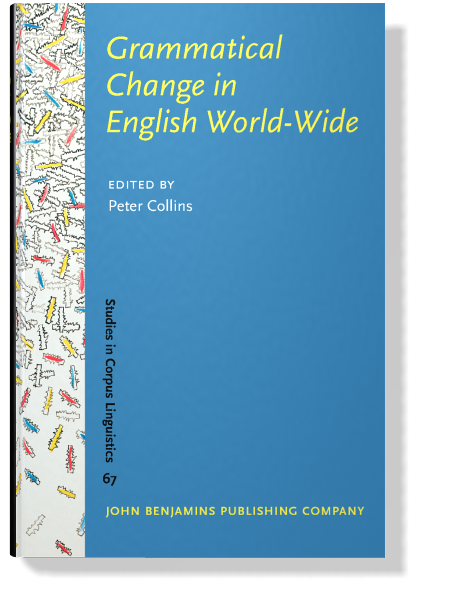
In:Grammatical Change in English World-Wide
Edited by Peter Collins
[Studies in Corpus Linguistics 67] 2015
► pp. 465–484
The development of an extended time period meaning of the progressive in Black South African English
Published online: 24 February 2015
https://doi.org/10.1075/scl.67.19roo
https://doi.org/10.1075/scl.67.19roo
This chapter examines the use of the progressive aspect in Black South African English (BSAfE) since the late 19th century in corpora of fiction and newspapers. Previous research points to on-going change in native varieties and the extension to stative contexts in non-native varieties of English. The findings are: There has been a consistent increase in the frequency of the construction. Stative and achievement verbs are used in the progressive aspect proportionally more often in BSAfE than in native varieties. The progressive with stative verbs encodes states of longer duration alongside the meaning of temporary duration which is conventional in native varieties. The functional differences are not a recent or gradual innovation, but are present from the earliest available BSAfE data. Keywords: Black South African English; progressive aspect; stative verbs; duration

References (38)
Barnett, Ursula A. 1983. A Vision of Order: A Study of Black South African Literature in English (1914-1980). Cape Town: Maskew Miller Longman.
Bowerman, Sean. 2008. White South African English: Morphology and syntax. In Varieties of English, 4: Africa, South and Southeast Asia, Rajend Mesthrie (ed.), 472–487. Berlin: Mouton de Gruyter.
Coetzee-Van Rooy, A. Susan. 2011. Discrepancies between perceptions of English proficiency and scores on English tests: Implications for teaching English in South Africa. SAALT Journal for Language Teaching 45(2): 151–181.
Collins, Peter, Borlongan, Ariane & Yao, Xinyue. 2014. Modality in Philippine English: A diachronic study. Journal of English Linguistics 42(1): 68–88.
De Kock, Leon. 1996. Civilising Barbarians: Missionary Narrative and African Textual Response in Nineteenth-Century South Africa. Johannesburg: Witwatersrand University Press.
Denison, David. 1998. Syntax. In The Cambridge History of the English Language, Vol. IV: 1776-1997, Suzanne Romaine (ed.), 92–329. Cambridge: CUP.
De Wit, Astrid & Brisard, Frank. 2014. A cognitive grammar account of the semantics of the English present progressive. Journal of Linguistics 50(1): 49–90.
Finn, Stephen M. 1986. The abuse of English by students at Vista University. English Usage in Southern Africa 17(1): 1–8.
Gamaroff, Raphael. 1988. The problematic progressive. English Usage in Southern Africa 19(1): 20–31.
Gut, Ulrike & Fuchs, Robert. 2013. Progressive aspect in Nigerian English. Journal of English Linguistics 41(3): 243–267.
Hoffman, Sebastian. 2010. Towards an International Historical Corpus of Post-Colonial Varieties of English. Poster presented at the 31st ICAME conference, Giessen, Germany.
Hundt, Marianne & Mair, Christian. 1999. ‘Agile’ and ‘uptight’ genres: The corpus-based approach to language change in progress. International Journal of Corpus Linguistics 4: 221–242.
Jespersen, Otto. 1931. A Modern English Grammar on Historical Principles, Vol 4. Heidelberg: Carl Winters.
Kranich, Svenja. 2010. The Progressive in Modern English: A Corpus-Based Study of Grammaticalization and Related Changes. Amsterdam: Rodopi.
Labov, William. 2010. Principles of Linguistic Change, Vol. 3: Cognitive and Cultural Factors. Oxford: Wiley-Blackwell.
Leech, Geoffrey, Hundt, Marianne, Mair, Christian & Smith, Nicholas. 2009. Change in Contemporary English: A Grammatical Study. Cambridge: CUP.
Louwrens, Louis J. 1996. On the occurrence of the progressive -sa- in Northern Sotho verbs of state. South African Journal of African Languages 16(4): 123–127.
Mesthrie, Rajend. 2008. Synopsis: Morphological and syntactic variation in Africa and South and Southeast Asia. In Varieties of English, 4: Africa, South and Southeast Asia, Rajend Mesthrie (ed.), 624–635. Berlin: Mouton de Gruyter.
Quirk, Randolph, Greenbaum, Sidney, Leech, Geoffrey & Svartvik, Jan. 1985. A Comprehensive Grammar of the English Language. London: Longman.
Roessingh, Hetty, Kover, Pat & Watt, David. 2005. Developing cognitive academic language proficiency: The journey. TESL Canada Journal 23: 1–27.
Rothmayr, Antonia. 2009. The Structure of Stative Verbs [Linguistik Aktuell/Linguistics Today 143]. Amsterdam: John Benjamins.
Sharma, Devyani. 2009. Typological diversity in new Englishes. English World-Wide 30(2): 170–195.
Trudgill, Peter. 2004. Dialect Contact and New-Dialect Formation: The Inevitability of Colonial Englishes. Edinburgh: EUP.
. 2010. Investigations in Sociohistorical Linguistics: Stories of Colonisation and Contact. Cambridge: CUP.
Van Rooy, Bertus. 2006. The extension of the progressive aspect in Black South African English. World Englishes 25(1): 37–64.
. 2010. Societal and linguistic perspectives on variability in World Englishes. World Englishes 31(1): 3–20.
. 2014. Progressive aspect and stative verbs in Outer Circle varieties. World Englishes 33(2): 157–172.
Van Rooy, Bertus & Wasserman, Ronel. 2014. Do the modals of Black and White South African English converge? Journal of English Linguistics 42(1): 51–67.
Wasserman, Ronel 2014. Modality on Trek: Diachronic Changes in Written South African English across Text and Context. PhD dissertation, North-West University.
Cited by (15)
Cited by 15 other publications
Mesthrie, Rajend
Stell, Gerald
Buschfeld, Sarah
2021. The question of structural nativization in Namibian
English. In The dynamics of English in Namibia [Varieties of English Around the World, G65], ► pp. 169 ff.
Lenoble, Christophe
van Rooy, Bertus
van Rooy, Bertus
van Rooy, Bertus
Brato, Thorsten
2019. The historical corpus of English in Ghana (HiCE Ghana). In Corpus Linguistics and African Englishes [Studies in Corpus Linguistics, 88], ► pp. 119 ff.
Fuchs, Robert, Bertus van Rooy & Ulrike Gut
2019. Corpus-based research on English in Africa. In Corpus Linguistics and African Englishes [Studies in Corpus Linguistics, 88], ► pp. 37 ff.
Fuchs, Robert & Valentin Werner
2018. The use of stative progressives by school-age learners of English and the importance of the variable context. International Journal of Learner Corpus Research 4:2 ► pp. 195 ff.
Fuchs, Robert & Valentin Werner
2020. The use of stative progressives by school-age learners of English and the importance of the variable context. In Tense and Aspect in Second Language Acquisition and Learner Corpus Research [Benjamins Current Topics, 108], ► pp. 53 ff.
Rautionaho, Paula, Sandra C. Deshors & Lea Meriläinen
This list is based on CrossRef data as of 1 december 2025. Please note that it may not be complete. Sources presented here have been supplied by the respective publishers. Any errors therein should be reported to them.